
Reviewed · POMPEII & VESUVIUS TOURS
Pompeii: Entry Ticket and Guided Tour with an Archaeologist
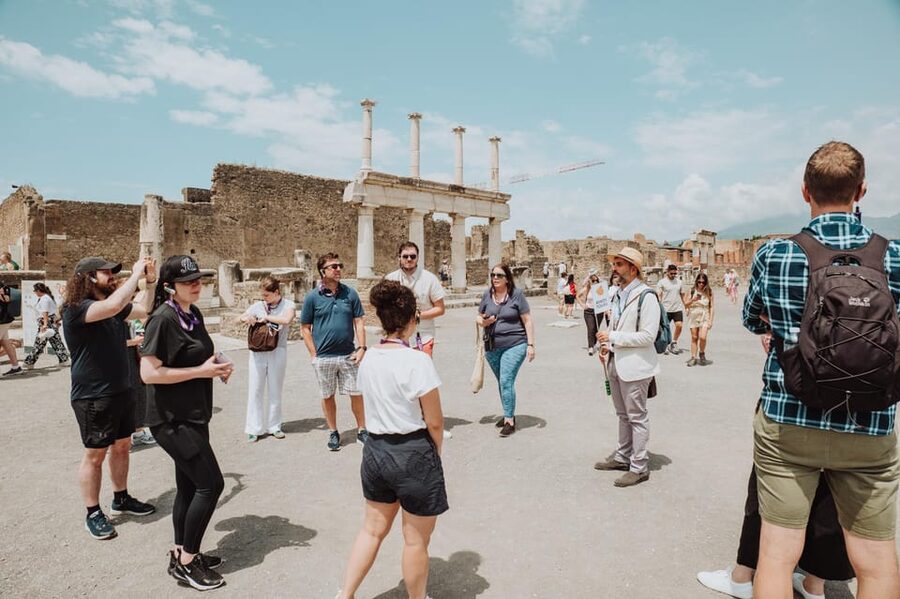
Pompeii makes the past walk beside you. This small-group tour in Campania brings you around the ruins of Pompeii, buried after Vesuvius erupted in 79 AD, with an archaeologist leading the story at an easy pace. You also get skip-the-line access, which matters because Pompeii is big and time slips away fast.
I really like two things here. First, the route hits major landmarks like the Casa del Fauno, Temple of Jupiter, House of Menander, and the Lupanar, so you do not just collect random photos. Second, you stay in a group of up to 20, with headsets for groups of 10 people or more, so you can actually hear your guide when the crowds thicken.
One consideration: this is a walking tour on uneven ancient surfaces. Wear good shoes, and expect some steps and short climbs, even if the tour is only 2 hours.
In This Review
- Key things that make this Pompeii tour worth your time
- Why an archaeologist guide changes the Pompeii experience
- Skip-the-line access: how it affects your 2-hour plan
- From Porta Marina to the Temple of Apollo: getting your bearings fast
- Foro Civile di Pompei and the Forum Baths: reading public life
- House of the Faun: the highlight that sets the tone
- The Lupanar and the city’s social reality
- House of Menander: where domestic life feels sharper
- Macellum of Pompeii and Forum Baths: markets, meeting points, routines
- Plaster casts and theaters: the emotional and the cultural
- Termopolium and main streets: tiny details that make the city click
- Headsets, crowds, and how to hear your guide
- What to wear and bring for uneven stone and quick steps
- Price and value: what $35 really buys you
- Who this tour is best for, and who should rethink it
- Languages and guide style: English, Spanish, French, and more
- Should you book this Pompeii archaeologist tour?
- FAQ
- How long is the Pompeii entry and guided tour with an archaeologist?
- What landmarks will the tour cover?
- Is skip-the-line access included?
- How big is the group?
- Are headsets provided?
- What languages are available for the live tour guide?
Key things that make this Pompeii tour worth your time
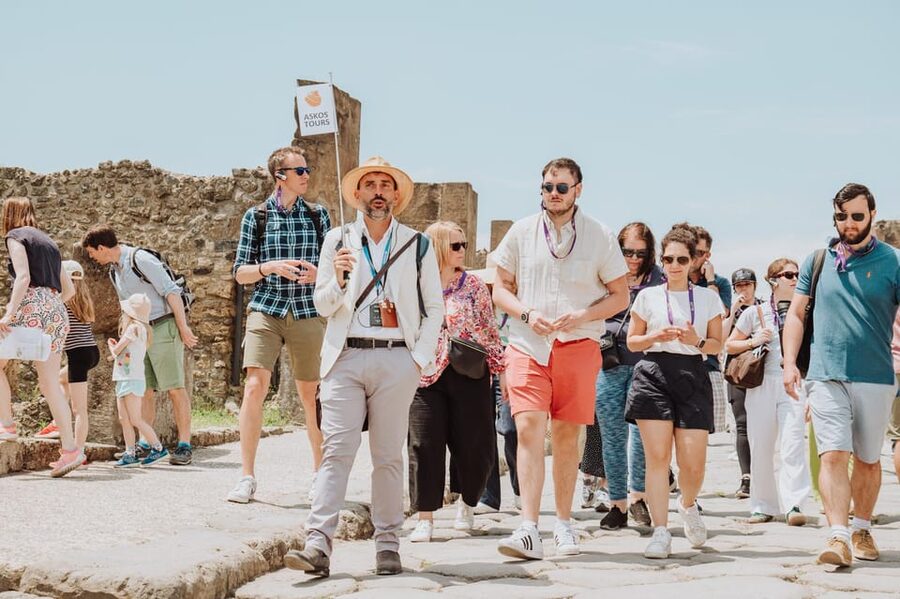
- Archaeologist-led explanations that connect buildings to real daily life in 1st century Pompeii
- Small group size (up to 20), which keeps it more human and less like a cattle line
- Skip-the-line entrance so you spend more time inside the ruins
- Headsets for groups of 10+, helping you hear clearly near busy areas
- Top stops with meaning, including Casa del Fauno and House of Menander, plus the Lupanar
- Practical wrap-up tips for what to do after the guided portion ends
Why an archaeologist guide changes the Pompeii experience
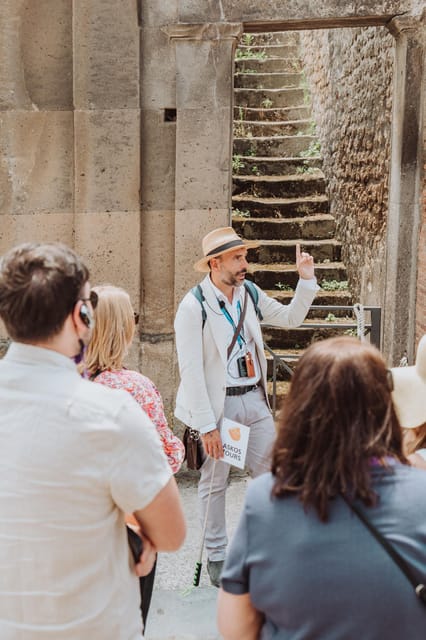
Pompeii is visually stunning, but it is also easy to misread. You see doorways, fresco fragments, street corners, and plaster casts, and your brain may try to guess the story. That is where an archaeologist guide flips the whole experience. You start seeing why each space looks the way it does, and how ordinary routines worked in a city that had not finished aging into ruins yet.
The vibe from the guide line-up is consistently part professor, part storyteller. Guides like Teresa, Anna Sorrento, Raffaella, Alfredo, Paolo, and even Mike (described as an archaeologist himself) come through as animated, funny, and serious about facts. Expect routes that connect architecture, everyday habits, and Roman-era ideas in plain language. When someone has spent a career looking at these remains, you pick up details you would never think to notice on your own.
You also get context that helps the site feel less like a museum and more like a place where people lived, shopped, argued, bathed, and socialized. Pompeii is the kind of destination where that matters. A quick glance is pretty. A guided read is the difference between seeing and understanding.
More Pompeii digs and Vesuvius climbs:
- Pompeii: Small Group Tour with an Archaeologist
★ 4.8 · 12,264 reviews - Pompeii: Skip-the-Line Entrance Ticket with Audio Guide
★ 4.0 · 2,509 reviews - Naples: Pompeii and Mt. Vesuvius with Lunch and Wine Tasting
★ 4.5 · 2,454 reviews
Skip-the-line access: how it affects your 2-hour plan
This tour includes an entrance ticket and skip-the-line benefits through Pompei Express. In a place like Pompeii, the benefit is not just convenience. It is math. With only 2 hours, losing time at the gate makes the rest of the walk feel rushed.
Instead, the tour gets you into the thick of it and starts moving. The route begins at a meeting point that can vary by option, and then you pass key entrance-side landmarks. You get early views and momentum, so you are not still orienting yourself when you reach the big houses.
If you are planning to see more of Pompeii after, this is also a good strategy. The guided tour gives you anchors, so your self-guided follow-up feels purposeful instead of wandering.
From Porta Marina to the Temple of Apollo: getting your bearings fast
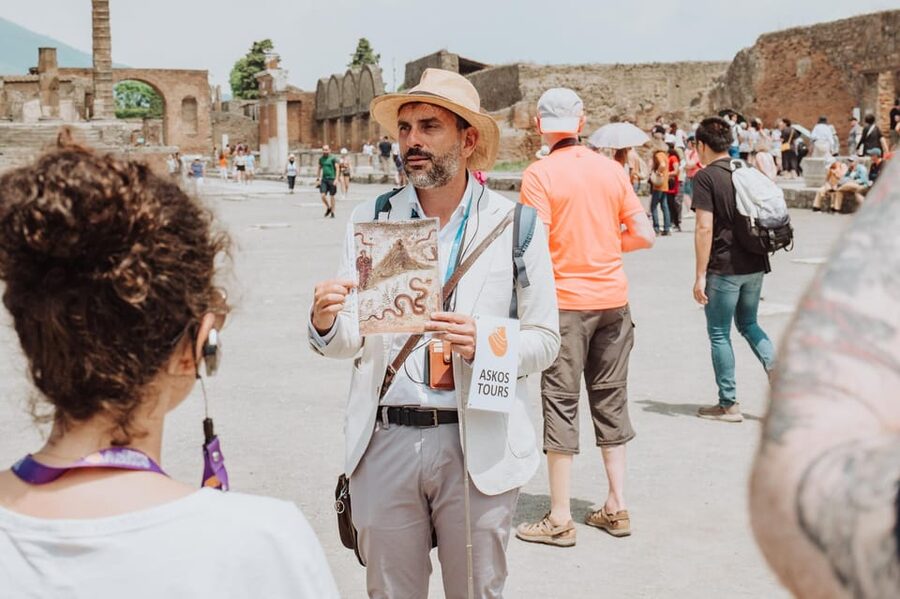
Right away, you work through the entrance approach. You pass Porta Marina (about 10 minutes) and then the Temple of Apollo (about 10 minutes). These early stops do not feel like random sightseeing. They act like a framework. You start to understand how the site is laid out and how you will later read the streets and public spaces.
What you should watch for here is the transition from modern crowds to ancient geometry. Even if you do not know the names, you begin to see how Pompeii is organized for foot traffic, with tight turns, open spaces, and buildings set right along the route.
Because you walk right from the start, you will want to be ready. Put on comfortable shoes before you arrive. The paths are uneven, and you might climb a couple of steps. If you arrive with sore feet, your enjoyment drains quickly.
Foro Civile di Pompei and the Forum Baths: reading public life
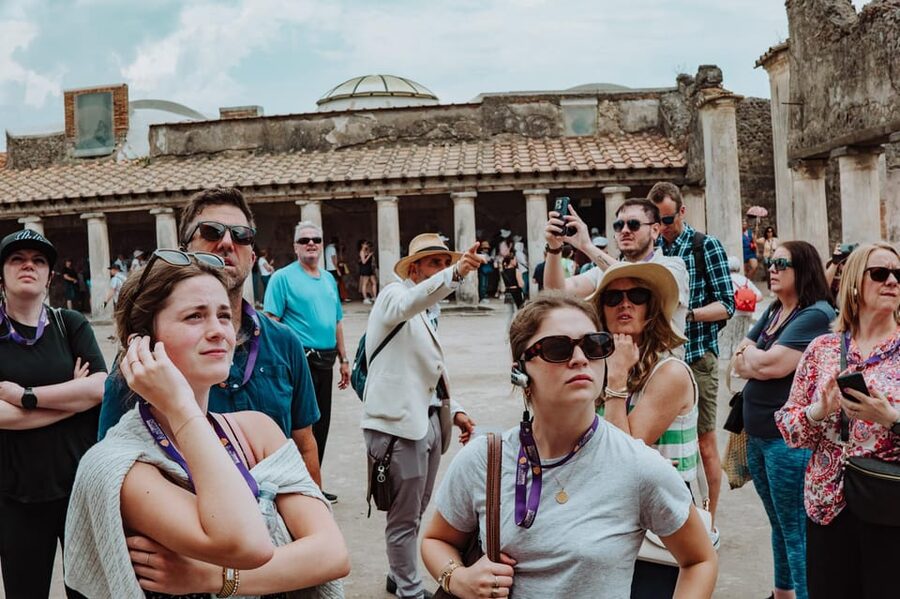
After the early landmark passes, you spend time around the public core. You pass Foro Civile di Pompei (about 20 minutes). Then later you visit Forum Baths (about 10 minutes) as part of the guided sequence.
This is one of the most valuable parts of the tour for first-timers. Houses get the headlines, but a city is more than private rooms. The forum area and baths show you communal spaces where people crossed paths, handled everyday needs, and spent time.
The baths stop is also a helpful reminder that Pompeii was not only art and tragedy. It was a working city with routines. Even in ruins, the shape of these places gives you clues about daily life.
A quick practical note: this segment can bring more people into view. Keep an eye on your footing, and let your guide pull you past confusion. With the headset option, you can stay in the conversation instead of fighting background noise.
A few more Pompei Campania options to weigh
- Pompeii: Skip-the-line-Ticket and Guided Tour
★ 4.6 · 1,152 reviews - Pompeii: Skip-the-Line Entry Ticket with Digital Guide App
★ 4.1 · 770 reviews - Pompeii: Afternoon to Sunset Guided Tour with Ticket
★ 4.9 · 484 reviews - Pompeii: Skip-the-Line Ticket with Audio Guide and Map
★ 4.0 · 117 reviews
House of the Faun: the highlight that sets the tone
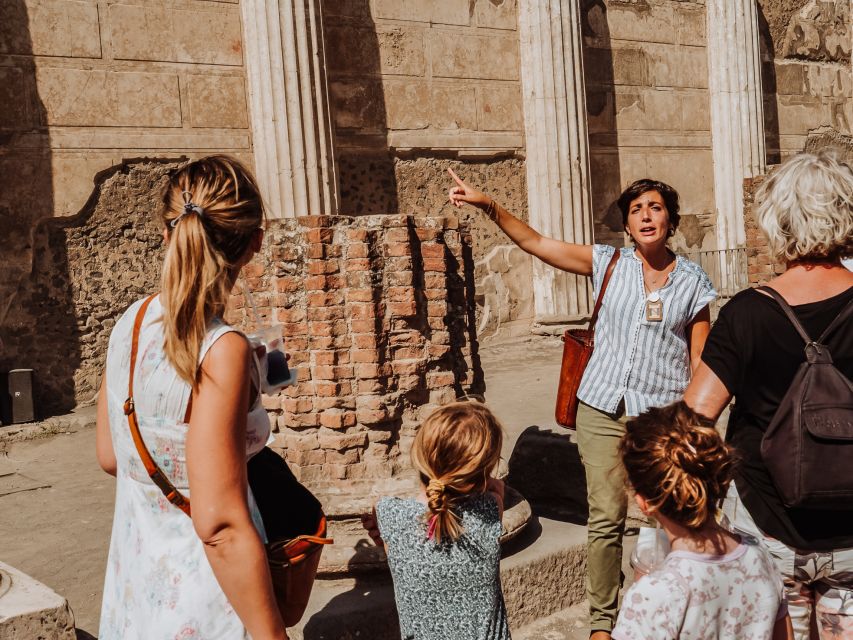
One of your main guided stops is the House of the Faun (about 20 minutes). This is the kind of place that makes you slow down. You stop being a spectator and start being a reader of space: rooms, doorways, and how the layout signals status and function.
Guides consistently use this house as a turning point. You learn to connect decorative elements and planning choices to what mattered to the people who lived there. The point is not just to see something famous. It is to understand what makes it important and what details you should look for next time you visit another house in Pompeii.
If you like architecture, art, or how people arranged their private lives, this stop is a big win. It also helps you compare later houses because you start using the same mental checklist.
The Lupanar and the city’s social reality
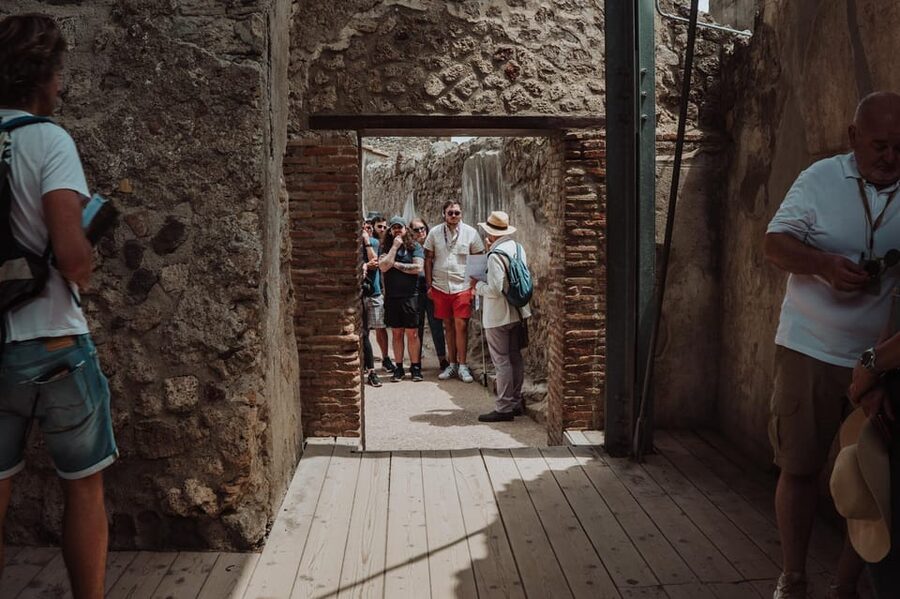
Next comes Lupanar (about 20 minutes). This is one of those stops that is both historically fascinating and emotionally strange, because it tackles aspects of life that do not fit into a postcard.
Having a guide matters here. Without context, you can end up with a surface-level read. With a trained archaeologist, you get a clearer sense of what you are looking at and why this site is preserved the way it is.
This stop also shows why the tour is more than a photo walk. Pompeii is a snapshot of real behavior, real spaces, and real boundaries. The Lupanar connects the idea of the Roman city to lived social patterns.
House of Menander: where domestic life feels sharper
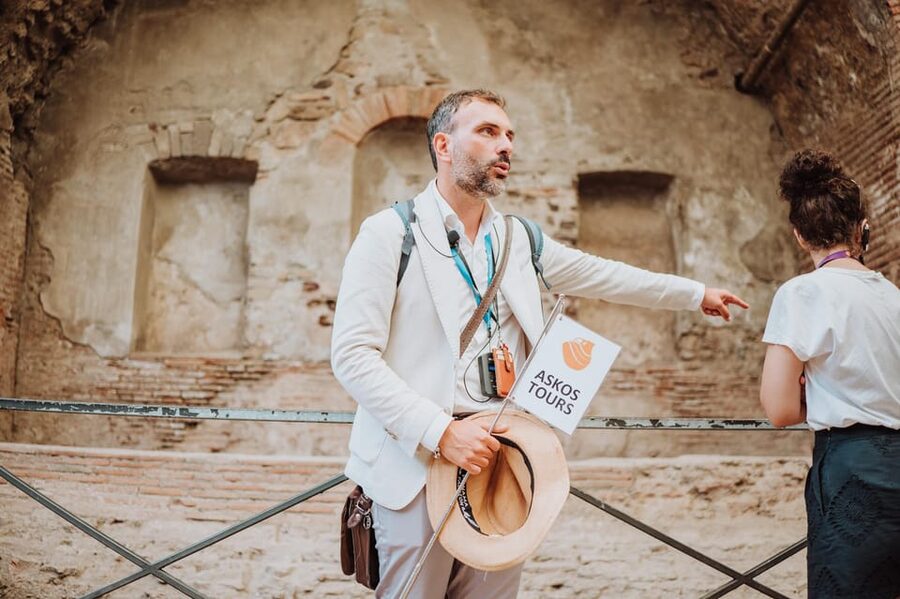
Another major guided visit is House of Menander (about 20 minutes). This house helps you see a different side of Pompeii compared with the House of the Faun. Instead of a single mood, you get variety in how households were designed, decorated, and organized.
In a short 2-hour format, this is smart. Two big house visits back-to-back give you contrast. You start recognizing recurring layout ideas, while noticing differences that your guide points out. It turns Pompeii into a set of readable lessons, not just big rooms.
If you care about how art and daily routine intersect, this is a strong stop. Guides often bring humor and human-scale stories here, which helps the whole site feel less distant.
Macellum of Pompeii and Forum Baths: markets, meeting points, routines
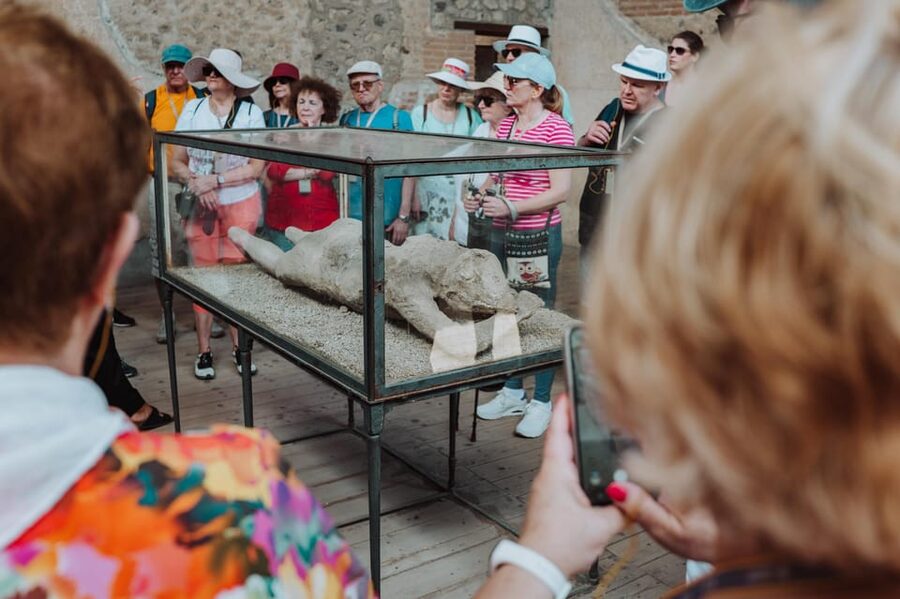
You also visit Macellum of Pompeii (about 10 minutes). The Macellum is a market type of space, and even in a ruin it helps you understand how people ate, shopped, and handled the daily logistics of living. In a 2-hour tour, that is a good use of time, because it balances the houses with the city’s practical pulse.
Then you finish this portion with Forum Baths (about 10 minutes). This pairing is useful. You get both movement through public spaces and the leisure side of life. Together, they show Pompeii as a city built for regular rhythms, not just grand monuments.
This is also where you feel the advantage of a guide’s pace. Pompeii does not give you clear “time to stop” markers. A good guide creates that rhythm so you do not miss your chance to see the best stuff without racing.
Plaster casts and theaters: the emotional and the cultural
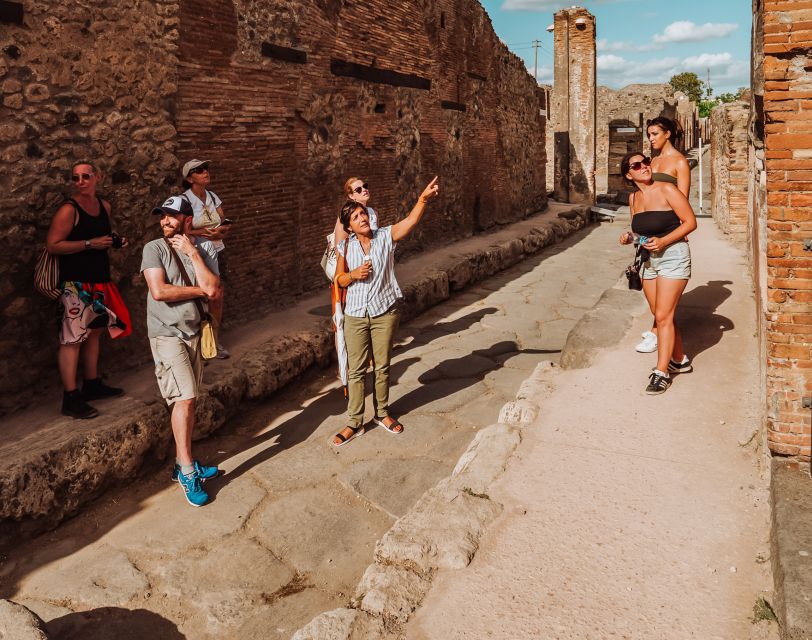
Beyond the time-stamped stops, the tour experience includes iconic elements like the Plaster Casts of victims and the Theaters. These are not just famous for their shock value. They remind you that Pompeii is not an abstract civilization. It is people frozen in a moment, plus the cultural life they had before the eruption.
The plaster casts also shift how you interpret everything else you see. After that stop, you notice the city’s rooms and streets as a stage for human lives, not only a preserved archaeological site. It is heavy. A good guide keeps it respectful, clear, and grounded.
Theaters add balance. They bring the cultural side back into view. That matters because Pompeii was not only survival and routine. It was entertainment, gatherings, and shared public culture too.
Termopolium and main streets: tiny details that make the city click
The tour also covers places like the Termopolium and walks through the main streets, so you get a sense of how the city worked at street level. These stops are great if you love the “how would it feel to be there” side of travel. They give you small anchor points to imagine the sounds and flow of a day in Pompeii.
You will not spend forever at street level here, but the guide’s explanations help you see what to look for. You stop treating the ruins like disconnected objects and start understanding them like parts of a working city layout.
The value is that your guided walk becomes a set of visual cues. After the tour, you are more likely to recognize what you are seeing instead of guessing.
Headsets, crowds, and how to hear your guide
Included headsets apply for groups of 10 people or more. In practice, this is a big upgrade. Pompeii can get loud with foot traffic, and it is hard to listen if you are craning your neck between walls and moving groups.
That said, one common practical complaint showed up in the experience: some people found the ear pieces awkward. One person said they had to hold the headset to hear well when crowds got thick, and that they ended up a bit disoriented when they tried to go off on their own after the tour.
My advice is simple. Keep the headset positioned from the start and check that it is snug. Also, if you plan to explore afterward, use the tour as your navigation primer, but carry a phone map and give yourself enough time to slow down.
What to wear and bring for uneven stone and quick steps
This tour is 2 hours of walking. Reviews and experience notes point to uneven paths and occasional steps. So pack like it is a “good walking shoes” day, not a “light sneakers” day.
Bring water. One review mentioned ending up dehydrated and hungry after walking farther than expected past the guided portion. Pompeii can feel cooler than the surrounding area, but once you are moving, you still burn time and fluids fast.
If rain shows up, it does not automatically stop your plans. One guide did their best to keep the tour going during rainy conditions, and the experience still worked. Umbrellas can get annoying in crowds, so a compact rain layer is often smarter.
Price and value: what $35 really buys you
At about $35 per person, the price is best understood as a bundle, not just a ticket. You get the entrance ticket, an archaeologist guide, and a small-group format. You also get skip-the-line access, plus headsets for some group sizes.
If you go on your own, you can absolutely see Pompeii. But you will likely lose more time figuring out what you are looking at. You also tend to miss the connections between buildings, social life, and why certain places matter. This tour compresses that learning into a short walk.
So the value is not that it is cheap. It is that it makes your limited time count. Two hours with the right guide can turn Pompeii from a list of sights into a clear story of a city that stopped suddenly in 79 AD.
Who this tour is best for, and who should rethink it
This is a walking tour and the rules reflect that. It is not suitable for wheelchair users and it is not meant for people with mobility impairments. Mobility scooters are not allowed.
It is also not set up for unaccompanied minors, so you will want to travel with an adult who stays with kids.
If you travel with a small dog, only dogs that do not exceed 10 kg in weight and a maximum height of 40 cm are permitted. The dog must be on a leash, held in the arms inside buildings, and you must collect its excrement. If that sounds like extra hassle, you might decide to travel without a pet.
For most active adults, this tour hits a sweet spot. It is structured enough to keep you from getting lost and distracted, but short enough that you can still roam afterward with more confidence.
Languages and guide style: English, Spanish, French, and more
The live tour guide is offered in multiple languages: English, Spanish, French, Italian, Portuguese, and German. That is a practical advantage if you want to understand the details without relying on translation apps.
The guide approach also seems consistent across languages and personalities. Multiple guides were described as funny, engaging, and able to explain both the ancient world and the present-day significance. Names that stood out include Teresa, Anna Sorrento, Anna, Giancarlo, Alfredo, Paolo, Mario, Alexandra, Diego, Mina, and Mike. Even when guides were serious about facts, they used humor to keep you listening.
If you like a tour that feels like you are walking with a friend who happens to be an archaeologist, this is your style.
Should you book this Pompeii archaeologist tour?
Yes, if you want Pompeii to make sense quickly. A small group, skip-the-line entry, and an archaeologist guide are a powerful combo for a 2-hour visit. You will see top houses like the Casa del Fauno and House of Menander, plus the Lupanar and market and bath areas, and you will leave with clearer ideas on what you just saw.
Skip it only if your mobility is limited or if you need wheelchair access. Also think twice if you hate walking on uneven ground, because Pompeii demands it even in a short guided format.
If you are a first-timer, or you are returning and want to see the city with better context, this is the kind of booking that turns a once-in-a-lifetime site into a story you can actually retell.
FAQ
How long is the Pompeii entry and guided tour with an archaeologist?
The duration is 2 hours.
What landmarks will the tour cover?
You will see major Pompeii landmarks including the Marina Gate, the Basilica, the Forum, ancient baths, the Lupanar, the Casa del Fauno, the House of Menander, the Temple of Apollo, the Temple of Jupiter, and the theaters. The tour also includes stops such as the Termopolium, Plaster Casts of victims, and the Macellum, along with main streets.
Is skip-the-line access included?
Yes. The entrance ticket includes skip-the-line access.
How big is the group?
The tour is a small group with up to 20 people.
Are headsets provided?
Headsets are included for groups of 10 people or more.
What languages are available for the live tour guide?
The live tour guide is available in English, Spanish, French, Italian, Portuguese, and German.
Latest reviews around Pompei Campania
- Pompeii and Herculaneum: Guided Tour with an Archaeologist★ 5.0 · 164 reviews
- Pompeii 3hours Villa of Mysteries tour with an Archaeologist★ 4.8 · 486 reviews
- Pompeii: Small-Group Tour of Pompeii and Herculaneum★ 4.8 · 867 reviews
- Pompeii: Skip-the-Line Guided Tour★ 4.6 · 139 reviews
- Pompeii: Skip-the-Line Ticket with Audio Guide and Map★ 4.0 · 117 reviews
- Pompeii: Skip-the-line-Ticket and Guided Tour★ 4.6 · 1,152 reviews
- Pompeii: Skip-the-Line Entry & Audioguide★ 3.8 · 225 reviews
- Pompeii: Guided Tour with Skip-the-Line Entry★ 4.9 · 812 reviews
Pompeii & Vesuvius Tours, compared.

Pompeii: Entry Ticket with Optional Audio Guide
Read our review →
Pompeii: Small Group Tour with an Archaeologist
Read our review →

Pompeii Small Group Tour with an Archaeologist
Read our review →
Pompeii, Amalfi Coast and Positano Day Trip from Rome
Read our review →
Pompeii and Mount Vesuvius Day Trip from Rome with Pizza Lunch
Read our review →Browse the lists this tour appears in