

Reviewed · POMPEII & VESUVIUS TOURS
Pompeii 3hours Villa of Mysteries tour with an Archaeologist
Pompeii feels small once an archaeologist guides you. This small-group 3-hour walk starts at Porta Marina Superiore and strings together Pompeii’s standout houses and public spaces, finishing with Villa of the Mysteries access. One practical consideration: it is not suitable for wheelchair users or anyone with mobility impairments, because you’re walking uneven, ancient ground.
The biggest draw for me is how the guide turns ruins into real daily life. In past departures, names like Theresa, Julia, Yolanta, and Alexandra have been highlighted for strong Pompeii experience and clear, story-driven explanations that make the frescoes and domestic details easier to read.
You also get a route that’s designed for timing, not just ticking boxes. You’ll hit major sites in a way that aims to reduce time stuck in the thickest crowds, and then you can keep exploring on your own after the guided portion.
In This Review
- Key highlights you should care about
- Entering Pompeii through Porta Marina Superiore (not the chaos)
- House of the Vettii, then the theatre and big-room Pompeii
- House of the Vettii
- Large Theatre
- House of the Faun
- Lupanare
- Forum Baths
- House of Menander, Basilica, and the civic heart
- House of Menander
- Basilica
- Foro Civile di Pompei
- House of the Tragic Poet and Temple of Apollo
- House of the Tragic Poet
- Temple of Apollo
- The Villa of the Mysteries: why this stop is worth the effort
- Pace, comfort, and packing for a 3-hour Pompeii sprint
- Price and value: what you’re really paying for at $88
- Who should book this Pompeii archaeologist tour
- Should you book Askos Tours for Pompeii?
- FAQ
- How long is the Pompeii tour?
- What is the price per person?
- Where do we meet the guide?
- Is the Villa of the Mysteries ticket included?
- Does this tour skip the ticket line?
- What languages are offered?
- Do I need to bring anything besides sunscreen and water?
- Is the tour rain or shine?
- Are pets allowed?
- Is transportation or food included?
- Is this tour suitable for wheelchair users?
Key highlights you should care about

- Privileged Villa of the Mysteries entry, with expert commentary focused on the famous frescoes
- Small-group format, so questions are actually doable and you do not get swallowed by the crowd
- Archaeologist-led storytelling, connecting houses, art, and everyday Roman life to what you see in front of you
- A smart sequence of Pompeii landmarks, from the city gate through homes, forums, and temples
- Skip-the-ticket-line entry using the included Pompeii Plus ticket
Entering Pompeii through Porta Marina Superiore (not the chaos)
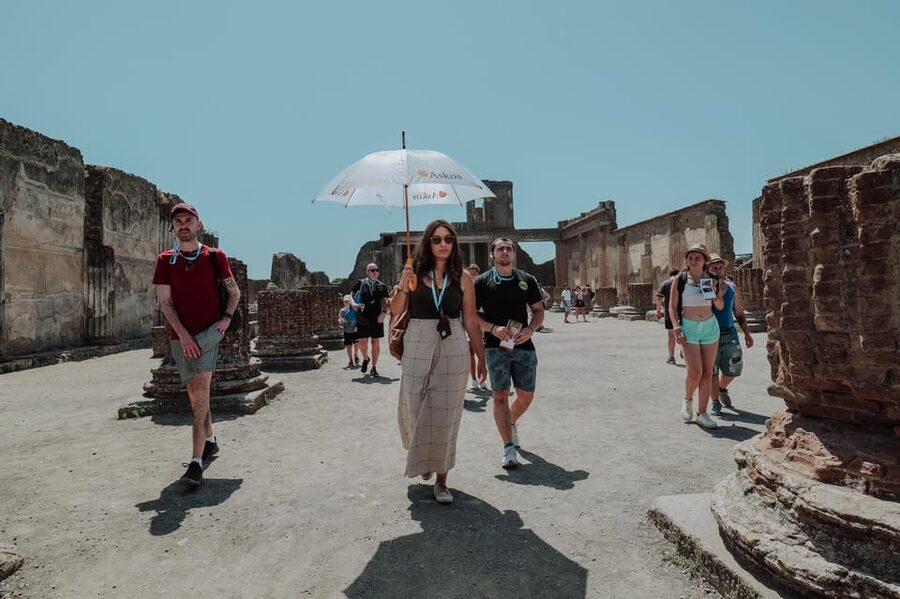
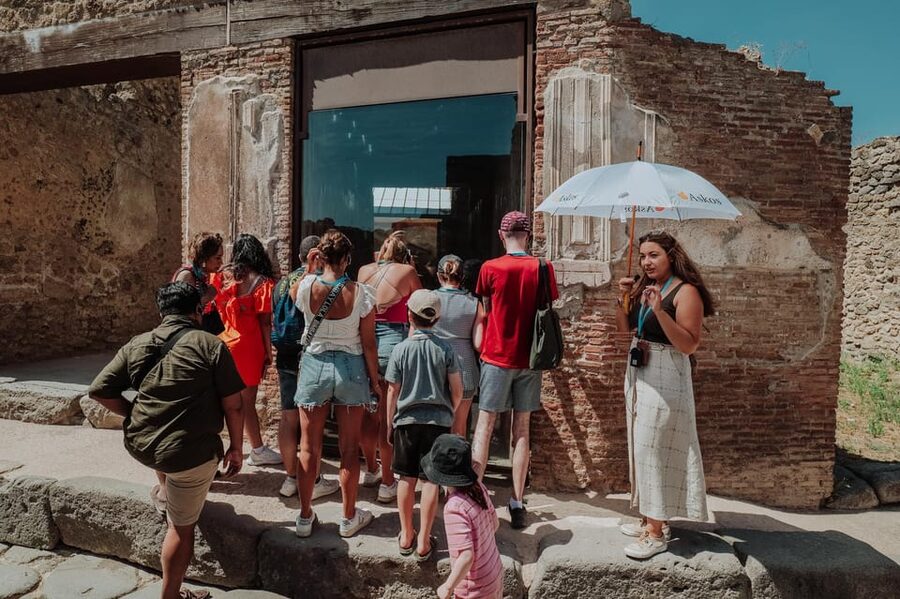
The tour starts at the Porta Marina Superiore entrance gate. The guide meets you there holding a sign that says ASKOS TOURS. Having a clear, single meeting point matters in Pompeii because the site is large and signage can be confusing, especially if you arrive hot, tired, or both.
What you’re aiming for in the first minutes is momentum. You move onto cobbled streets and get oriented as you walk away from the busiest flows. This is the part where an archaeologist’s approach really helps, because they can point out why certain street alignments, entrances, and building layouts mattered to how people moved through the city.
Also note the starting location details: the tour lists Via Villa dei Misteri, 2 as the starting location, but the actual guide meet point is at Porta Marina Superiore. Plan to arrive early enough to find your guide calmly, not at sprint pace.
More Pompeii digs and Vesuvius climbs:
- Pompeii: Entry Ticket and Guided Tour with an Archaeologist
★ 4.8 · 19,459 reviews - Pompeii: Small Group Tour with an Archaeologist
★ 4.8 · 12,264 reviews - Pompeii: Skip-the-Line Entrance Ticket with Audio Guide
★ 4.0 · 2,509 reviews
House of the Vettii, then the theatre and big-room Pompeii
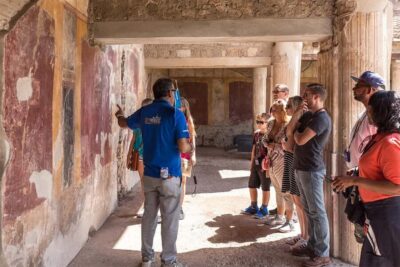
After orientation, the route builds from residential life into public life. One of the strongest reasons to take a guided Pompeii tour is that Pompeii’s best details are often small: wall surfaces, doorways, layout choices, and how rooms connect. When you see those things with a guide, you stop thinking of ruins as random piles and start reading them like a plan.
House of the Vettii
This stop is on the residential side, and that’s where Pompeii can feel most human. You’ll get a guided look at a Pompeian house, and the tour focus is on domestic lifestyle and the kinds of art and objects Romans lived with. Even if you only catch a handful of rooms in detail, having context can change what you notice, especially frescoes and the way art was placed where daily movement brought people past it.
What to watch for: look for how spaces transition from one function to another, because that is where daily routine shows up.
Large Theatre
Next comes a big public venue. A theatre is one of those places where you can see how social life organized itself in the city. Even without getting lost in complicated details, the guided approach helps you connect architecture to crowd behavior, like where people would gather and how events shaped the city’s rhythms.
What to watch for: sightlines and how the space is arranged for an audience experience.
Nearby, and just as well reviewed:
- Naples: Pompeii and Mt. Vesuvius with Lunch and Wine Tasting
★ 4.5 · 2,454 reviews - Pompeii: Skip-the-line-Ticket and Guided Tour
★ 4.6 · 1,152 reviews - Pompeii: Small-Group Tour of Pompeii and Herculaneum
★ 4.8 · 867 reviews - Pompeii: Guided Tour with Skip-the-Line Entry
★ 4.9 · 812 reviews
House of the Faun
This continues the house-to-city rhythm. Pompeii houses can feel like micro-worlds, and a guide helps you see them as statements of status and taste as much as shelter. Expect the tour to keep highlighting the relationship between layout and everyday life, not just naming parts of a building.
Lupanare
Then the tour shifts again into a more specialized site in the Pompeii story. The value here is not scandal or trivia. It’s that sites like this help you understand the range of daily activities in Roman cities, and why Pompeii looks the way it does when you map real life onto it.
Practical note: this is still within a 3-hour overall window, so you are not going to tour every nook like a full-day program. The goal is a guided hit list that still feels meaningful.
Forum Baths
After the theatre and specialized site, the route includes the Forum Baths. Baths are an ideal “big switch” from interiors to city life. You’ll get a guided view that ties everyday routine to public infrastructure, which is one of the best ways to keep Pompeii from feeling like only art and architecture.
What to watch for: how the space reads as something shared, not private.
House of Menander, Basilica, and the civic heart

By the time you reach the Forum-area landmarks, Pompeii starts to feel less like a set of buildings and more like a functioning city. This part is where political and religious life show up in stone, and where you can really grasp how different parts of Pompeii fit together.
House of Menander
Back to domestic space again, which might sound repetitive, but it’s actually a smart pacing choice. It lets you compare one style of home to another without losing the thread. The guide’s commentary is what turns these comparisons into understanding, like why rooms and art appear where they do.
Basilica
The Basilica is one of those civic structures that helps you imagine arguments, business, and public gatherings. The guided format keeps you from walking past the scale without meaning. You’ll also benefit from the tour’s timing, since you’re meant to experience key areas with less interference from the loudest crowd surges.
Foro Civile di Pompei
The civic forum area ties the day together. This is where the tour’s design shows: you’re walking through spaces that once buzzed with debates, exchanges, and ceremonies. Even if you know nothing about Roman politics, the guide helps you connect what you see to what people likely did here, because the interpretation is the point.
What to watch for: look at how spaces open up and where people would naturally gather or pass through.
House of the Tragic Poet and Temple of Apollo
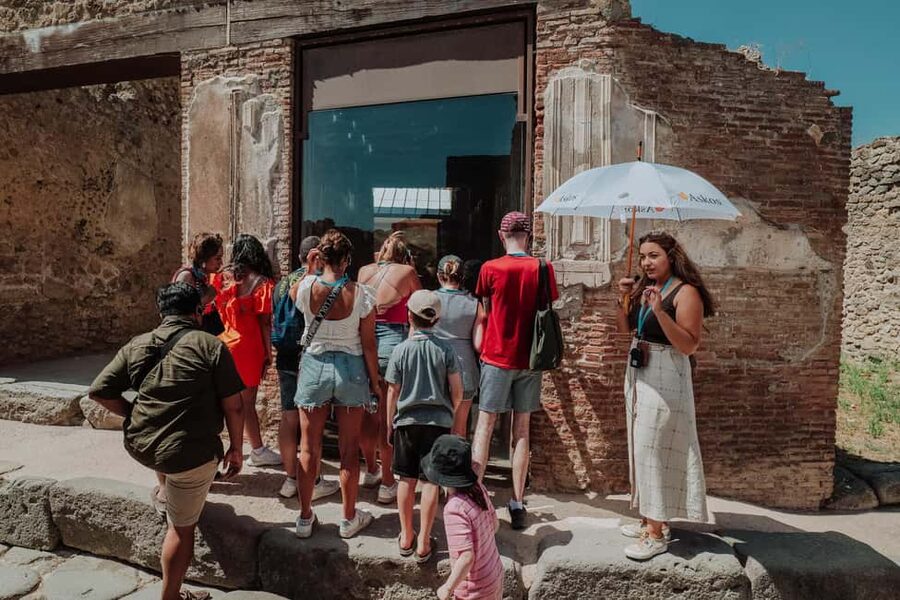
This section keeps the route moving while adding variety. You’ll visit the House of the Tragic Poet, then continue to the Temple of Apollo.
House of the Tragic Poet
Another house stop, but with a different personality. The guided tour approach is what makes it worthwhile in a shorter program: you are not just seeing a house, you’re learning how Romans used art and domestic space to express identity. This stop is great for people who loved Pompeii’s frescoes in photos and want to understand how they functioned in real rooms.
Temple of Apollo
Then comes the Temple of Apollo, and that shifts your perspective again. Temples anchor the city’s religious life, and a guided visit helps you connect worship spaces to the city’s overall layout. If you’ve been thinking Pompeii is mostly about what collapsed, this is where it starts to feel like people were building, believing, and performing a shared culture.
The Villa of the Mysteries: why this stop is worth the effort
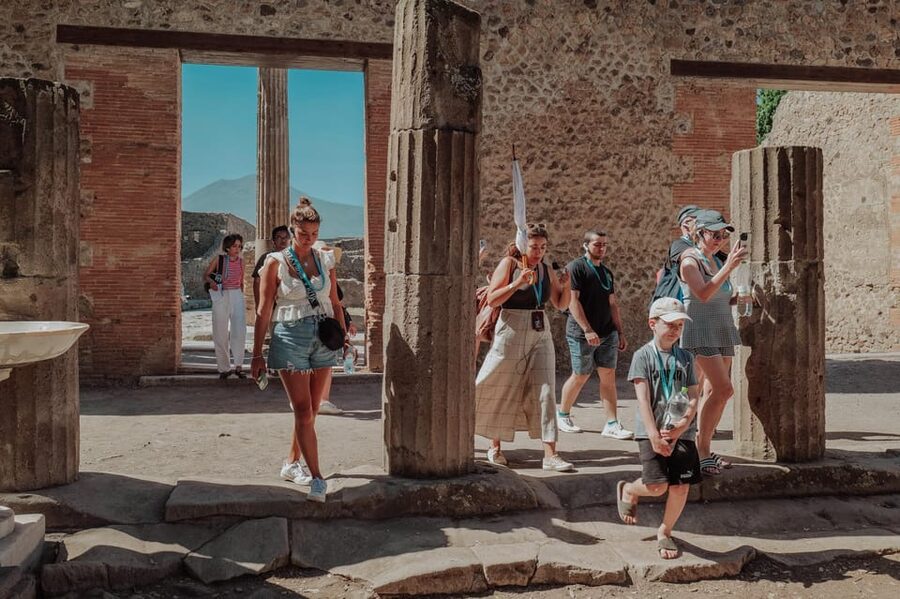
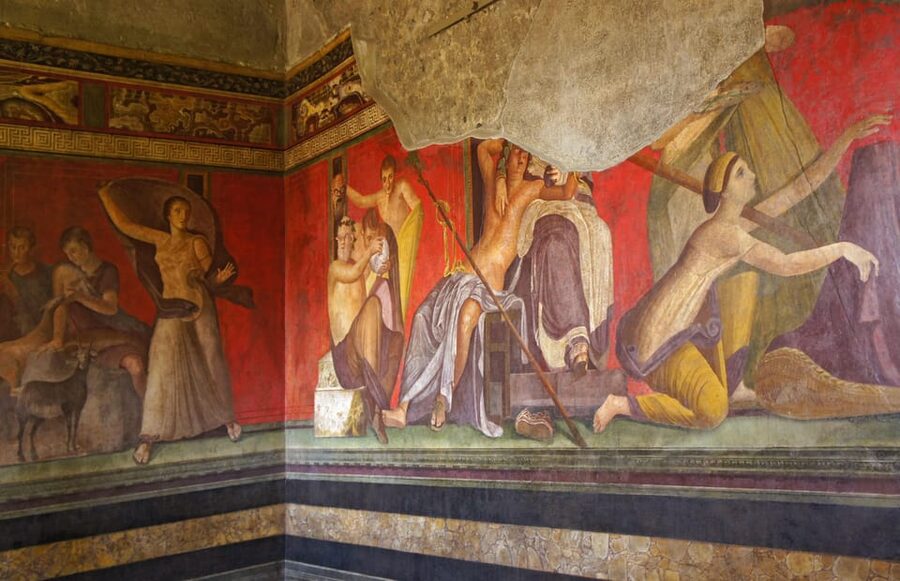
The highlight is the Villa of the Mysteries. This is the spot with the famous frescoes, and the key word here is interpretation. You’re not just looking at painted walls, you’re getting archaeologist commentary that helps you read what’s there and why it mattered.
The tour is set up to experience this with a quieter rhythm than you might get on a free-for-all visit. That matters because the Villa is visually intense. If you’re surrounded by constant shoulder-to-shoulder movement, you end up rushing, taking quick photos, and leaving your attention on autopilot. With the guide’s pacing, you can actually slow down and notice details.
Also, this is often when the temperature can feel more manageable, because villas can provide a different kind of shade and airflow than open plaza areas. A few people like to use this moment to reset, especially if you packed water and a small snack. Just remember the tour includes the ticket but not food, so plan accordingly.
What I’d prioritize during this stop: focus on what the archaeologist says about the frescoes, because that’s the difference between seeing a painting and understanding a scene.
Pace, comfort, and packing for a 3-hour Pompeii sprint
This is a 3-hour tour with a long list of Pompeii stops, so you should treat it like an active walking experience, not a slow museum stroll. The route covers multiple zones, and you’re on ancient surfaces the whole time.
Here’s what to bring based on the tour guidance:
- Passport or ID card
- Comfortable, closed-toe shoes (no flip-flops)
- In summer, a hat and water
The tour also runs rain or shine, so bring a light layer or rain protection you can actually tolerate while walking. Pompeii is not the place for slippery soles or flimsy footwear.
Small pets are allowed inside the Archaeological Park of Pompeii if they are under 10 kg and kept on a leash. If you are traveling with a pet, this is a useful detail because some major attractions restrict animals much more strictly.
One more practical tip from experience at Pompeii: use the start of the tour to set yourself up for comfort. Ear pieces are mentioned by some participants, which helps everyone hear the guide without craning. Still, you should bring your own bottle habits, because you will feel the heat before you notice you are thirsty.
Price and value: what you’re really paying for at $88
At $88 per person, this tour prices itself as a guided-ticket package rather than a basic entry pass. The included Pompeii Plus entrance ticket covers the Archaeological Park plus the Villa of the Mysteries, and the tour also includes skip-the-ticket-line entry. That combination matters because it reduces time lost to lines and gets you into the parts that most visitors struggle to time well.
You are also paying for interpretation. Pompeii is huge, and self-guided visits often turn into a photo sprint. Here, the archaeologist-led structure is the product: you get a plan that moves through key houses and civic spaces while tying them together with context. Many people rate this as a major upgrade because you learn how to see rather than just what to see.
The main thing you still pay separately: transportation and food and drinks are not included. So it’s smart to plan either a water strategy and light snack, or at least the post-tour meal, since 3 hours of Pompeii walking can be surprisingly hungry work.
Who should book this Pompeii archaeologist tour
This is a strong fit if you:
- Want the Villa of the Mysteries as part of your visit, but do not want to spend hours mapping the site
- Prefer a small-group format where you can ask questions without shouting
- Like architecture plus everyday context, meaning you care about houses and public life, not only big views
- Have limited time and still want more than a surface-level walk
It may not be ideal if you:
- Need wheelchair access or have mobility impairments (the tour is not suitable)
- Want a super slow pace with lots of solo time in each room, because the route is designed for guided coverage in 3 hours
Should you book Askos Tours for Pompeii?

My take: if this is your first serious look at Pompeii, and you want Villa of the Mysteries access with an archaeologist’s guidance, this is an easy yes. The value comes from the pairing of included ticketing, small-group pacing, and a route that keeps you moving through the most important zones without feeling like you’re lost.
Book it if you want to leave Pompeii with better questions in your head, not just more photos on your phone. If you already know Pompeii well and you want to roam endlessly, you might do fine with self-guided time. But for most people visiting on a tight schedule, this is one of the cleanest ways to make 3 hours count.
FAQ
How long is the Pompeii tour?
The tour duration is 3 hours.
What is the price per person?
The price is $88 per person.
Where do we meet the guide?
Meet at the entrance gate called Porta Marina Superiore. The guide will hold a sign that says ASKOS TOURS.
Is the Villa of the Mysteries ticket included?
Yes. The tour includes the Pompeii Plus entrance ticket, which covers the Archaeological Park plus the Villa of the Mysteries.
Does this tour skip the ticket line?
Yes, it includes skip-the-ticket-line entry.
What languages are offered?
The live guide language options include German, Italian, French, English, Spanish, and Portuguese.
Do I need to bring anything besides sunscreen and water?
You should bring your passport or ID card, and wear comfortable closed-toe shoes.
Is the tour rain or shine?
Yes, the tour takes place rain or shine.
Are pets allowed?
Small pets within 10 kg are allowed inside the Archaeological Park of Pompeii if they are kept on a leash.
Is transportation or food included?
No. Transportation and food and drinks are not included.
Is this tour suitable for wheelchair users?
No. It is not suitable for wheelchair users or people with mobility impairments.
Latest reviews around Pompei Campania
- Pompeii and Herculaneum: Guided Tour with an Archaeologist★ 5.0 · 164 reviews
- Pompeii: Small-Group Tour of Pompeii and Herculaneum★ 4.8 · 867 reviews
- Pompeii: Skip-the-Line Guided Tour★ 4.6 · 139 reviews
- Pompeii: Skip-the-Line Ticket with Audio Guide and Map★ 4.0 · 117 reviews
- Pompeii: Skip-the-Line Entry & Audioguide★ 3.8 · 225 reviews
- Pompeii: Skip-the-line-Ticket and Guided Tour★ 4.6 · 1,152 reviews
- Pompeii: Guided Tour with Skip-the-Line Entry★ 4.9 · 812 reviews
- Pompeii: Guided Tour with Archaeologist with max. 12 People★ 5.0 · 155 reviews
Pompeii & Vesuvius Tours, compared.
Pompeii: Entry Ticket and Guided Tour with an Archaeologist
Read our review →
Pompeii: Entry Ticket with Optional Audio Guide
Read our review →
Pompeii: Small Group Tour with an Archaeologist
Read our review →
Pompeii Small Group Tour with an Archaeologist
Read our review →
Pompeii, Amalfi Coast and Positano Day Trip from Rome
Read our review →Browse the lists this tour appears in