
Reviewed · POMPEII & VESUVIUS TOURS
Pompeii Small Group Tour with an Archaeologist
Pompeii makes more sense with a real archaeologist. I like the small group size, max 20, because you actually hear the stories. I also love the plaster cast stop at the Granaries of the Forum, where the eruption shifts from a textbook event to real people. The only drawback is the tour is about two hours, so you will not see every corner of this huge site.
You meet at Porta Marina Superiore inside the park, and you head in right away with skip-the-line tickets. From guides such as Alessandra, Paolo, Teresa, Alfredo, and Vincenzo, the common thread is strong storytelling plus a pace that keeps the walk moving without feeling like a sprint. This is still a walk on ancient ground, so wear real shoes and plan for uneven steps and ramps.
In This Review
- Key highlights at a glance
- Why this Pompeii tour feels manageable in two hours
- Porta Marina Superiore entry: meeting point, mobile ticket, and first moments
- Basilica and Forum: seeing Pompeii’s daily engine first
- Granaries of the Forum and the plaster casts: the eruption made human
- House of Menander and Stabian Baths: homes, decor, and routine
- Lupanar brothel ruins and the House of the Faun’s scale
- Teatro Piccolo and Teatro Grande: ending with Pompeii’s public stage
- Price and value around $35.67 for a guided foundation
- Tips to make your walk easier: shoes, sun, and stairs
- Who should book this Pompeii archaeologist small group tour
- The short answer: should you book?
- FAQ
- Where do I meet the guide?
- How long is the tour?
- Is skip-the-line entry included?
- What’s included in the price?
- What should I bring or wear?
- Is the tour wheelchair or scooter friendly?
Key highlights at a glance
- Small group experience (up to 20) that makes questions and explanations actually possible
- Skip-the-line Pompeii Express ticket so you start seeing ruins sooner
- Forum-to-homes route hitting the Basilica, Forum, House of Menander, and House of the Faun
- The eruption made personal through the casts at the Granaries of the Forum
- Stabian Baths and Lupanar for daily life and the city’s notorious brothel lane
- Headsets for groups of 16 or more so you do not lose the guide’s narration
Why this Pompeii tour feels manageable in two hours
Pompeii is big. Really big. Even with a map, it can feel like you are walking through labeled rooms without understanding how they connect. This tour is built for first-timers who want the clearest path through the highlights, in a time window that fits a day trip.
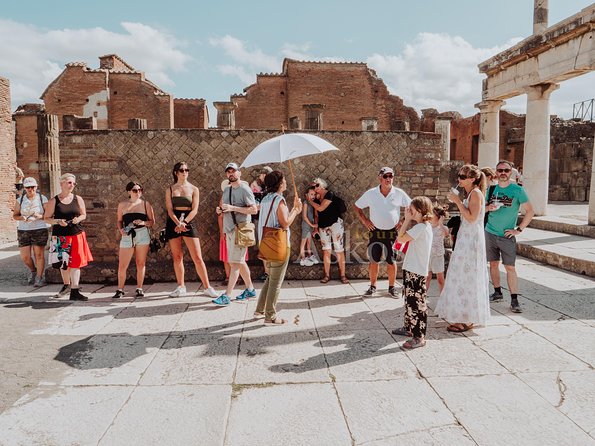
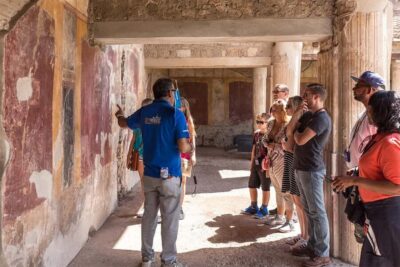
The small group is a big part of why it works. With a maximum of 20 people per guide, the stops do not become a crowd scene where only the front can hear. If your group is 16 or more, you get headsets, which helps a lot on a windy, open archaeological site where voices can disappear fast.
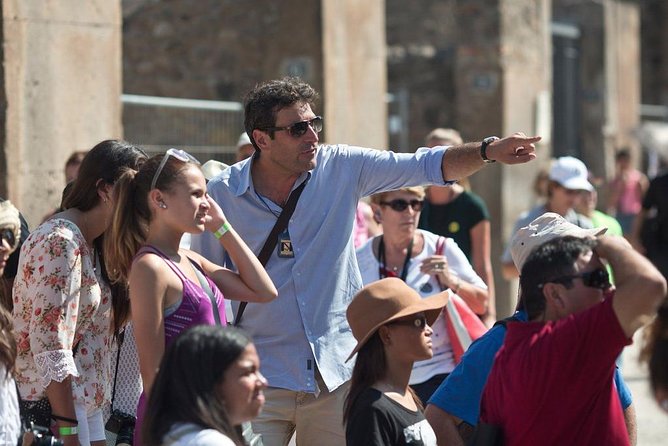
You also get a licensed guide with an archaeological background, so you are not just hearing generic facts. You are learning what you are looking at, why it mattered, and how the eruption preserved what it did. The pace is guided and purposeful, but the stops are long enough to pause and look, not just point-and-walk.
One more practical note: this is designed for about two hours. If you want to linger for a full half day, you should treat this as the foundation tour, then add extra time after if your schedule allows.
More Pompeii digs and Vesuvius climbs:
- Pompeii: Entry Ticket and Guided Tour with an Archaeologist
★ 4.8 · 19,459 reviews - Pompeii: Entry Ticket with Optional Audio Guide
★ 4.2 · 12,360 reviews - Pompeii: Small Group Tour with an Archaeologist
★ 4.8 · 12,264 reviews
Porta Marina Superiore entry: meeting point, mobile ticket, and first moments
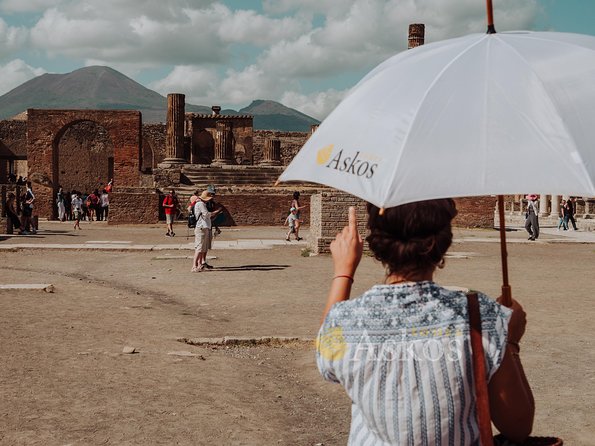
The tour starts at the Pompeii Archaeological Park at Porta Marina Superiore. Your guide meets you at the entrance holding an Askos Tours sign, so you can spot the group quickly instead of wandering the perimeter.
You also get a Pompeii Express entrance ticket included in the price, with a mobile ticket. In plain terms, this is about getting you inside with less time wasted in lines. That matters at Pompeii because the site gets crowded, and a delay early in the morning or afternoon can swallow the whole day.
One detail I appreciate: the tour finishes inside the ruins. That means you are not suddenly dumped back at the gate. You can keep exploring on your own right after the guided portion, which is handy if you want to revisit something that caught your eye during the story.
Plan to arrive a bit early. Pompeii is huge, signage can be confusing, and the route inside is not designed for easy catch-up if you miss the group at the start.
Basilica and Forum: seeing Pompeii’s daily engine first
Most people remember Pompeii as tragedy. This tour starts by showing you the city’s functions before it turns to the eruption.
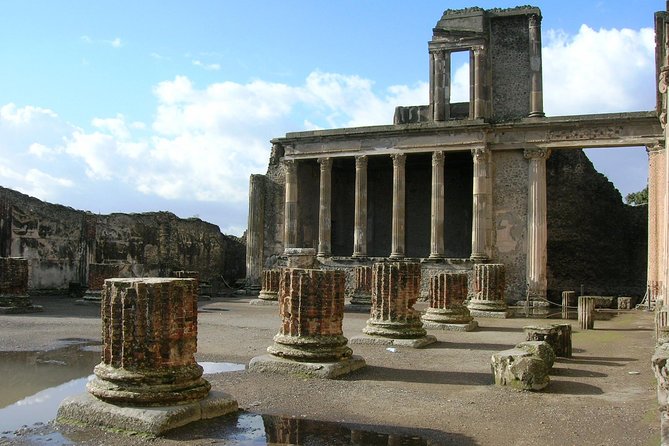
You begin with the Basilica, described as an open portico that sheltered merchants and activities. That stop helps you understand the rhythm of daily life. You start to see Pompeii as a working city, not just a frozen postcard. The Basilica setting also explains why a place like this became a natural gathering point, where business and public activity lived side by side.
Next comes the Foro de Pompeya, the main square and civic heart. Think of it as the city’s “center of gravity.” A good guide makes you look beyond architecture and into social meaning: where people gathered, how public space shaped everyday movement, and why the city’s layout tells a story.
If you are the type who likes structure, this is a smart opening. It gives you a mental map early. Then when you move toward houses, baths, and the brothel quarter, everything makes more sense as part of one urban system.
Granaries of the Forum and the plaster casts: the eruption made human
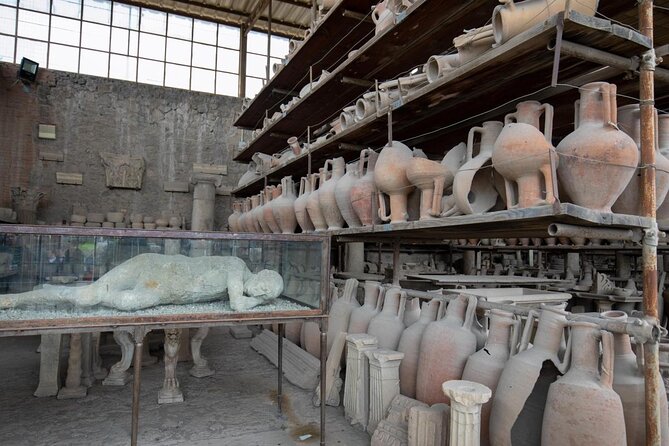
This is one of the stops that people talk about for a reason. You pause at the Granaries of the Forum, where you see marble tables, plus baths for fountains that adorned house entrances. That detail may sound small, but it matters. It shows how everyday beauty and water features were built into the city’s fabric.
Then the emotional pivot happens. You also see plaster casts of victims of the famous eruption that destroyed Pompeii, along with casts of a dog and a tree. This combination is powerful because it reminds you that the event was not only about humans. The whole living environment was affected, and the site preserves those traces in a way that photographs never fully capture.
A good archaeologist guide helps you interpret what you are seeing without turning it into shock theater. The value here is context: how and why casts were created, what can be inferred, and what you should not assume. The goal is understanding, not just staring.
The practical benefit is pacing. You get a seated-style pause in the story flow. After learning how the city worked, you are ready to face what the eruption changed in an instant.
Nearby, and just as well reviewed:
- From Naples: Pompeii Ruins & Mount Vesuvius Day Tour
★ 4.3 · 11,459 reviews - From Rome: Pompeii, Amalfi Coast, and Sorrento Day Trip
★ 4.6 · 7,031 reviews - From Rome: Pompeii, Amalfi Coast and Positano Day Trip
★ 4.6 · 6,620 reviews - Pompeii, Amalfi Coast and Positano Day Trip from Rome
★ 4.5 · 6,250 reviews
House of Menander and Stabian Baths: homes, decor, and routine

After the Forum area, the tour shifts into private and semi-private life.
At the House of Menander, you focus on one of Pompeii’s richest homes in terms of architecture and decoration. This is where you start seeing how status was expressed through space and design. A house like this is not just walls and rooms, it is a whole system of display, comfort, and everyday function.
What I like about this stop is how it teaches you what to look at. Instead of treating the ruins like a pile of stones, you learn how rooms were arranged, how decoration communicated taste, and what the house could tell you about the people inside.
Next are the Stabian Baths, also called Terme Stabiane. These occupy a vast area, and they are presented as the oldest thermal complex in the city. Baths were social spaces as much as they were functional spaces, so this stop helps you understand Pompeii as a place where hygiene, conversation, and leisure overlapped.
Even if you are not a Roman-bathing fanatic, you’ll get more out of this visit with a guide because baths can look confusing as ruins. The guide turns the jumble into a route: how the spaces likely worked and what the layout suggests about daily routines.
Lupanar brothel ruins and the House of the Faun’s scale
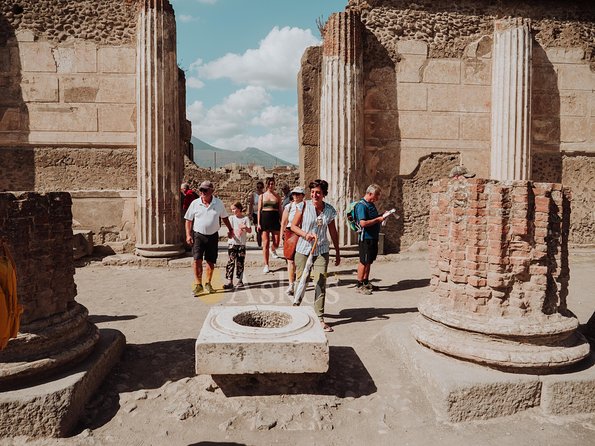
Pompeii is famous for many things. One of them is the city’s preserved brothel quarter, and this tour includes the Lupanar, described as the most famous brothel ruin in Pompeii.
At the Lupanar, you get a peek at the brothel ruins as part of the bigger picture of city life. The point is not prurient curiosity. It is context: how certain neighborhoods were organized, what public-facing spaces looked like, and how the city handled commerce in all its forms. A careful guide keeps it respectful and grounded in the physical evidence.
Then comes the House of the Faun, a large and impressive private residence in Pompeii. This stop is all about scale. The larger a home is, the more you can read into it: who had influence, how much space they controlled, and how the architecture supported that lifestyle.
If you have seen photos of Pompeii, you might think you know what the big moments look like. The House of the Faun helps you feel the difference between a small dwelling and a true power base. It is the kind of stop where you start noticing the logic of the layout, not just the decoration.
Between the Lupanar and the House of the Faun, you get a quick but clear contrast. One space tells you about the city’s seedy side. The other shows you what wealth and status looked like in stone.
Teatro Piccolo and Teatro Grande: ending with Pompeii’s public stage
The tour includes a brief look at the so-called Teatro Piccolo, then ends with a visit inside the city’s largest theater.
Theater stops can feel like “one more ruin” if you visit alone. With a guide, they become social history. You learn what these venues were for and why public entertainment mattered in Roman civic life. Pompeii’s theaters were not just for shows. They were about community, identity, and public rhythm.
Teatro Grande is positioned as the most important theater in Pompeii, and you get to visit inside. This is a great ending point because it gives you a wide-angle feeling. After walking through homes, baths, and lanes, you return to a space designed for crowds.
Even with a tight two-hour loop, this finale helps you remember Pompeii as a whole city, not just a series of compartments.
Price and value around $35.67 for a guided foundation
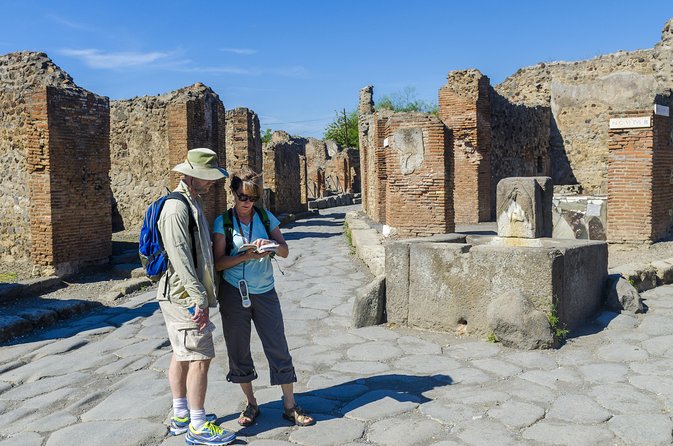
At about $35.67 per person for roughly two hours, you are not just paying for a warm body with a map. You are paying for three things that add up quickly at Pompeii: skip-the-line entry, an archaeologist background guide, and a structured route that prevents you from wandering.
The Pompeii Express entrance ticket is included, which helps justify part of the cost. You also get guidance for the entire duration, and the tour caps at 20 people per guide, which usually leads to better pacing and fewer “wait for everyone” moments than large group buses.
What is not included is straightforward: food and drinks, plus transportation to and from Pompeii. So budget for your own water and snacks, or plan to eat after the tour.
If you are paying for just one guided experience in Pompeii, I think this one is a solid choice because it covers the big named sights plus the interpretive stops, especially the Granaries and casts.
And if your plans change, you have the option of free cancellation up to 24 hours in advance for a full refund.
Tips to make your walk easier: shoes, sun, and stairs
This tour runs in all weather, rain or shine. That means you should dress for conditions, not for a perfect postcard day.
Wear comfortable shoes. Pompeii is uneven, with steps and ramps. A guide can help you see more because you are not constantly stopping to figure out where to go, but they cannot fix the ground under your feet. In the guides’ own pacing, the walking is steady, so your footwear matters.
Bring a small bottle of water. In summer, you will want sunscreen and sunglasses too. There is little shade, so plan for sun exposure.
A note on accessibility: mobility scooters are not allowed. The tour is not recommended for travelers with mobility issues or impairments because of steps and ramps and steep climbs. If this is you, it may be worth asking about a private tour better suited to your needs.
Pets are also regulated. Service animals are allowed. Dogs are permitted only if they do not exceed 10 kg in weight and 40 cm in height, and you must keep them on a leash and held in your arms inside buildings, with collection of excrement mandatory.
Who should book this Pompeii archaeologist small group tour
This is ideal if:
- You want a clear route through Pompeii’s main highlights in about two hours
- You are visiting for the first time and want help turning ruins into a story
- You like archaeology that connects places to real people, especially at the casts stop
- You want a guide who can answer questions without drowning you in jargon
It may not be ideal if:
- You need more time to linger and compare details room by room
- You have mobility limitations that make steep, uneven routes difficult
- You prefer total freedom and are comfortable navigating without interpretation
The short answer: should you book?
Yes, if you want Pompeii to make sense quickly, this tour is a strong value. The structure, small group size, and skip-the-line entry reduce stress, and the stops hit the mix of public life, home life, and the human impact of the eruption. It is a great “foundation tour,” especially if you plan to continue exploring after.
If you are unsure, think like this: for Pompeii, your biggest problem is not finding ruins. It is finding meaning. A good archaeologist guide solves that faster than any app.
FAQ
Where do I meet the guide?
Meet at the Pompeii Archaeological Park entrance at Porta Marina Superiore. The guide will be holding a sign with the company name Askos Tours.
How long is the tour?
The tour is about 2 hours.
Is skip-the-line entry included?
Yes. You get a Pompeii Express entrance ticket included with the tour.
What’s included in the price?
Guidance for the full duration, a Pompeii Express entrance ticket, a licensed guide with an archaeological background, and a small group capped at 20 people. Headsets are provided for groups of 16 or more.
What should I bring or wear?
Wear comfortable shoes. In summer, bring sunglasses and sunscreen, and bring a small bottle of water.
Is the tour wheelchair or scooter friendly?
No. Mobility scooters are not allowed, and the tour is not recommended for travelers with mobility issues or impairments due to steps, ramps, and steep climbs.
Latest reviews around Pompeii
- Vesuvius National Park Skip-the-Line Ticket★ 3.8 · 221 reviews
- From Rome: Day Trip to Pompeii with Tickets★ 4.4 · 1,161 reviews
- From Rome: Sorrento & Pompeii Day Tour with Hotel Pickup★ 4.2 · 257 reviews
- Pompeii Ruins Private Tour with Optional Skip-the-Line Entry★ 4.9 · 732 reviews
- From Rome: Pompeii All-Inclusive Tour with Live Guide★ 4.3 · 261 reviews
- Pompeii and Herculaneum: Guided Tour with an Archaeologist★ 5.0 · 164 reviews
- Pompeii 3hours Villa of Mysteries tour with an Archaeologist★ 4.8 · 486 reviews
- From Sorrento: Pompeii and Vesuvius Tour★ 4.5 · 201 reviews
Pompeii & Vesuvius Tours, compared.
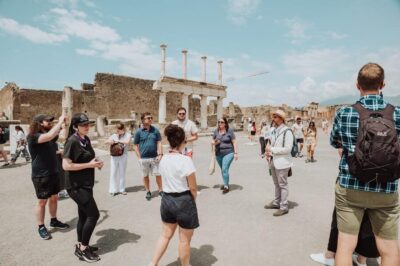
Pompeii: Entry Ticket and Guided Tour with an Archaeologist
Read our review →
Pompeii: Entry Ticket with Optional Audio Guide
Read our review →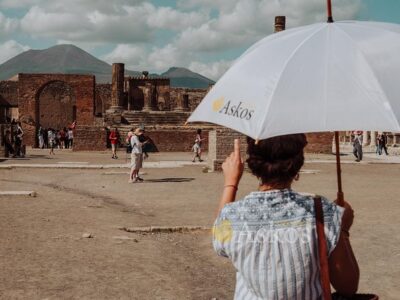
Pompeii: Small Group Tour with an Archaeologist
Read our review →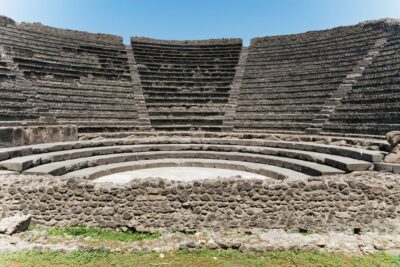
Pompeii, Amalfi Coast and Positano Day Trip from Rome
Read our review →
Pompeii and Mount Vesuvius Day Trip from Rome with Pizza Lunch
Read our review →Browse the lists this tour appears in