
Reviewed · POMPEII & VESUVIUS TOURS
Pompeii: Small Group Tour with an Archaeologist
One of Italy’s biggest ruins feels human again with a guide. This archaeologist-led Pompeii tour takes you through streets and buildings frozen by the 79 AD eruption, with expert stories that make the stones easier to read. I like how the small-group flow keeps the pace calm, and I also like the option to go longer if you want the famous fresco stop. One drawback to plan for: the site has uneven ground, steps, and short climbs, so it is not a great fit for mobility limits.
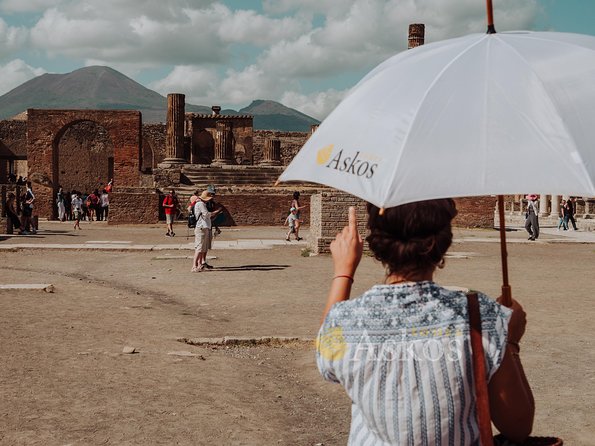
You start entering at Porta Marina Superiore, then walk the old city core through places like the Forum and Basilica, with Mount Vesuvius in your line of sight. I also love that you get a chance to look closely at preserved artwork, including mosaics and frescoes, plus plaster casts that help you picture what happened when the eruption trapped people. The only real consideration is time: the 2-hour version covers major highlights, but Pompeii is enormous, so you will want to extend your day after the official tour ends.
In This Review
- Key points that make this Pompeii tour worth your time
- Why Pompeii feels different with an archaeologist guiding your walk
- Choosing the right length: 2 hours vs 3 hours and the Villa of the Mysteries
- Meeting points, entry at Porta Marina Superiore, and using the headsets
- The first walk inside Pompeii: Porta Marina Superiore to the Forum
- Basilica, Temples, and the city’s practical rhythm
- Baths, bakeries, and the Great Theater: entertainment and daily life
- Houses and artworks: frescoes, mosaics, and what you can really see up close
- The Lupanar brothel stop: context matters, and so does the guide
- The 3-hour highlight: Villa of the Mysteries frescoes
- Getting the most out of your free time after the tour
- Price and value: why this Pompeii tour tends to feel fair
- Who this tour is best for, and who should skip it
- Should you book Pompeii: Small Group Tour with an Archaeologist?
- FAQ
- How long is the Pompeii tour?
- What is included in the tour price?
- What is not included?
- Where do I meet the group?
- Does this tour let you skip the ticket line?
- What languages are available for the guide?
- Is the tour suitable for wheelchair users or mobility impairments?
- Are luggage or mobility scooters allowed?
- Is there somewhere to store a small bag?
Key points that make this Pompeii tour worth your time
- Archaeologist-led explanations that help you spot details you would normally walk right past
- Two tour lengths: a solid 2-hour route, plus a 3-hour option that adds the Villa of the Mysteries
- Early, efficient entry that includes skip-the-ticket-line access
- Close-up art moments with mosaics and frescoes you can actually study
- Brothel and everyday-life stops like the Lupanar, handled with care and context
- Good end-of-tour guidance, so you know where to go next on your own
Why Pompeii feels different with an archaeologist guiding your walk
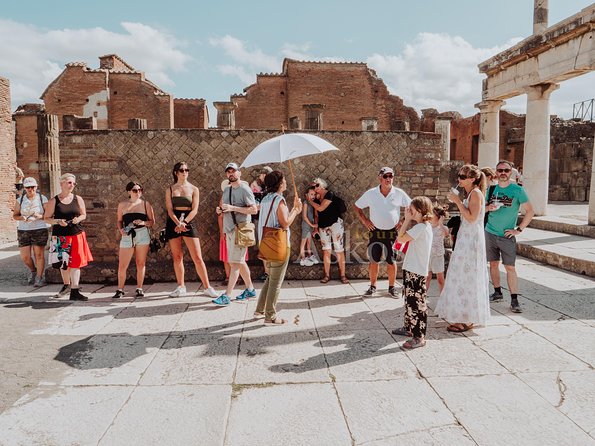
Pompeii is not just impressive. It is confusing, at least at first glance. A lot of visitors see walls, doorways, and stone floors, then move on without realizing what they are looking at. This is where an archaeologist guide makes the whole place click.
On this tour, you get the why behind the what. You learn how the city was shaped, how Roman public life worked, and what everyday jobs and rituals looked like in real spaces. That matters because Pompeii is big, and you will get more value when you can connect each stop to a bigger story.
You will also hear human-scale details that feel surprisingly vivid, from how people used public buildings to what daily routines might have looked like. In reviews, guides like Roxanne, Alexandra, Alessandra, Paulo, Anna, Mario, and Michele show up repeatedly for doing exactly this, with clear storytelling and a sense of humor that keeps the group from turning into a shuffle.
More Pompeii digs and Vesuvius climbs:
- Pompeii: Entry Ticket and Guided Tour with an Archaeologist
★ 4.8 · 19,459 reviews - Pompeii: Skip-the-Line Entrance Ticket with Audio Guide
★ 4.0 · 2,509 reviews - Naples: Pompeii and Mt. Vesuvius with Lunch and Wine Tasting
★ 4.5 · 2,454 reviews
Choosing the right length: 2 hours vs 3 hours and the Villa of the Mysteries
You have two choices here. The baseline tour is about 2 hours, focused on major Pompeii highlights. The longer 3-hour tour adds a visit to the Villa of the Mysteries, where the preserved frescoes are the main event.
If you are short on time or you want to keep your afternoon free, the 2-hour option is a good move. It gives you a strong orientation fast, and it leaves you with enough energy to explore more once you are on your own.
If you want more depth, the extra hour is one of the easiest ways to get it. The Villa of the Mysteries stop is a top reason this tour gets recommended, especially for people who want to see how Pompeii art can tell stories, not just decorate rooms.
Meeting points, entry at Porta Marina Superiore, and using the headsets
The meeting point can vary depending on the option you book, so check your specific confirmation details before you head out. One practical plus: you are getting skip-the-ticket-line entry, which helps you start walking faster instead of waiting at the gates.
Most tours enter at Porta Marina Superiore, one of the city’s gates. That matters because Pompeii’s layout is not intuitive, and starting from a gateway with context helps you understand where you are in relation to the rest of the site. There is also a free cloakroom near the Porta Marina Superiore entrance, subject to availability, which is helpful if you are carrying a day bag.
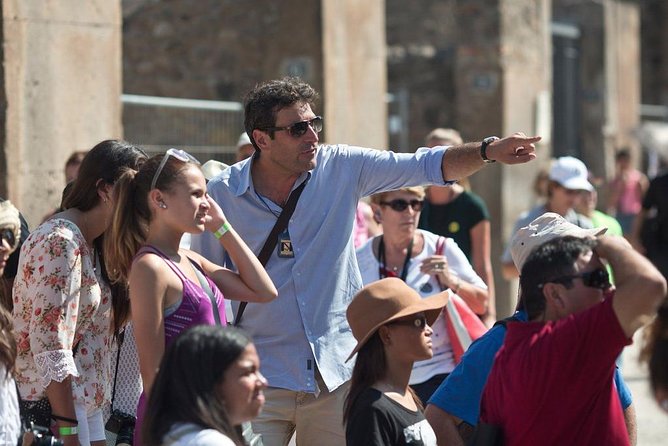
Headsets are provided for larger groups (for groups of 16 or more). In real life, that is a comfort upgrade in a busy park, but do expect you might need a moment to get the audio comfortable in your ears. This is also the kind of thing that is easier if you arrive a few minutes early.
The first walk inside Pompeii: Porta Marina Superiore to the Forum

The tour begins by taking you into Pompeii and orienting you with the main street flow. From there, you work your way toward the Forum, Pompeii’s public heart. You will feel the shift from “tourist ruins” to “city layout” once you see the Forum in context.
Your guide will point out how the Roman city functioned around public spaces like the Forum and how buildings served different purposes, not just different looks. As you move through the area, you will also get a chance to understand Pompeii’s relationship to the landscape, including views toward Mount Vesuvius.
This is a good stretch to bring your questions. If you have ever wondered what a Forum was for, or what people did on a typical day, you are in the right place at the right time. The guide’s stories tend to connect the architecture to real routines, which is exactly what turns the ruins into something you can picture.
Nearby, and just as well reviewed:
- Pompeii: Skip-the-line-Ticket and Guided Tour
★ 4.6 · 1,152 reviews - Pompeii: Small-Group Tour of Pompeii and Herculaneum
★ 4.8 · 867 reviews - Pompeii: Guided Tour with Skip-the-Line Entry
★ 4.9 · 812 reviews - Pompeii: Skip-the-Line Entry Ticket with Digital Guide App
★ 4.1 · 770 reviews
Basilica, Temples, and the city’s practical rhythm
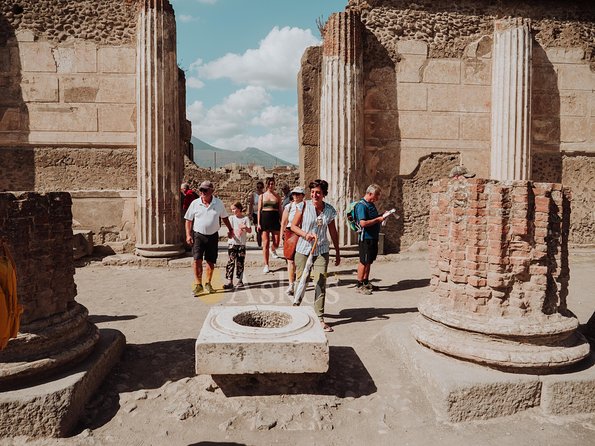
After the Forum, you typically move through key civic and religious stops, including the Basilica and major temple areas such as the Temple of Apollo and Temple of Jupiter. The Basilica is often described as a business and legal center, and that framing helps you read the space.
Instead of seeing a big hall, you start thinking about paperwork, transactions, announcements, and how Roman rules played out in public rooms. The temples then add the other layer, religion and civic identity tied to the gods, not just private belief.
Depending on timing and conditions inside the park, the exact route and order can shift slightly due to overcrowding or temporary closures. That is normal for Pompeii, and it is also why it helps to have a guide who can keep the story coherent while working around the day’s bottlenecks.
Baths, bakeries, and the Great Theater: entertainment and daily life
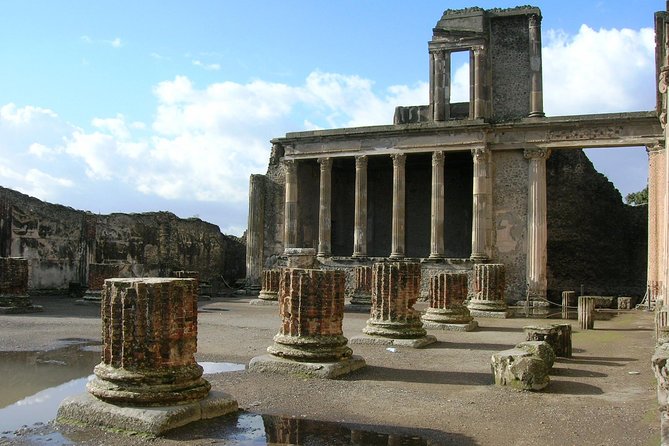
Pompeii’s best tours do not stop at monuments alone. They also show you how the Romans lived, ate, washed, prayed, and socialized. This route takes you past the thermal baths, plus stops tied to everyday services like a bakery area, and then into entertainment at the Great Theater.
If you care about how ordinary life worked, these are some of the most satisfying parts of the walk. The baths were not only for cleaning, they were social hubs. Seeing the layout, even in ruins, helps you understand why they were so central to Roman city life.
The Theater is your break from the “everyday work” mood. It gives you a sense of civic culture, performances, and the kind of public gathering that made city life feel shared. One extra detail that can make this stop feel especially alive: guides often highlight small features people would miss, like how entrances and nearby spaces were used.
Houses and artworks: frescoes, mosaics, and what you can really see up close
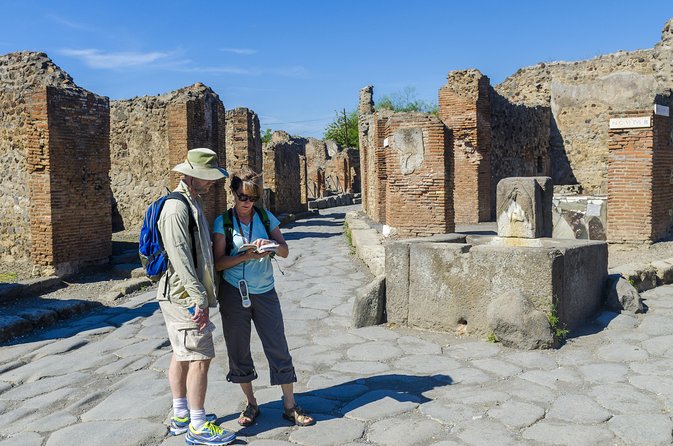
Pompeii’s houses are where the site starts to feel personal. Instead of thinking only in terms of streets and buildings, you see the world of private spaces, decorated rooms, and social status.
This tour commonly includes stops at homes such as the House of the Faun and House of the Vettii. You also may visit the House of Menander, depending on the exact program and flow that day. The big advantage here is that your guide helps you focus on the visual language of Pompeii art and decoration.
You will look at preserved frescoes, plus mosaics and other artworks up close. These are not quick photo stops. The guide’s pacing is built around letting you take in details, then explaining what those details mean or why they were placed where they were.
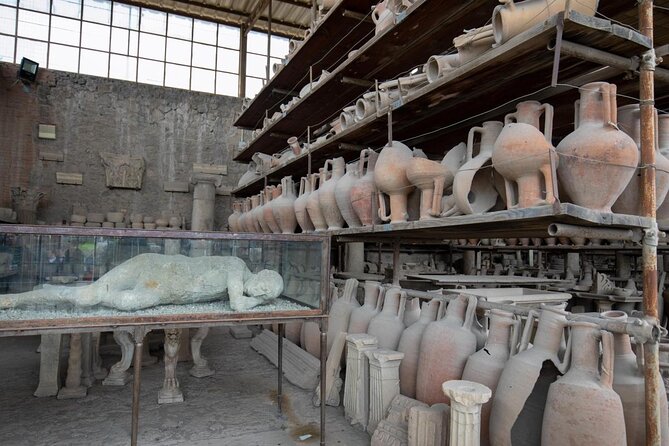
There is also a moment built in to connect the ruins to human fate. You may stop to see plaster casts of people affected by the eruption. One review note said that plaster casts are now on display in sealed glass cases, rather than shown inside dwellings, so if you have seen old photos online, adjust your expectations.
The Lupanar brothel stop: context matters, and so does the guide
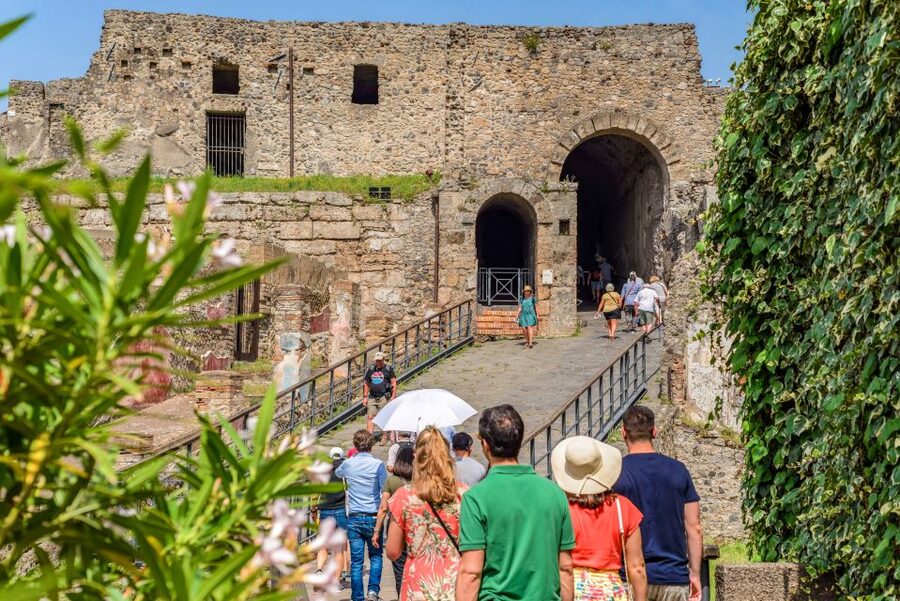
Yes, you will pass the Lupanar, the famous brothel in Pompeii. This is one of the stops that can surprise people, mostly because it is not just a building, it is a snapshot of how the city had a structured sexual economy.
The tour includes discussion of how the Lupanar got its name and what you can see inside, including preserved stone beds and frescoes. One reason this tour consistently earns high praise is that guides tend to handle the adult themes with sensitivity and context, so it does not feel like a shock stop.
This is also where your guide’s job really shows. Without explanation, the space can feel awkward or random. With context, it becomes part of the larger Pompeii story, including how people interacted, how businesses operated, and how public and private life overlapped.
The 3-hour highlight: Villa of the Mysteries frescoes
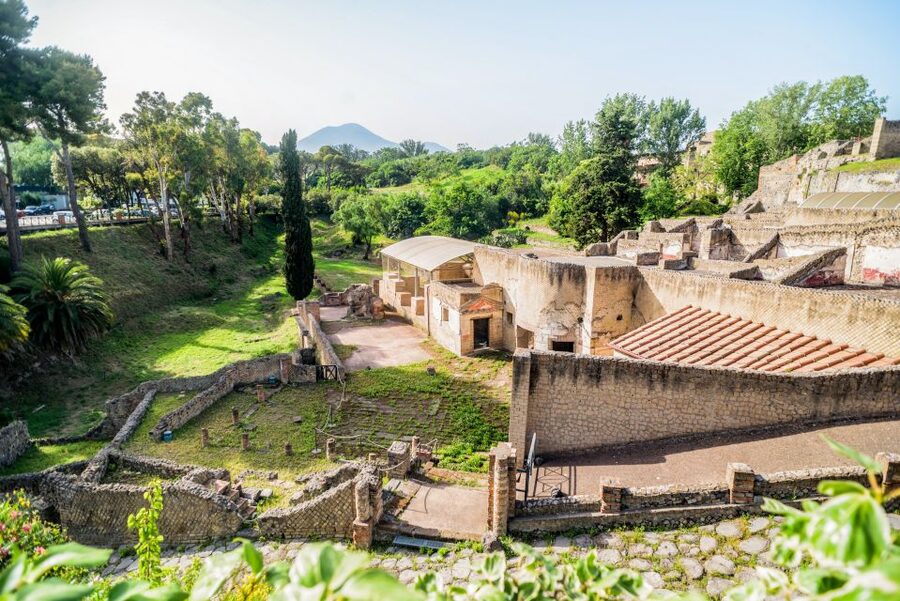
If you pick the 3-hour option, the Villa of the Mysteries is the big reason. The frescoes here are famous, and the guide’s role is to help you read them as artwork, not just color on a wall.
You get to see the frescoes in an organized visit rather than wandering around trying to guess what you are looking at. The guide’s explanations tend to focus on symbolism and the way scenes were arranged, which is what makes the Villa stop feel special even if you have already read about it online.
In reviews, the Villa stop is repeatedly called out as a wow moment, especially when guides lean into clear, story-driven interpretation. It is a good choice for anyone who wants one standout art-focused segment instead of spreading attention thin across more rooms.
Getting the most out of your free time after the tour
One smart part of this experience is the built-in reset at the end. After the guided portion, you get freedom to explore the archaeological site on your own.
You do not just leave with a list of stops. The guide is also supposed to share tips for how to spend the rest of your day, which helps you turn the official route into a personalized follow-up. This matters because Pompeii is huge. Even if you walk well, you cannot see everything, so your choices in the second half of the visit matter.
Here is how I’d use that time:
- Go back for a second look at the one house or art detail you liked most during the tour. You will notice more the second time.
- Use quieter areas to take photos without a crowd pressing in.
- If you still have energy, connect the dots. Pick your next stop based on what you just learned, not just what looks famous on the map.
A few reviews mention that some guides route around the heaviest congestion and take you to less packed areas. That is a real benefit because Pompeii can feel like a bottleneck factory during peak hours. If your guide does that, lean into it and keep your eyes open for details in those calmer pockets.
Price and value: why this Pompeii tour tends to feel fair
At about $40 per person for a 2-hour guided experience, the value is in the interpretation. You are paying for an expert to help you understand the site, not just for entry.
Pompeii entry alone is not trivial, and your ticket here is included in the tour price. When you add the guided time plus the chance to stay afterward with a clearer sense of where you want to go next, it becomes an easy decision for most first-timers.
If you already have a guidebook and you are determined to explore on your own, you might find the cost less appealing. But if you want to see more and understand more with less guesswork, the price feels like it buys back your time.
Who this tour is best for, and who should skip it
This is a strong fit if you want:
- A structured overview of Pompeii’s major public and private spaces
- Up-close viewing of preserved frescoes, mosaics, and artwork
- A clear path that helps you avoid getting lost in a massive site
It also tends to work well for families, since guides often keep things engaging for different ages. Still, children must be accompanied by an adult.
Skip or rethink if you have mobility challenges. The tour is not recommended for travelers with mobility issues or impairments due to steps and ramps and some steep climbing. A review specifically warned about uneven terrain, slopes, and steps around the site and dining areas, and the provided info also says it is not suitable for wheelchair users.
Should you book Pompeii: Small Group Tour with an Archaeologist?
Book it if you want Pompeii to feel legible. This tour gives you the missing guide layer that turns scattered ruins into a city you can understand in a couple of hours, then lets you stretch your visit afterward.
I would especially book if you care about art and interpretation, because the stops include preserved frescoes and mosaics and the guide helps you see what matters. If you can handle the schedule, the 3-hour option that adds the Villa of the Mysteries is the easiest upgrade for people who want one standout art-focused segment.
One last practical note: bring your ID or passport (a copy is accepted), skip the big bags (luggage and large bags are not allowed), and be ready for a walking route inside a real archaeological park. If you go in with that mindset, you will get a lot out of a day at Pompeii.
FAQ
How long is the Pompeii tour?
The experience lasts about 2 to 3 hours, depending on the option you choose.
What is included in the tour price?
Your Pompeii entry ticket and a 2- or 3-hour guided tour by an archaeologist are included. You also get headsets for listening to the guide when available for groups of 16 or more, plus time to explore the archaeological site on your own after the tour.
What is not included?
Food and drinks are not included, and transportation to the meeting point is also not included. Other personal expenses are not included either.
Where do I meet the group?
The meeting point may vary depending on the option booked, so you should check the specific meeting point details for your reservation.
Does this tour let you skip the ticket line?
Yes, skip-the-ticket-line entry is included.
What languages are available for the guide?
The tour is available in French, Spanish, German, Portuguese, English, and Italian.
Is the tour suitable for wheelchair users or mobility impairments?
No. It is not recommended for travelers with mobility issues or impairments, and it is listed as not suitable for wheelchair users.
Are luggage or mobility scooters allowed?
Smoking is not allowed. Luggage or large bags are not allowed, and mobility scooters are also not allowed.
Is there somewhere to store a small bag?
A free cloakroom service is located next to the Porta Marina Superiore entrance, subject to availability.
Latest reviews around Pompei Campania
- Pompeii and Herculaneum: Guided Tour with an Archaeologist★ 5.0 · 164 reviews
- Pompeii 3hours Villa of Mysteries tour with an Archaeologist★ 4.8 · 486 reviews
- Pompeii: Small-Group Tour of Pompeii and Herculaneum★ 4.8 · 867 reviews
- Pompeii: Skip-the-Line Guided Tour★ 4.6 · 139 reviews
- Pompeii: Skip-the-Line Ticket with Audio Guide and Map★ 4.0 · 117 reviews
- Pompeii: Skip-the-Line Entry & Audioguide★ 3.8 · 225 reviews
- Pompeii: Skip-the-line-Ticket and Guided Tour★ 4.6 · 1,152 reviews
- Pompeii: Guided Tour with Skip-the-Line Entry★ 4.9 · 812 reviews
Pompeii & Vesuvius Tours, compared.
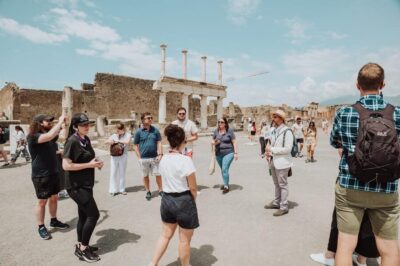
Pompeii: Entry Ticket and Guided Tour with an Archaeologist
Read our review →
Pompeii: Entry Ticket with Optional Audio Guide
Read our review →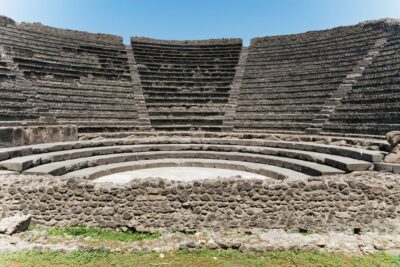
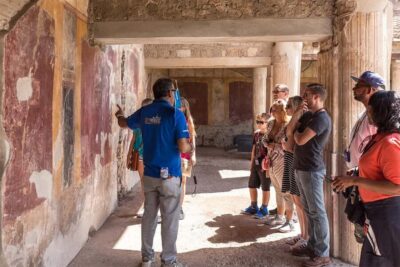

Pompeii Small Group Tour with an Archaeologist
Read our review →
Pompeii, Amalfi Coast and Positano Day Trip from Rome
Read our review →
Pompeii and Mount Vesuvius Day Trip from Rome with Pizza Lunch
Read our review →Browse the lists this tour appears in