
Reviewed · POMPEII & VESUVIUS TOURS
Pompeii: Group Tour with an Archeologist Guide
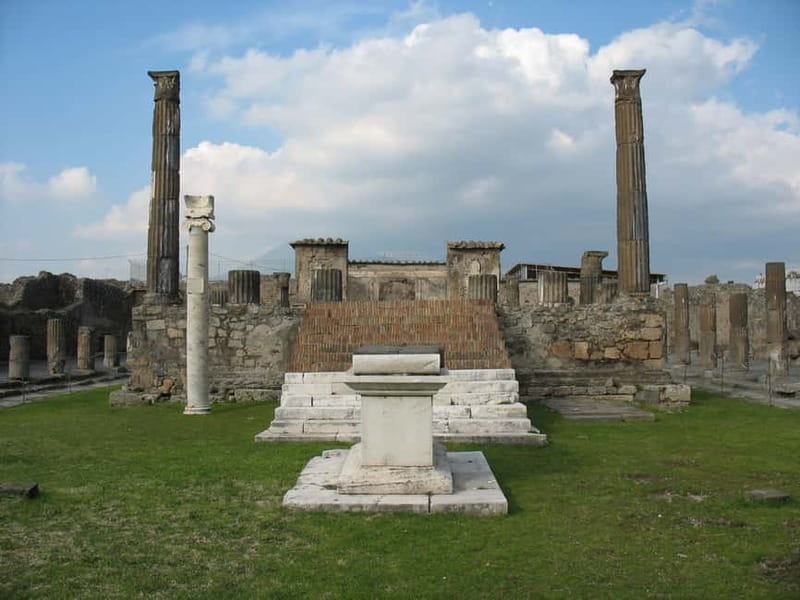
Pompeii makes more sense with a guide. This 2-hour group walk through the ancient city, buried by Vesuvius in 79 AD, turns scattered ruins into a story you can actually follow. I especially like the skip-the-line setup because it protects your limited time, and the archaeologist guide approach that helps you read what you’re seeing instead of just staring at stones.
I love how the tour targets the most important western-side landmarks, from the Forum area and baths to the Porta Marina stretch and the theaters. I also like the human layer you get from the plaster casts of Pompeii’s victims, plus stops at named houses such as the House of the Tragic Poet and the House of the Golden Cupid. Guides who have led this tour, like Ernaldo, Alfonso, Lena, and Giuseppe, are known for pacing the walk and answering questions without turning the whole thing into a lecture.
One drawback to plan for: it’s a large group format and it’s only 2 hours, so you may leave wanting more depth or additional areas outside the western route.
In This Review
- Key Points to Know Before You Go
- Pompeii in 2 Hours, What This Group Tour Really Delivers
- Meeting at Tempio Travel in Vircumvesuviana, Then Straight to Porta Marina
- The Western-Side Route and Porta Marina to Basilica, Forum, and Baths
- Forum Life, Main Street Walking, and the Theaters Moment
- Lupanar Brothel Visit and How the Guide Frames Roman Reality
- Named Houses and the Garden of the Fugitives
- Frescoes, Plaster Casts, and Feeling the Human Side of 79 AD
- Headsets, Guide Style, and Keeping Up in a Larger Group
- What to Wear and Bring, and What to Leave Behind
- Price and Value: Is $50.11 Worth It?
- Who This Pompeii Tour Suits Best
- Should You Book This Pompeii Archaeologist Guide Tour?
- FAQ
- How long is the Pompeii group tour?
- Where do I meet the guide?
- What languages are offered?
- Are luggage or large bags allowed?
- Is the tour suitable for people with mobility impairments?
- Is entrance free on the first Sunday of each month?
Key Points to Know Before You Go
- Skip-the-line entry saves time, which matters at a site this popular.
- Western Pompeii focus hits major sights like the Basilica, Forum, baths, and theaters in a short window.
- Whisper headsets help you keep up in a bigger group.
- Plaster casts bring the tragedy closer, not just as facts but as scenes you can understand.
- Named houses and the Garden of the Fugitives add variety beyond the big public buildings.
- Comfort matters: Pompeii gets hot fast, and you’ll be walking on uneven ground.
Pompeii in 2 Hours, What This Group Tour Really Delivers
This tour is built for people who want the Pompeii highlights without losing half their day to queues and confusion. In just 2 hours, you cover a carefully chosen slice of the site, mostly the western part where the headline buildings and famous neighborhoods cluster together.
The other big win is interpretive help. Pompeii can feel like a giant open-air puzzle when you’re on your own. With a guide like Ernaldo or Alfonso, you get context for what the spaces were used for, how Roman life worked, and why certain details matter. That makes the frescoes, streetscapes, and public architecture click faster.
The tradeoff is also real: 2 hours does not cover the whole city. If you’re chasing every last room or every side street, this tour will feel like an excellent foundation, not the finish line.
More Pompeii digs and Vesuvius climbs:
- Pompeii: Entry Ticket and Guided Tour with an Archaeologist
★ 4.8 · 19,459 reviews - Pompeii: Entry Ticket with Optional Audio Guide
★ 4.2 · 12,360 reviews - Pompeii: Small Group Tour with an Archaeologist
★ 4.8 · 12,264 reviews
Meeting at Tempio Travel in Vircumvesuviana, Then Straight to Porta Marina
You’ll start at the Tempio Travel office on the 1st floor of the Vircumvesuviana train station. From there, you’re guided to the entrance, with the process organized enough that you’re not wandering, second-guessing, or losing time.
A small practical note that can save frustration: the Tempio Travel office is in a building with a red logo, and you’ll need to take stairs to reach the office level. Once you’re at the right spot, the tour moves with purpose.
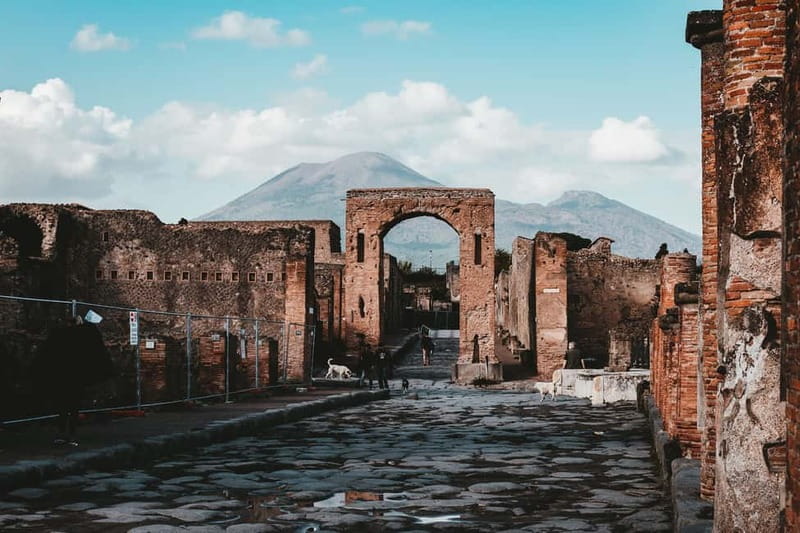
After that, your first major stop is at Porta Marina, the gateway that frames the opening chapter of the western route. It’s a good way to begin because it puts you in the right mindset: Pompeii wasn’t just ruins, it was a functioning city with entrances, traffic flow, and a layout you can follow.
The Western-Side Route and Porta Marina to Basilica, Forum, and Baths
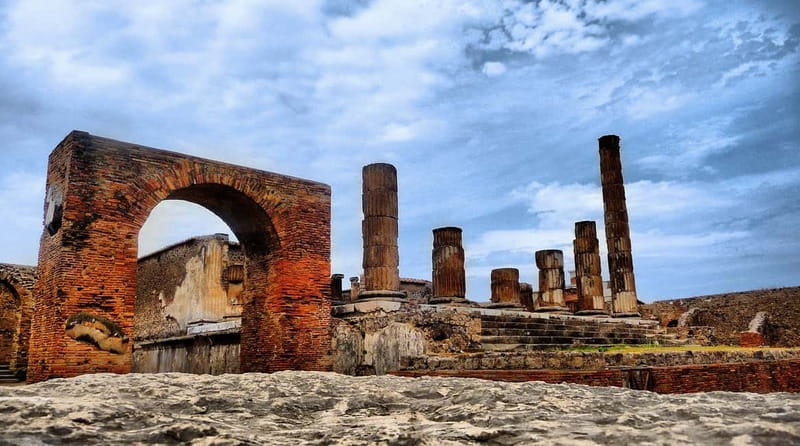
Porta Marina sets the tone. You’re not just collecting photos, you’re walking through a space that once linked travelers and residents to the heart of the city. From that starting point, the guide leads you through the western cluster of major civic and public places.
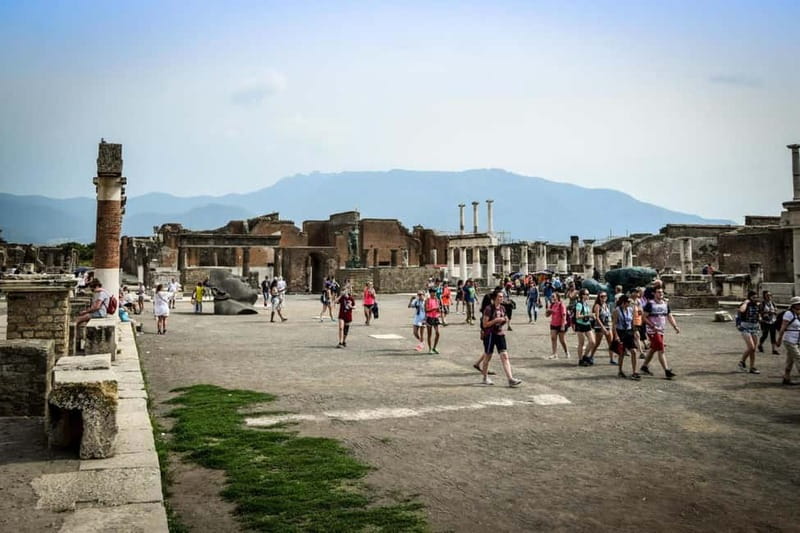
You’ll spend time around the Basilica and the Forum area, which are central to how Roman cities organized public life. The value here is that a guide can explain what you’re looking at in everyday terms, like where people gathered, what activities were likely happening, and how buildings communicated power and order. Without that, it’s easy to recognize names like Forum or Basilica while still missing the point.
Then comes the baths. Roman bathing wasn’t just hygiene, it was social time, gossip time, and sometimes business time. A good guide helps you visualize the rhythm of these spaces, so the building shapes do more for you than just provide shade.
This is also where the “skip-the-line” benefit shows up. If you do Pompeii solo, you often spend more time waiting than walking. Here, you get moving quickly and you’re already in the key zone early, when your energy is higher.
Forum Life, Main Street Walking, and the Theaters Moment
One reason this tour works well is that it keeps variety while staying in one coherent region. After the big public spaces, you’ll move along the main street and toward the theaters.
The main street segment matters because it helps you connect buildings to movement. Roman streets were designed for flow, markets, entrances, and daily routes. When you walk this part with a guide, you start noticing how the city’s layout would have shaped routine life.
Theaters are a highlight for many first-time visitors because they instantly feel dramatic. You can picture audiences, sound, and spectacle. With a guide, you also learn why these buildings mattered culturally, not just aesthetically.
A practical tip: Pompeii ground surfaces can be uneven and there are lots of steps and curbs. Comfortable walking shoes are non-negotiable, especially if you’re combining this with other stops later in the day.
A few more Pompeii options to weigh
- Mount Vesuvius: Skip-the-Line Ticket and Smart Digital Guide
★ 4.2 · 2,780 reviews - Pompeii: Skip-the-Line Entrance Ticket with Audio Guide
★ 4.0 · 2,509 reviews - Pompeii: Guided Walking Tour with Entrance Ticket
★ 4.3 · 1,423 reviews - Rome to Pompeii Guided Tour with Wine & Lunch by High Speed Train
★ 5.0 · 1,379 reviews
Lupanar Brothel Visit and How the Guide Frames Roman Reality
The tour includes the Lupanar, the famous brothel often associated with Pompeii. This is the kind of stop that can make a group tour worth it, because a guide can put it in context rather than leaving you with shock or stereotypes.
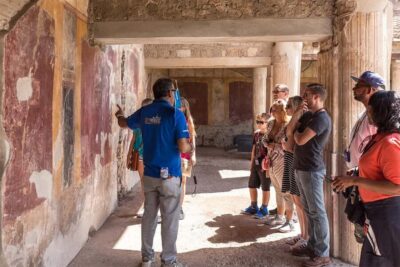
You’ll also likely see wall artwork that helps explain what Roman urban life included, including the frescoes that Pompeii is known for. When you have someone explaining the setting and the purpose of these details, the experience becomes more grounded and less like you’re hunting for shock-value.
Still, do go in with the right expectations. This is an adult-themed element of city life, and it’s handled as part of the full Pompeii picture rather than as a sensational detour.
Named Houses and the Garden of the Fugitives

One of the nicest parts of this tour is that it doesn’t stay only on government buildings. You’ll visit quieter, more intimate spaces, including the Garden of the Fugitives, plus the House of the Tragic Poet and the House of the Golden Cupid.
The Garden of the Fugitives is powerful because it’s tied to escape attempts and the moments right before the disaster overwhelmed Pompeii. A guide helps you understand what the layout means and why the area is named that way.
Then you move into named houses, where you can see how domestic life worked. These homes are the kind of stops where names help you anchor your memory, so later, when you look at photos or sketches you took, you can connect each view to a specific part of the city.
If you like the mix of public and private Pompeii, this section is one of the best reasons to choose a guided format. On your own, it’s easy to focus only on the biggest structures and miss the homes entirely or misunderstand what you’re seeing.
Frescoes, Plaster Casts, and Feeling the Human Side of 79 AD
Pompeii is a site of tragedy, but the guides know how to translate that into something you can understand during a walk. You’ll see frescoes tied to what life looked like on the walls, not just the architecture around them.
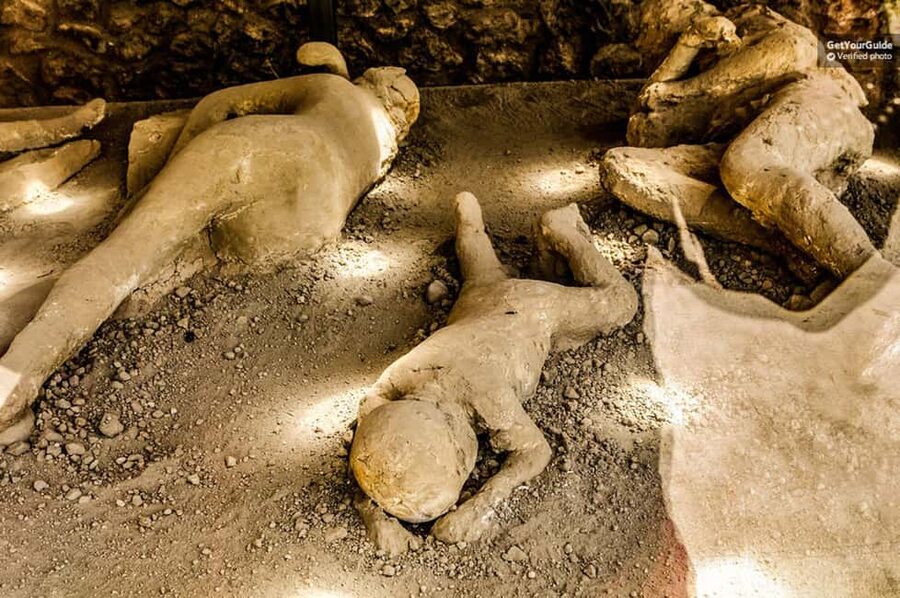
You’ll also see plaster casts of Pompeii’s tragic citizens. This is one of the most emotionally gripping elements, because it turns the event into individual figures rather than distant historical facts. It’s also where a good guide’s pacing matters. If you rush through, the significance can get lost. With headsets and structured stops, you tend to get the time you need to actually process what you’re looking at.
Heat can make this part feel longer, and it’s worth planning for it. One simple piece of advice I’d follow: if the sun is brutal, buy shade outside the entrance in the roadside tents rather than waiting until you’re miserable inside. A paper umbrella solution has worked for people in the middle of afternoon tours, and it’s easy to stash once you’re done.
Headsets, Guide Style, and Keeping Up in a Larger Group
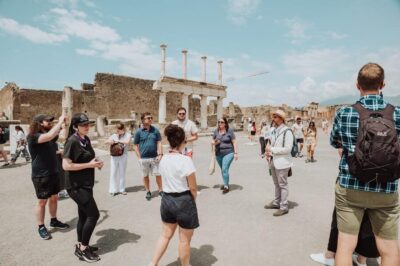
This is a live tour with whisper headsets for large groups, and it makes a noticeable difference. Without audio support, you lose details as soon as someone’s standing in your sightline. With the headset, you can keep up even when the group is moving at a steady pace.
Guide style is also a big factor in why this tour scores well. From what I’ve seen across guide performance, the most praised guides tend to balance context with storytelling and answer questions without dragging the tour. Names like Alfonso, Laura, and Antonio come up in this kind of format because they’re clear, practical, and able to keep momentum.
One more perk: the tour ends with suggestions for what to do next in modern Pompeii, including direction toward the Sanctuary Dedicated to Our Lady of the Holy Rosary, which is a few steps from the archaeological site. Even if you only have an hour more, that kind of local guidance can prevent aimless wandering.
What to Wear and Bring, and What to Leave Behind

This tour is straightforward, but you’ll enjoy it more if you pack for walking and sun.
Bring:
- Passport or ID card
- Comfortable shoes
Not allowed:
- Luggage or large bags
Pompeii is not the place to travel light in the “small inconvenience” way. If you arrive with bulky items, you may end up dealing with storage or restrictions you didn’t expect. Stick to what you need for a couple of hours and keep your hands free for photos.
Also plan for weather. Even if you’re visiting in the afternoon, the heat can be intense. If it rains, you might still tour the grounds, so a compact umbrella or rain layer can help.
And if you care about timing accuracy, arrive a few minutes early. The starting point is tied to the train station area, and it’s easier to find the correct office before your group begins moving.
Price and Value: Is $50.11 Worth It?
At about $50.11 per person for a 2-hour guided experience, this is priced like a “high-impact” Pompeii option. The value is not just the guide, it’s the time saved.
Skip-the-line tickets matter at Pompeii because delays eat the hours you could spend in the key zones. The headsets are also part of the value equation, especially in a bigger group where it’s easy to miss directions.
The tour also gives you a tight mix of major civic buildings, domestic houses, and emotional exhibits like the plaster casts. If you’re short on time, that variety is exactly what you want. If you have more time, this tour still works as a smart starter because it helps you understand the site so you can explore the remaining areas with better instincts.
The only time I’d hesitate is if you’re trying to maximize coverage across every corner of Pompeii. In that case, you’d likely want a longer, broader plan. Here, the focus is clear: see the important western highlights, learn what you’re seeing, then move on.
Who This Pompeii Tour Suits Best
This tour fits best if:
- you have limited time and want a strong introduction
- you prefer guided structure over self-guided confusion
- you want the major sights, including named houses and plaster casts, within 2 hours
- you appreciate a guide who can explain details while keeping a good walking pace
It may not fit if:
- you use a mobility aid, since it is not suitable for people with mobility impairments
- you want to wander slowly and independently through every area without a set route
- you expect the tour to cover Pompeii end to end, it does not
Should You Book This Pompeii Archaeologist Guide Tour?
I think you should book this tour if you want Pompeii to feel intelligible fast. The combination of skip-the-line entry, headsets, and a structured route through Porta Marina, the Forum zone, baths, theaters, the Lupanar area, and named houses makes this a practical choice, not just a convenient one.
If your main goal is pure coverage across the entire site, you may want a longer program. But if your goal is to see the big moments, understand them as you go, and then still have energy for modern Pompeii afterward, this is a solid call.
If you do book, show up early, wear shoes you can trust on uneven ground, and plan for heat. Your future self will thank you when you realize you spent your time walking Pompeii, not standing in lines.
FAQ
How long is the Pompeii group tour?
The tour lasts 2 hours.
Where do I meet the guide?
Meet at the Tempio Travel office located on the 1st floor of the Vircumvesuviana train station. The tour ends back at the same meeting point.
What languages are offered?
The tour is available in English and Italian.
Are luggage or large bags allowed?
No. Luggage or large bags are not allowed on this activity.
Is the tour suitable for people with mobility impairments?
No, it is not suitable for people with mobility impairments.
Is entrance free on the first Sunday of each month?
Yes, entrance is free of charge on the first Sunday of each month, but tickets cannot be reserved in advance, so entry is not guaranteed.
Latest reviews around Pompeii
- Vesuvius National Park Skip-the-Line Ticket★ 3.8 · 221 reviews
- From Rome: Day Trip to Pompeii with Tickets★ 4.4 · 1,161 reviews
- From Rome: Sorrento & Pompeii Day Tour with Hotel Pickup★ 4.2 · 257 reviews
- Pompeii Ruins Private Tour with Optional Skip-the-Line Entry★ 4.9 · 732 reviews
- From Rome: Pompeii All-Inclusive Tour with Live Guide★ 4.3 · 261 reviews
- Pompeii and Herculaneum: Guided Tour with an Archaeologist★ 5.0 · 164 reviews
- Pompeii 3hours Villa of Mysteries tour with an Archaeologist★ 4.8 · 486 reviews
- From Sorrento: Pompeii and Vesuvius Tour★ 4.5 · 201 reviews
Pompeii & Vesuvius Tours, compared.
Pompeii: Entry Ticket and Guided Tour with an Archaeologist
Read our review →
Pompeii: Entry Ticket with Optional Audio Guide
Read our review →
Pompeii: Small Group Tour with an Archaeologist
Read our review →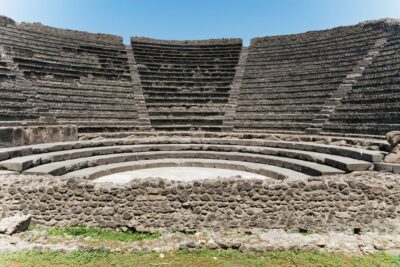

Pompeii Small Group Tour with an Archaeologist
Read our review →
Pompeii, Amalfi Coast and Positano Day Trip from Rome
Read our review →Browse the lists this tour appears in