
Reviewed · POMPEII & VESUVIUS TOURS
Skip-the-Line Pompeii Guided Tour from Sorrento
Pompeii feels huge, until you get a guide. This tour pairs skip-the-line access with an air-conditioned coach so you spend less time stuck in crowds and more time seeing real details. One consideration: the site has uneven ancient stone, so this is not a slow, drift-through kind of visit.
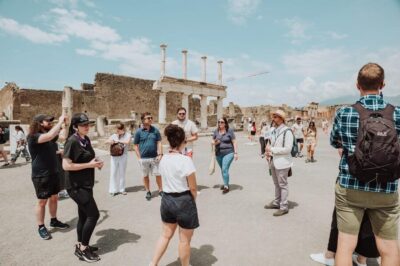
The tour runs about 5 hours round trip from Sorrento, with a structured route that hits the Forum area and key sights. Plan on following the group, plus using the included headphones at Pompeii if you’re in a larger group.
In This Review
- Key things that make this Pompeii tour worth your time
- Sorrento to Pompeii, with comfort built in
- Skip-the-line tickets: what saving time really buys you
- The Forum area: where Pompeii felt like a working city
- Civil Forum and Temple of Jupiter
- Basilica and Macellum: business and food culture
- Via dell’Abbondanza, Stabian Baths, and the Lupanar
- Via dell’Abbondanza: the main street in your head
- Stabian Baths: everyday life with real bodily rhythms
- Lupanar: official brothel, blunt social reality
- The big-ticket sights: House of the Faun, mosaics, and theater
- House of the Faun: elite home meets Alexander Mosaic
- Basilica area and Teatro Grande
- Pacing, photos, and how to make the most of limited time
- Price and value: is $90.70 a fair deal?
- Should you book this Pompeii tour from Sorrento?
- FAQ
- How long is the Pompeii guided tour from Sorrento?
- Where do I meet in Sorrento?
- Is Pompeii admission included?
- Does the tour include skip-the-line access?
- What language is the tour offered in?
- Is transportation included?
- Are headphones provided?
- Is food included?
- Can I cancel and get a refund?
Key things that make this Pompeii tour worth your time
- Skip-the-line entry so you can head inside faster
- Comfortable transport from central Sorrento, with air-conditioning
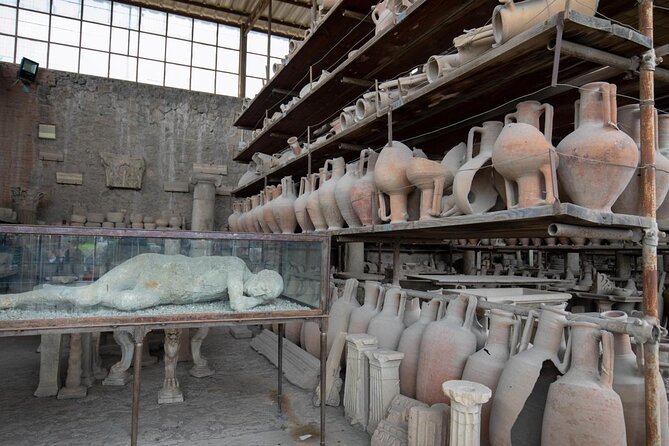
- Headphones at Pompeii when the group is over 10 people, for clearer commentary
- A smart highlight route that covers daily life, elite homes, and major public spaces
- Small group size with a maximum of 29 people
- Multiple departure options (morning or afternoon) so you can match it to your day
Sorrento to Pompeii, with comfort built in
Leaving from central Sorrento means you are not losing time on complicated transfers. You meet at IAMME IA! – Gray Line Amalfi Coast in Piazza Torquato Tasso 16, and then you’re on an air-conditioned vehicle headed to Pompeii. For a place like this, where walking is part of the deal, it helps a lot to start the day cool, calm, and ready.
The timing is also designed for flow. You get a round trip schedule of about 5 hours total, which is long enough to cover major highlights without dragging you into an all-day marathon. If you’re doing Pompeii as part of a Sorrento stay, that matters. You still need energy for dinner that night, and you do not want your trip plan to feel like work.
If you go for an early departure, you’ll usually benefit from lighter crowds and gentler temperatures. Even if you pick an afternoon slot, arriving with a plan is the main win, because Pompeii is easy to feel overwhelmed by once you’re inside.
More Pompeii digs and Vesuvius climbs:
- Sorrento: Skip-the-Line Pompeii Express Tour by Train
★ 4.8 · 2,038 reviews - Priority Access Pompeii & Mt. Vesuvius Full day from Sorrento
★ 4.5 · 1,376 reviews - Pompeii Express Guided Tour by Train from Sorrento
★ 4.5 · 770 reviews
Skip-the-line tickets: what saving time really buys you
Skip-the-line access is not just a convenience. It changes your visit. Pompeii is enormous, and when you waste time at the entrance, you lose the best part of the day you came for: being able to concentrate on the ruins instead of sprinting to keep up.
With this tour, you head directly into the site as part of a guided group. You’re not wandering blindly trying to figure out what to see first. And you’re not stuck waiting while the day heats up.
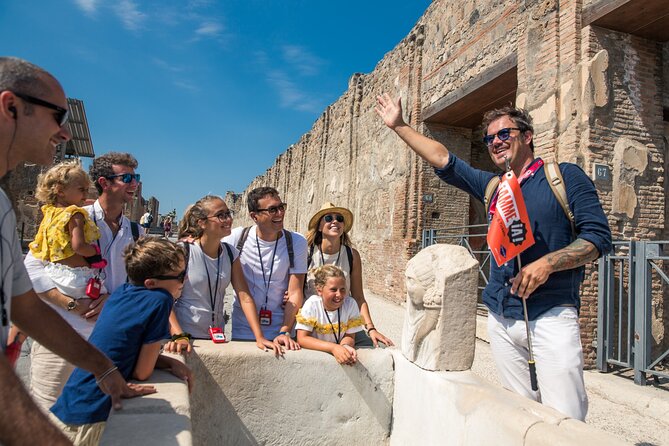
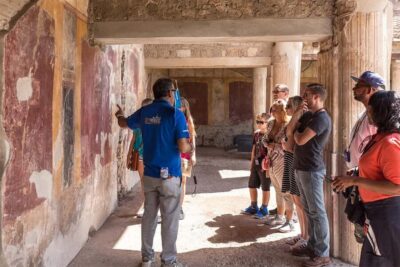
Also, the guide experience matters here. Pompeii is preserved architecture and street plan, but it only clicks when someone points out the purpose behind each space. This tour is set up so you get that context while you walk, not after you’ve already moved on.
The Forum area: where Pompeii felt like a working city
Most people picture Pompeii as dramatic houses and mosaics. This tour gives you something just as important: the daily machinery of Roman public life.
Civil Forum and Temple of Jupiter
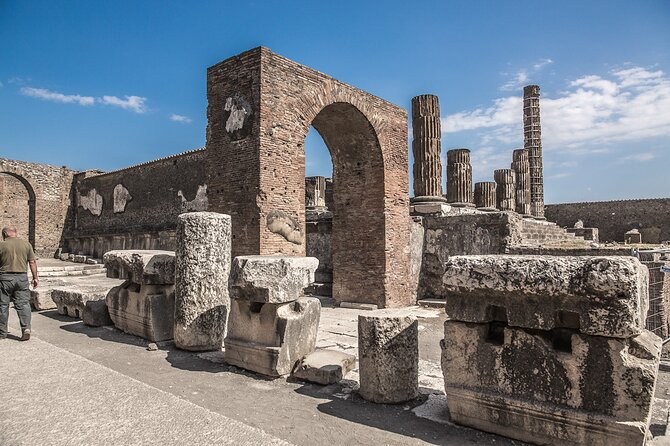
The Civil Forum is described as the core of daily life, tied to city administration, justice, business, trade, and worship. That’s a big concept, so here’s the practical takeaway for your visit. When you look at these stone remains, you want to imagine meetings, announcements, arguments, and commerce happening in the open air.
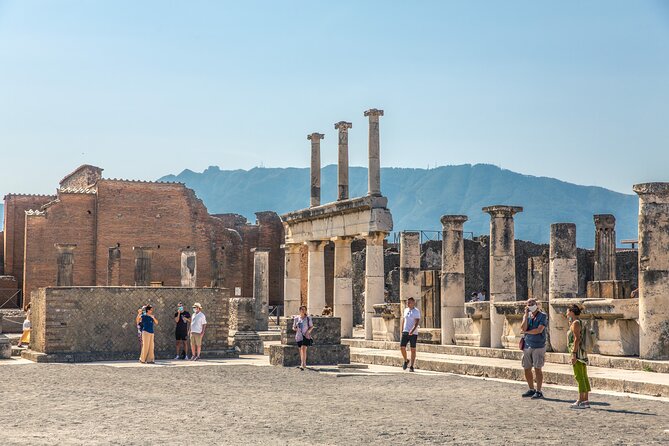
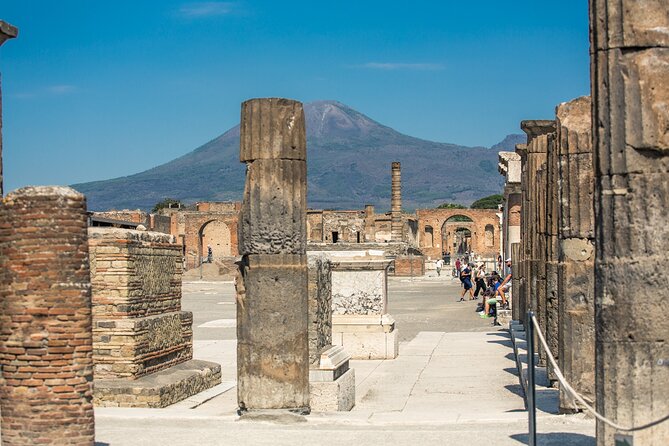
On the north side of the Forum is the Temple of Jupiter, with Mount Vesuvius rising behind it. The guide framing is key: when the colony was founded, the temple was radically renovated and became a Capitolium, with statues representing Jupiter, Juno, and Minerva. The structure isn’t just a landmark. It’s a statement of power and identity, and it helps you understand why the Romans built these spaces to be seen and used.
More Amalfi Coast days out:
- Sorrento: Exclusive Capri Boat Tour and Optional Blue Grotto
★ 4.8 · 3,170 reviews - Sorrento Farm and Food Experience including Olive Oil, Limoncello, Wine tasting
★ 5.0 · 2,524 reviews - Capri Blue Grotto Small-Group Boat Day Tour From Sorrento
★ 4.5 · 2,511 reviews - From Sorrento/Nerano: Amalfi and Positano Boat Tour
★ 4.6 · 2,440 reviews
Basilica and Macellum: business and food culture
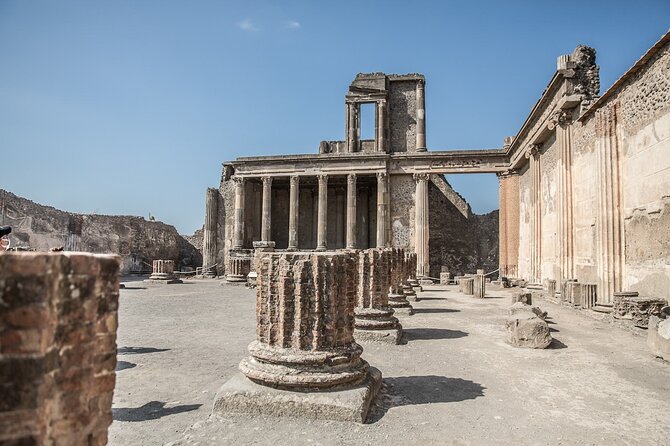
Next comes the Basilica, the large public building used for business and administration of justice. This is where you can start connecting the layout of the Forum to how a city ran. The Basilica is huge, and the scale helps you see why people needed that central indoor space for transactions.
Then you’ll move to the Macellum. It’s a market complex, built around a courtyard with areas for worship and space that likely supported commerce, including a counter area possibly for fish to be sold. If you like travel moments that feel real, this is a strong one. Markets are where social life becomes visible, and Pompeii’s preserved structure gives you a rare chance to picture that routine.
Via dell’Abbondanza, Stabian Baths, and the Lupanar
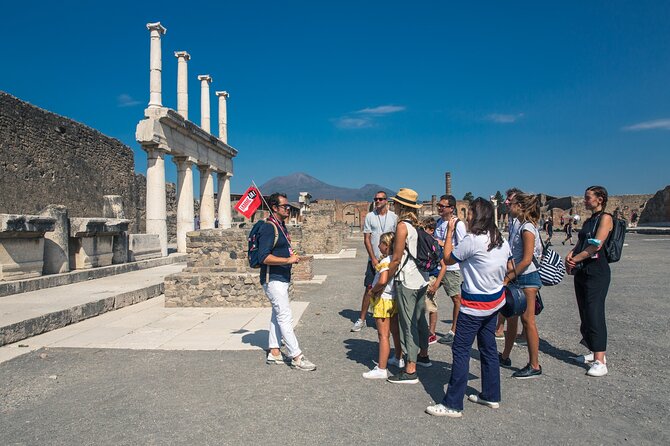
This is where the tour shifts from civic buildings to street life and personal routine. It’s also where you get variety, because Pompeii is not one uniform “ruin look.” You’re moving through different kinds of spaces.
Via dell’Abbondanza: the main street in your head
Via dell’Abbondanza was Pompeii’s main street, a decumanus maximus running east to west between major points of the city. You’re in the right place to imagine shops, workshops (officinae), cafés, snack-bars, and restaurants lining the road.
The smart thing about stopping here is that the street becomes a tool. When you stand on the route, you get oriented faster than if you jump straight to isolated sights. You start thinking, Where would people come from? Where would they pause? Where would the noise be?
Even a short stop is useful because your guide can point out how this street connected to the Forum and the gates, so the whole city plan makes more sense.
Stabian Baths: everyday life with real bodily rhythms
Behind the Temple of Jupiter are the Stabian Baths, dating to soon after the colony was founded by veterans by General Silla. The bathrooms in Pompeii are fascinating because they were part of daily hygiene and social time, not luxury theater.
You’ll see the idea of separate entrances for women and men, and the sequence of spaces inside. In the men’s section you have an apodyterium for dressing, then a tepidarium for medium temperature bathing, a frigidarium for cold, and a calidarium for hot baths. You also learn that parts were damaged during the earthquake of 62 AD.
If you want your visit to feel less like a museum checklist, baths are a good choice. They give your brain something physical to imagine, warm water and changing temperatures, conversations while people got cleaned up.
Lupanar: official brothel, blunt social reality
The Lupanar is the famous official brothel in Pompeii, tucked into a narrow side street near the heart of town. This is a world-renowned stop, and it’s not polite. The building is purpose-built and includes small rooms with built-in masonry beds. What makes it stick in your memory are the erotic frescoes above the doors, likely acting as a visual menu, plus the graffiti left behind by visitors.
This is also one of those moments where having a guide helps a lot. You’re looking at structures, but you need context to understand how the Romans viewed and marketed sex work, and how ordinary people left language behind in the form of scribbles.
If you have kids with you, this is the place to think ahead. Decide based on your family comfort level, not just on curiosity.
The big-ticket sights: House of the Faun, mosaics, and theater
Now you shift toward the spaces that show wealth, art, and Roman entertainment.
House of the Faun: elite home meets Alexander Mosaic
The House of the Faun occupies an entire city block and is one of the largest and most luxurious private residences in Pompeii. It’s named after a bronze statue of a dancing faun found in the atrium, and it’s famous for the Alexander Mosaic.
The mosaic depicts the battle between Alexander the Great and Darius III of Persia. It’s a powerful reminder that Pompeii’s elite were plugged into wider Mediterranean culture. They weren’t just building houses for shelter. They were collecting symbols, stories, and artistic prestige.
If you care about how people lived beyond public life, this stop is worth your time. Two peristyle gardens and intricate floor mosaics help you picture daily movement through light, courtyards, and decorative surfaces.
Basilica area and Teatro Grande
Back in the Forum zone, the tour also highlights the Basilica’s role in administration and justice. That’s useful reinforcement after the Temple of Jupiter and market stops. You can start mapping who did what and where, which makes the whole city feel more coherent.
Finally, you reach Teatro Grande, built on a hillside using the natural depression of the terrain to shape an impressive auditorium divided into sectors. It would have hosted tragedies from Greco-Roman traditions.
Theater is another anchor for your imagination. It gives you an emotional angle. You are not only thinking about commerce and bathing. You’re also thinking about performance, public gathering, and shared stories.
Pacing, photos, and how to make the most of limited time
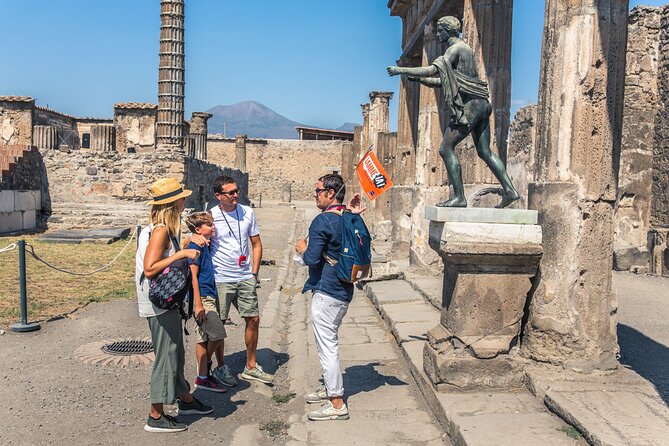
Pompeii rewards slow looking, but this tour is highlight-driven. You get about 2 hours on site total, then shorter time blocks at specific stops like Via dell’Abbondanza, Stabian Baths, the Lupanar, and Teatro Grande.
That means you should show up ready. If you want extra time for a bookstore visit or to return for a closer look, you’ll need to accept that the group schedule is doing the heavy lifting for you.
On the upside, the guide helps you avoid the most common problem at Pompeii: getting lost in the street network and forgetting what you already saw. In the guided format, you also get priority context at each stop, which is where most people gain real understanding.
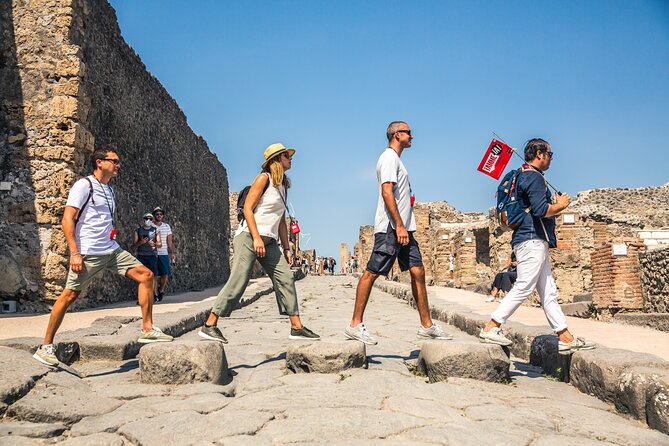
A practical tip: wear shoes you can handle on uneven stone. The terrain is part of the experience, and it can slow you down. Also bring water if you want it, since food and drinks are not included. You’ll likely want snacks for the ride back, even if the day is cooler than summer.
Price and value: is $90.70 a fair deal?
At $90.70 per person for about 5 hours, the price makes sense when you look at what you’re buying.
You’re getting:
- Skip-the-line access to Pompeii
- Round trip air-conditioned transportation from Sorrento
- An official guide plus headset support when your group is bigger
- Admission to the Pompeii archaeological site
For a top-tier site like Pompeii, skip-the-line entry alone can swing your day from rushed to focused. Then you add guided interpretation, which is the difference between seeing buildings and understanding why they mattered.
If you were planning to go on your own, you’d still need to solve transport from Sorrento, entry tickets, and route planning. This tour bundles those pieces into a smoother, lower-stress experience. The main tradeoff is flexibility. You get a structured highlights route, not total freedom.
One more point: this tour is often booked ahead, with an average booking lead time around 58 days. If Pompeii is a must-do for your trip, locking in your time slot sooner rather than later can help you avoid last-minute scramble.
Should you book this Pompeii tour from Sorrento?
Book it if you want:
- A guided route that helps Pompeii feel understandable fast
- Time savings from skip-the-line admission
- Comfortable transport and clear narration, with headphones if needed
- A “greatest hits” mix of Forum life, baths, a real street scene moment, elite homes, and the theater
Skip it or consider a different format if:
- You strongly need long solo time inside Pompeii, free from a set pace
- You struggle with lots of walking over uneven ancient ground
- You prefer to choose only a couple of areas and spend the rest of your time slowly roaming
My take: this is a solid value choice for a first Pompeii visit. You get the emotional impact of the ruins plus the practical context that makes them click, without turning the day into a logistics puzzle.
FAQ
How long is the Pompeii guided tour from Sorrento?
The tour lasts about 5 hours (approx.), including round trip transportation.
Where do I meet in Sorrento?
You meet at IAMME IA! – Gray Line Amalfi Coast, Piazza Torquato Tasso, 16, 80067 Sorrento NA, Italy.
Is Pompeii admission included?
Yes. Entry and admission to the Pompeii Archaeological Site are included.
Does the tour include skip-the-line access?
Yes. The tour includes skip-the-line access and a mobile ticket.
What language is the tour offered in?
The tour is offered in English.
Is transportation included?
Yes. You get round trip transportation by air-conditioned vehicle.
Are headphones provided?
Yes, headphones are included in Pompeii to hear the guide clearly for groups bigger than 10 passengers.
Is food included?
No. Food and drinks are not included.
Can I cancel and get a refund?
Yes, free cancellation is available. You can cancel up to 24 hours in advance for a full refund.
More Day Trips out of Sorrento
- Day Trip to Positano, Amalfi & Ravello from Sorrento
★ 4.5 · 2,371 reviews - Capri & Blue Grotto Semi Private Boat Day Trip from Sorrento
★ 5.0 · 2,053 reviews - From Sorrento: Capri Boat Tour with Blue Grotto Visit
★ 4.7 · 1,759 reviews - From Sorrento: Positano and Amalfi Boat Trip with Transfer
★ 4.9 · 1,598 reviews
Latest reviews around Sorrento
- Full-Day Private Capri Boat Tour★ 5.0 · 154 reviews
- Capri Boat Tour from Sorrento with Limoncello★ 5.0 · 170 reviews
- Amalfi Coast in Full Private Tour★ 5.0 · 132 reviews
- Tasting of 5 Wines with Typical Products in Sorrento★ 5.0 · 109 reviews
- The Three Tenors in Sorrento★ 5.0 · 205 reviews
- Private Transfer from Sorrento to Naples Airport or Station★ 4.5 · 121 reviews
- Sorrento Food & Wine Tour – ‘Taste of Sorrento’★ 5.0 · 108 reviews
- Walking Food Tour in Sorrento w/ Limoncello Factory Lemon Grove★ 4.5 · 821 reviews
Pompeii & Vesuvius Tours, compared.
Pompeii: Entry Ticket and Guided Tour with an Archaeologist
Read our review →
Pompeii: Entry Ticket with Optional Audio Guide
Read our review →
Pompeii: Small Group Tour with an Archaeologist
Read our review →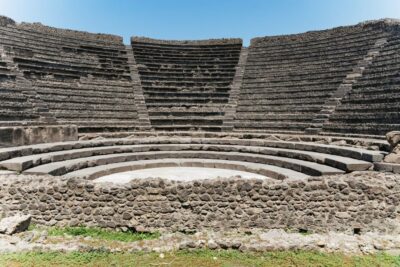
Pompeii Small Group Tour with an Archaeologist
Read our review →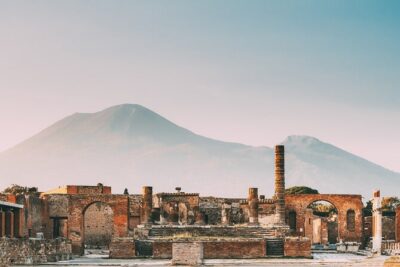
Pompeii, Amalfi Coast and Positano Day Trip from Rome
Read our review →Browse the lists this tour appears in