
Reviewed · POMPEII & VESUVIUS TOURS
Pompeii: Exclusive Tour with Archaeologist and Entry Tickets
A frozen city, explained by a working archaeologist. This Pompeii tour gets you in fast at Porta Marina and then uses a licensed guide to connect the ruins to real excavation work. I like how the 2 hours are paced for both first-timers and kids, and how guides like Livio and Antonio bring the details to life without turning it into a lecture. One thing to consider: it is a lot of walking on uneven ancient ground, and it is not suitable for wheelchair users or people with mobility impairments.
I also love the practical setup, the skip-the-line entry plus headsets so you do not have to strain to hear. And you get a smart mix of the famous spots and the places that usually get overlooked, like the Macellum area and the houses with standout art. The main drawback is simple: a 2-hour tour is a great introduction, but you will still want extra time after to see what caught your eye.
In This Review
- Key points that matter before you go
- Why Porta Marina and an archaeologist-led route is worth the time
- Skip-the-line entry, headsets, and the fast reality of a 2-hour visit
- Porta Marina Superiore: where your Pompeii story begins
- The Roman Forum and Basilica: politics, power, and public space
- Temples of Jupiter and Apollo: religion you could walk to
- Baths and the Forum Baths: social life, comfort, and routine
- Macellum market and the plaster casts: where the tragedy gets real
- The houses that show status: House of the Vettii and House of the Faun
- House of the Tragic Poet and the Lupanare: culture, entertainment, and uncomfortable truths
- Theatre District and the Large Theatre: performance and public gathering
- After the tour: what to do with your drop-off and how to extend the day
- What you can realistically expect from the guides (and why people love them)
- Price, group size, and who this tour suits best
- Should you book this Pompeii archaeologist tour?
- FAQ
- Where is the meeting point?
- How long is the tour?
- Is the entry ticket included, and do you skip the line?
- What languages are available?
- Is there a private option?
- What should you bring?
- Is it suitable for wheelchair users or people with mobility impairments?
Key points that matter before you go
- Skip-the-line entry with admission express tickets included, so you spend less time waiting and more time looking.
- Archaeologist and licensed guide who can answer tough questions about how Pompeii was found and studied.
- Headsets for clearer audio in a large, noisy site.
- A tight, high-impact route through the Forum, baths, markets, and major houses.
- Haunting plaster casts at the Macellum, paired with daily-life context so it lands harder than shock value.
- Small group or private slot, with drop-off that lets you keep exploring after the tour.
Why Porta Marina and an archaeologist-led route is worth the time
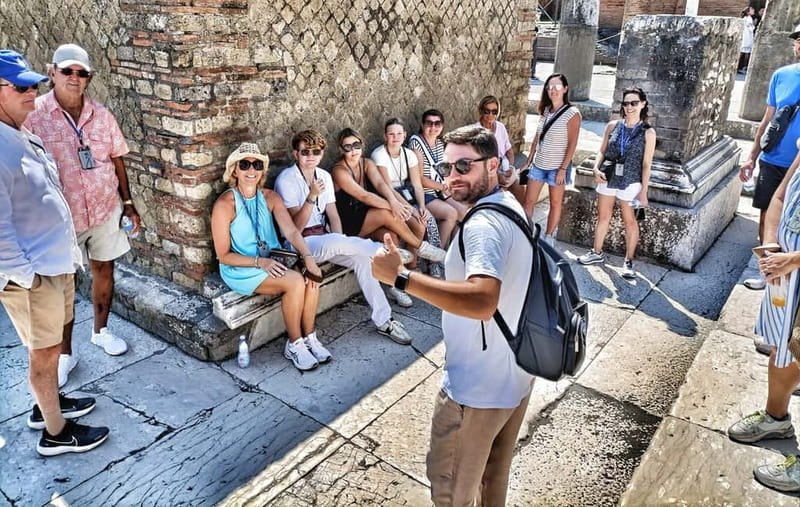
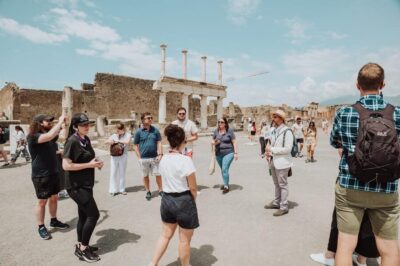
Pompeii is not hard to “see,” but it is hard to really understand without a guide. Starting at Porta Marina matters because it frames the ruins as a functioning city, not just a collection of postcard views. Your guide points you toward the flow of movement and civic life, and that makes even familiar places feel new.
The archaeologist angle is the difference between facts and meaning. In reviews, guides such as Raffaelle, Ivan, and Ricardo are praised for being quick to answer questions and for connecting the eruption story to what excavators actually uncovered. That kind of perspective helps you notice details you would otherwise skip, like how spaces were used day to day.
The tour also stays realistic about time. With a 2-hour window, you get a curated path through major highlights, plus a few less obvious corners where your group can slow down. If your goal is to “tick off” Pompeii, this is efficient. If your goal is to learn how Romans lived and why the city preserved so much, this works because the stops are placed in a logical order.
More Pompeii digs and Vesuvius climbs:
- Pompeii: Entry Ticket and Guided Tour with an Archaeologist
★ 4.8 · 19,459 reviews - Pompeii: Entry Ticket with Optional Audio Guide
★ 4.2 · 12,360 reviews - Pompeii: Small Group Tour with an Archaeologist
★ 4.8 · 12,264 reviews
Skip-the-line entry, headsets, and the fast reality of a 2-hour visit
Let’s talk about value, not just the price tag. At $50 per person for a 2-hour guided experience that includes skip-the-line entry and admission tickets, the economics make sense once you compare it to paying for tickets separately and losing time to queues. You also get the guide’s expertise, which is what helps you turn “I walked around” into “I understood what I saw.”
Two practical things help a lot on-site:
- Headsets, so you can hear explanations without drifting away.
- Small group size (and a private option), which makes it easier to move at a pace you can actually take in.
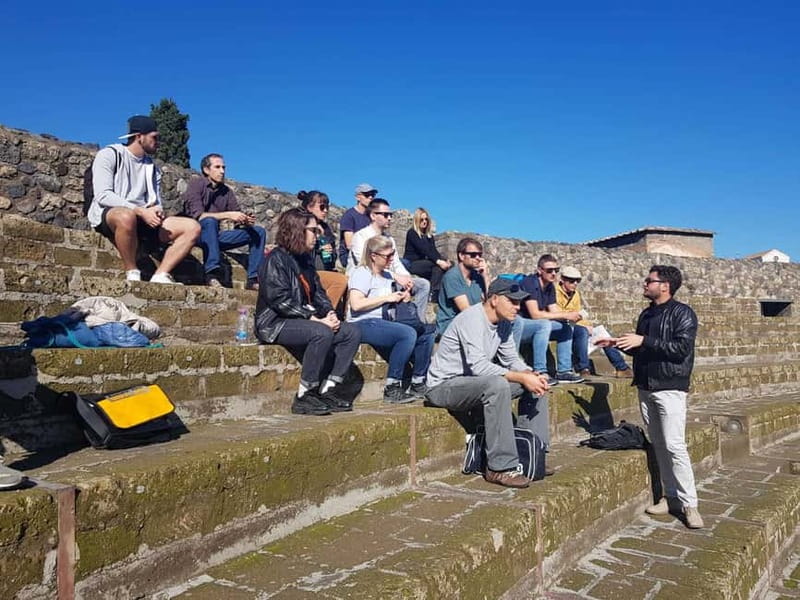
One more smart detail is what your guide does at the end. You are told what to prioritize after the tour with your group, which helps you avoid wandering randomly during the best part of your visit. Reviews mention that guides are friendly and organized, including help with practical moments like keeping the group steady in tricky conditions.
Main consideration: Pompeii’s ground is uneven and ancient. Comfortable shoes and water are not optional, and the tour is not suitable for wheelchair users or people with mobility impairments. Also, the whole experience depends on staying together, so if you like to roam silently for long stretches, you may feel a bit “held to the route” for the 2 hours.
Porta Marina Superiore: where your Pompeii story begins

You start outside the Pompeii ruins at Porta Marina entrance. If you are arriving by train, the meeting point is right in front of Pompei Scavi – Villa dei Misteri (Circumvesuviana). Your guide holds a sign for the tour, labeled Pompei VIP, which makes it easier to connect fast.
This first stop is more than a location pin. Porta Marina is a real Roman gate still standing, and it sets up the walk as an entry into the city’s rhythm. You are not just starting at a random point, you are starting at an edge where movement, trade, and daily routines would have started.
If you are using trains, do not assume there is one “Pompeii station.” One review specifically flagged that there are multiple train stations in the area, so check your route carefully before you commit your time.
The Roman Forum and Basilica: politics, power, and public space
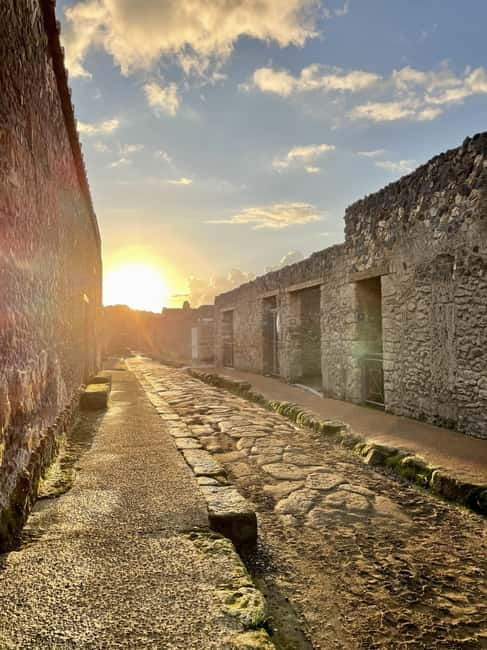
From the gate, the tour flows into Pompeii’s civic core, including the Basilica and the Foro Civile di Pompei (Forum). This is where you learn how Romans used public buildings for debate, business, and official life. Even if you have seen Roman forums before, the Pompeii setting is special because you see the spaces frozen close to how they were used.
Here’s what makes this stop work well with a guide: your archaeologist can explain not just what the buildings were, but how people would have moved through them. You also get help understanding the layout so the Forum does not become a blur of columns and stone.
A drawback at the Forum, as with most major sites in Pompeii: the area can feel crowded, depending on the time you go. The good news is the “skip the ticket line” part reduces stress early, and the headset setup helps you keep your place.
A few more Pompeii options to weigh
- Mount Vesuvius: Skip-the-Line Ticket and Smart Digital Guide
★ 4.2 · 2,780 reviews - From Naples: Pompeii Skip-the-Line Entry Ticket and Tour
★ 4.4 · 2,753 reviews - Pompeii: Skip-the-Line Entrance Ticket with Audio Guide
★ 4.0 · 2,509 reviews - Pompeii: Archaeological Park Tour with Ticket on request
★ 4.5 · 2,283 reviews
Temples of Jupiter and Apollo: religion you could walk to
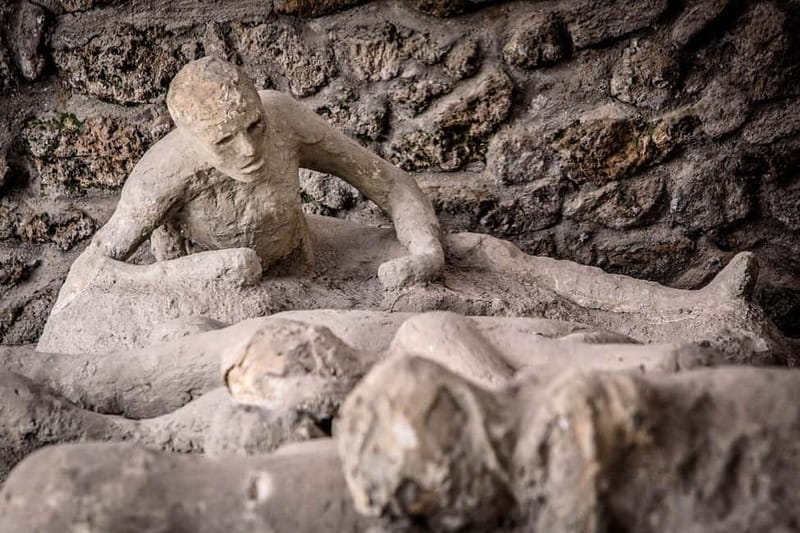
Next up are temples dedicated to major gods, including the Temple of Jupiter and the Temple of Apollo. This is the part of the tour that helps you connect Pompeii to the broader Roman world. You see that religion was not distant or abstract, it was woven into everyday geography.
With an expert guide, it is easier to spot how religious space functioned. You get context for why certain areas mattered to the city, and you learn what to look for visually so the temples do not feel like “another ruin.”
If you are traveling with kids, this segment often lands well because it is readable. Temples are simpler to understand than some of the more complex domestic art spaces later in the route, and a good guide can keep it engaging without losing accuracy.
Baths and the Forum Baths: social life, comfort, and routine
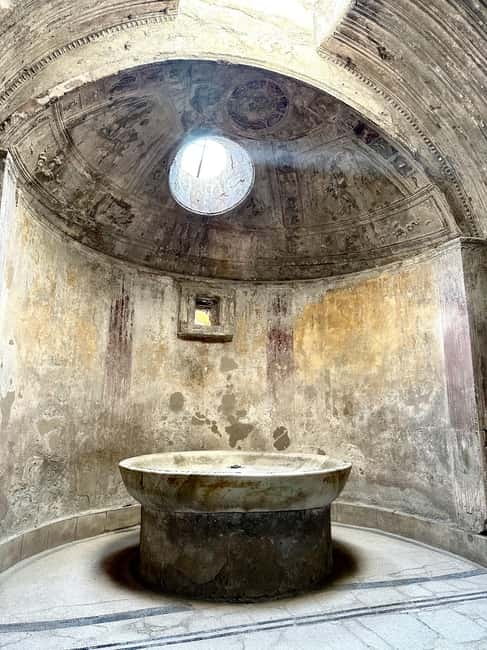
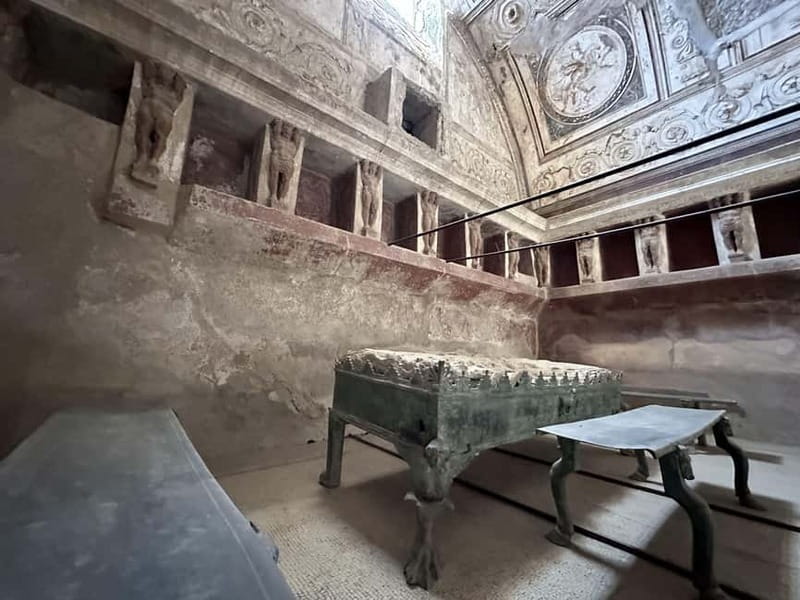
The tour includes the Forum Baths, which is a reminder that Pompeians cared about leisure and hygiene as part of city life. Baths were social spaces, not just practical infrastructure. Even when you only have a short window, this stop gives you a “Roman day in the life” perspective.
This is also where your archaeologist’s tone really matters. The best guides do not just say “people bathed,” they explain how baths fit into the city’s rhythm and what that meant socially. Reviews also highlight that guides keep a good pace and are patient with questions, which is helpful because baths can raise lots of curiosity fast.
Macellum market and the plaster casts: where the tragedy gets real
One of the tour’s most talked-about elements is the Macellum and the plaster casts connected to the victims. This stop is powerful because it shifts the story from a dramatic eruption to actual human moments, preserved in shocking detail.
What I like about this part of the experience is the way it is framed. If a guide can explain the eruption story and then point you to the market context, it helps you see Pompeii as a city full of ordinary routines right up to the end. That makes the plaster casts hit harder, but in a grounded way, not just through shock.
Practical consideration: this is an emotionally heavy stop. If you prefer a lighter tone, you can take a moment here, breathe, and keep moving when you are ready. The headset also helps, so you can stay present without getting stuck reading signage.
The houses that show status: House of the Vettii and House of the Faun
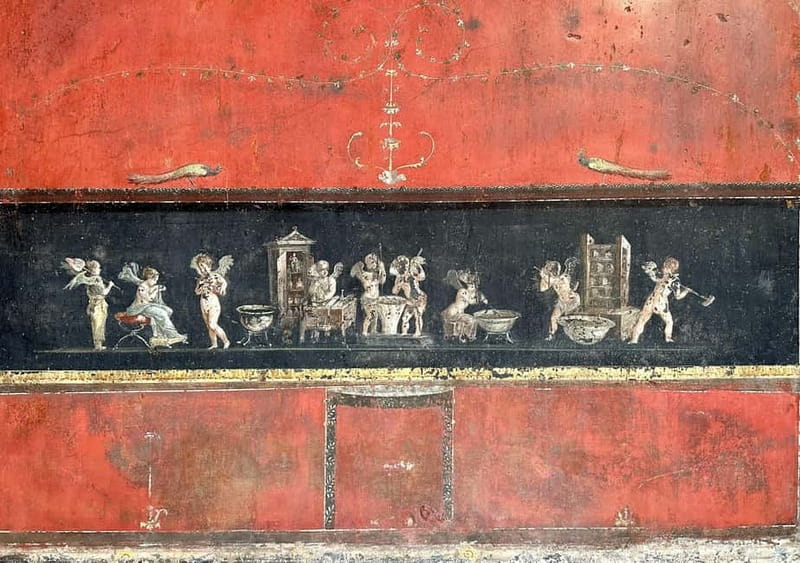
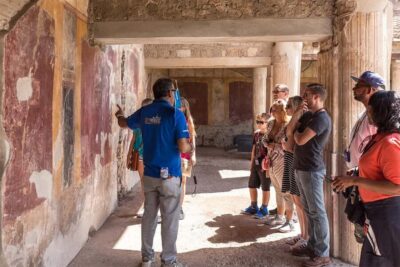
The heart of Pompeii’s art and household wealth shows up in the domestic stops. You visit key homes, including the House of the Vettii and the House of the Faun. These are the places where the tour’s promise about frescoes and mosaics becomes real. You get to see color and craftsmanship that look startlingly alive, especially after you have just been walking through civic buildings and markets.
Why this is valuable: domestic art was part of how Romans showed identity. A good guide helps you read that meaning. Reviews repeatedly praise guides for sharing details in a way you can understand quickly, including explanations that connect Pompeii to language and everyday culture. One review even mentioned a guide sharing etymology of common words, which shows how some guides use Pompeii as a doorway to broader learning.
Potential drawback: houses can be visually intense, and a 2-hour tour means you will not have time to “study” like a museum visit. Still, the benefit is that you leave with a sense of what matters, so you know what to look for later if you return on your own.
House of the Tragic Poet and the Lupanare: culture, entertainment, and uncomfortable truths
The itinerary also includes the House of the Tragic Poet and the Lupanare. The tragic poet house gives you another domestic snapshot, while the Lupanare is an example of how Pompeii did not hide the messy side of city life. It is not a comfortable topic, but it is part of what makes Pompeii historically valuable.
I like that this tour does not run from difficult reality. When a guide can explain context, you are less likely to treat these places like gossip. You learn how entertainment and social behavior existed in the city’s fabric.
If you are easily unsettled by heavy topics, approach the Lupanare with a “context first” mindset. Your guide’s job is to help you understand what you are seeing without sensationalizing it.
Theatre District and the Large Theatre: performance and public gathering
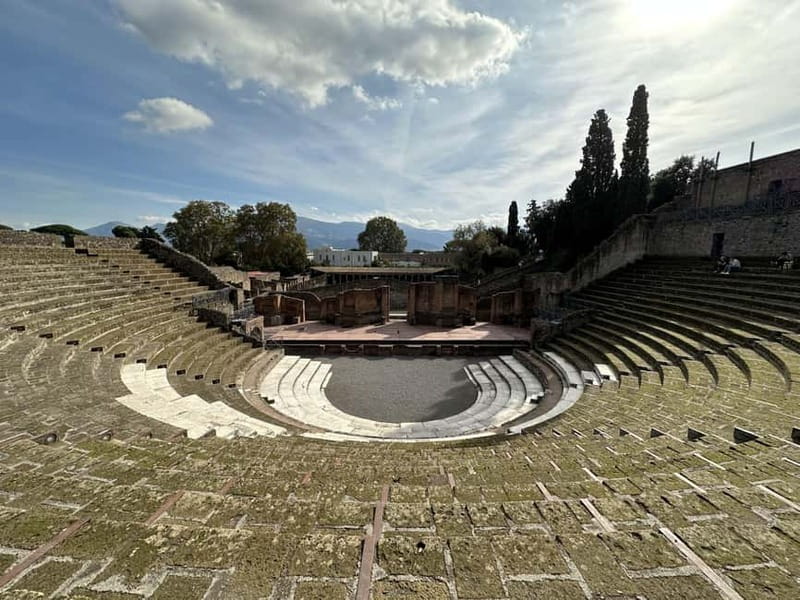
You end with the Theatre District and the Large Theatre. This stop reminds you that Pompeii’s people gathered for events, not just work and rituals. A theatre also helps you understand urban planning, because it is built for audiences and movement.
In reviews, guides are praised for being organized and for allowing photo opportunities. That matters here because theatre views can look similar from a distance, but up close you can start to see how the space is designed for crowds.
After the tour: what to do with your drop-off and how to extend the day
Your tour ends with drop-off locations at the Pompeii ruins area and also Piazza Esedra. That is a useful setup because it lets you keep exploring without starting over. After a tour like this, I recommend you use what you learned immediately. Go back to the places you found most interesting and slow down there, instead of trying to cover the entire park on autopilot.
One review mentioned staying in Pompeii for the rest of the day after the tour, which tells you something important. A 2-hour guided loop is a strong start, but it should also function like a map of what you care about.
If you have limited time, focus on one additional theme: art, markets, or architecture. The tour covers the big anchors, so your extra time can be targeted rather than frantic.
What you can realistically expect from the guides (and why people love them)
The overall rating is extremely high, and the reasons show up again and again in the guide feedback. People describe guides like Livio as funny, responsive, and professional. Others call out Antonio and Ricardo for being passionate and for making the details click. Ivan and Raffaelle are praised for helpful answers and an engaging style that works even with kids.
Across these comments, the consistent themes are:
- Clear explanations that connect ruins to real excavation findings
- A pace that keeps you moving without rushing you past everything
- Help with questions, including practical “wait, what am I looking at” moments
Also, the headset system is a genuine quality-of-life upgrade. Pompeii is busy. Even if your guide is great, audio problems can ruin attention. This tour tries to remove that friction.
Price, group size, and who this tour suits best
At $50 per person for an archaeologist-led, ticketed, skip-the-line experience, this is best thought of as a guided orientation plus a high-impact highlights route. You are paying for access, time saved, and expert interpretation. It is not a “see everything” pass, but that is not what you should want from a 2-hour slot anyway.
This tour is especially a good fit if:
- You want a first visit that actually teaches you something
- You do not want to waste time in queues at the gates
- You prefer small-group movement so you can hear and ask questions
- You want both famous buildings and meaningful context like the plaster casts and major homes
It may not be your best match if:
- You need lots of wheelchair-friendly routes or smoother surfaces (the tour says it is not suitable)
- You hate following a schedule at all, since the route includes specific stops
- You want a long, slow, museum-style experience
Should you book this Pompeii archaeologist tour?
Book it if you want Pompeii to make sense fast. The combination of skip-the-line entry, tickets included, headsets, and a real archaeologist-led route is a practical way to get the most meaning out of a short visit. I also like the mix of civic life, domestic art, and the Macellum plaster casts, because it tells a fuller story than only the big monuments.
Pass if you are looking for a fully independent day with no structure, or if mobility limits make uneven ground hard for you. If you can handle a couple hours of walking and you are willing to stay with the group, this is a strong value way to start your Pompeii chapter.
FAQ
Where is the meeting point?
You meet outside Pompeii’s Porta Marina entrance, in front of the train station Pompei Scavi – Villa dei Misteri (Circumvesuviana). Your guide holds a sign with the tour name Pompei VIP.
How long is the tour?
The duration is 2 hours.
Is the entry ticket included, and do you skip the line?
Yes. The experience includes skip-the-line entry tickets and Pompeii admission Express ticket.
What languages are available?
The live guide is available in English, Italian, French, and Spanish.
Is there a private option?
Yes. You can choose a small sharing group experience or a private slot.
What should you bring?
Bring a passport or ID card, comfortable shoes, and water.
Is it suitable for wheelchair users or people with mobility impairments?
No. The tour is not suitable for people with mobility impairments and wheelchair users.
Latest reviews around Pompeii
- Vesuvius National Park Skip-the-Line Ticket★ 3.8 · 221 reviews
- From Rome: Day Trip to Pompeii with Tickets★ 4.4 · 1,161 reviews
- From Rome: Sorrento & Pompeii Day Tour with Hotel Pickup★ 4.2 · 257 reviews
- Pompeii Ruins Private Tour with Optional Skip-the-Line Entry★ 4.9 · 732 reviews
- From Rome: Pompeii All-Inclusive Tour with Live Guide★ 4.3 · 261 reviews
- Pompeii and Herculaneum: Guided Tour with an Archaeologist★ 5.0 · 164 reviews
- Pompeii 3hours Villa of Mysteries tour with an Archaeologist★ 4.8 · 486 reviews
- From Sorrento: Pompeii and Vesuvius Tour★ 4.5 · 201 reviews
Pompeii & Vesuvius Tours, compared.
Pompeii: Entry Ticket and Guided Tour with an Archaeologist
Read our review →
Pompeii: Entry Ticket with Optional Audio Guide
Read our review →
Pompeii: Small Group Tour with an Archaeologist
Read our review →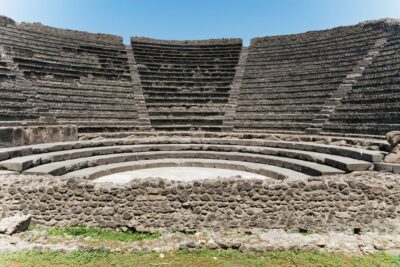
Pompeii Small Group Tour with an Archaeologist
Read our review →
Pompeii, Amalfi Coast and Positano Day Trip from Rome
Read our review →Browse the lists this tour appears in