
Reviewed · POMPEII & VESUVIUS TOURS
Pompeii and Mount Vesuvius Small Group Tour
Pompeii and Vesuvius in one day? Yes, please. This small group tour packs big impact into about eight hours, pairing an archaeologist-led Pompeii route with time on the crater trail and Bay of Naples views.
What I like most is the focus: you get a structured Pompeii visit with an archaeologist who can explain what you are actually seeing, including the layout and stories behind the stones. I also love the Vesuvius logistics, the licensed hiking guide, and the fact that the crater area can still offer that smoky, otherworldly look at the top.
The main drawback to plan for is that this is not a walk-and-linger kind of day. You will do an uphill hike in the open air, and weather can shrink visibility or switch the Vesuvius plan to Herculaneum.
In This Review
- Key things to know before you go
- Why This Pompeii and Vesuvius Combo Works in One Day
- Meet-Up Point, Small Group Size, and How the Day Flows
- Porta Marina Superiore and a Pompeii Archaeologist Guide You Can Actually Follow
- Pompeii Stops That Give You the Big Picture Fast
- Foro di Pompeya: the ancient main square
- Granaries of the Forum: food storage and public details
- House of Menander: luxury you can see in the layout
- Stabian Baths: the oldest thermal complex vibe
- Lupanar: Pompeii’s famous brothel stop
- House of the Faun: scale and impression
- Teatro Piccolo and Teatro Grande: what people watched
- Lunch and Food Planning During the Long Day
- Mount Vesuvius: National Park, Crater Edge, and the Real Climb
- When Vesuvius Is Closed: Herculaneum as the Weather Backup
- Guides Matter Here: Storytelling and Pacing That Make the Ruins Click
- Price and Tickets: Is This $119.77 a Good Deal?
- How Challenging Is the Vesuvius Hike and Who Should Skip It?
- If You Want the Best Day: My Booking Advice
- FAQ
- How long is the Pompeii and Mount Vesuvius small group tour?
- What is the meeting point for the tour?
- Do I need to buy Pompeii and Vesuvius tickets separately?
- What kind of guide will I have in Pompeii?
- How hard is the walk on Mount Vesuvius?
- What should I wear for the Vesuvius portion?
- Is food included?
- What happens if Vesuvius is closed due to weather?
- What languages is the tour offered in?
- Are young children allowed?
- Should You Book This Tour?
Key things to know before you go
Pompeii with an archaeologist guide: expect interpretation, not just a fast walkthrough.
A structured Pompeii route with standout stops: Forum, baths, brothel, and major houses.
Craterside views, plus real hiking: first part includes steps, and the last stretch is steep.
Small groups, capped sizes: Pompeii guide works up to 20, minivan ride is up to 14.
Weather plan exists: if Vesuvius is closed, Herculaneum can replace it.
Why This Pompeii and Vesuvius Combo Works in One Day
If your time is tight on the Amalfi Coast or Naples side, this format is smart. Pompeii is huge and easy to misread if you wander with only a map. Vesuvius, on the other hand, is weather and stamina dependent. Putting them together in one outing means you do the most important “why it all matters” parts without adding another full day.
The best part is that the tour doesn’t treat Vesuvius as just an optional photo stop. You get a guided climb to the crater edge, where you can understand the eruption in plain language, then you look out over the coastline and islands in the same trip.
In practical terms, you are trading slow travel for a focused day. For many people, that is the right trade.
More Pompeii digs and Vesuvius climbs:
- Pompeii: Entry Ticket and Guided Tour with an Archaeologist
★ 4.8 · 19,459 reviews - Pompeii: Entry Ticket with Optional Audio Guide
★ 4.2 · 12,360 reviews - Pompeii: Small Group Tour with an Archaeologist
★ 4.8 · 12,264 reviews
Meet-Up Point, Small Group Size, and How the Day Flows
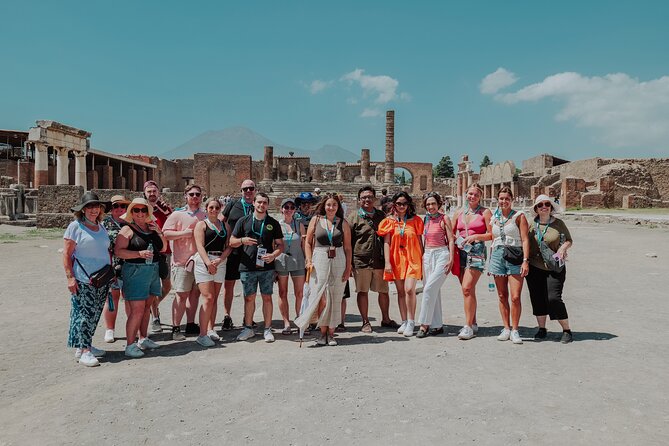
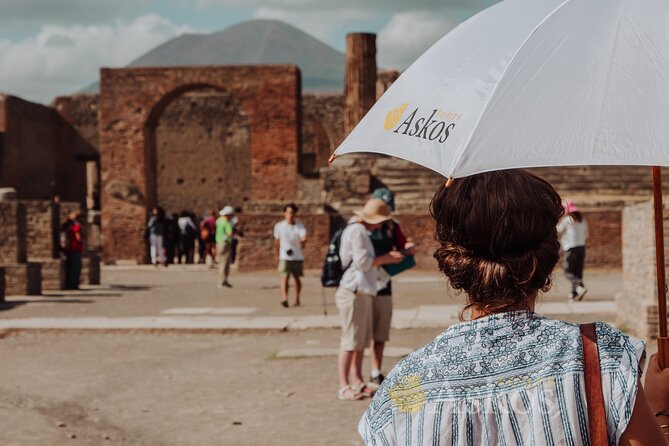
You meet near Pompeii at Via Villa dei Misteri, 2 (the tour ends back at the same meeting point). For the Pompeii ruins portion, your guide meets you at the main entrance called Porta Marina Superiore and holds an Askos Tours sign.
Group size is part of the value here. Pompeii is guided in a group of up to 20, but transportation for the day is in a modern minibus capped at 14. That usually translates to faster boarding, fewer transfers, and a better chance your guide can keep an eye on everyone.
Timing-wise, the day is built around two solid blocks: about 2 hours in Pompeii with an archaeologist, then about 2 hours around Vesuvius. In between, you move through shorter Pompeii stops that connect into a sensible route through the city.
Porta Marina Superiore and a Pompeii Archaeologist Guide You Can Actually Follow
Pompeii gets overwhelming fast. Streets branch, houses cluster, and walls look similar until someone gives you handles to grab. This tour gives you those handles.
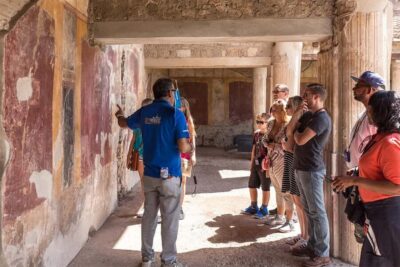
At the start, you enter with an archaeologist guide for a guided block of time at Pompeii ruins, and the site admission ticket for that guided segment is included. One of the most praised parts of this experience is that guides like Simona, Raffaela, and Anna have a way of turning the ruins into daily life. You do not just get dates. You get layout, culture, and the human details that make the place feel legible.
In real terms, that matters because Pompeii is not one attraction. It is a whole town, frozen in place. A good guide helps you notice patterns: where people walked, how neighborhoods were arranged, and why certain buildings mattered.
One more small practical point: the guide route is planned, so you do not spend your energy trying to figure out which street leads where. Your map becomes a support tool, not the main work.
Pompeii Stops That Give You the Big Picture Fast
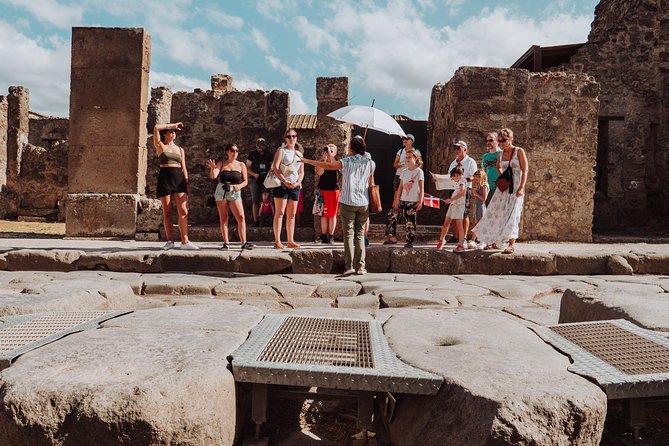
After the guided segment, you still get a sequence of stops that cover a lot of Pompeii’s “this is what daily life looked like” range. Here is what those different stops do for you, and what to watch for.
Nearby, and just as well reviewed:
- From Naples: Pompeii Ruins & Mount Vesuvius Day Tour
★ 4.3 · 11,459 reviews - From Rome: Pompeii, Amalfi Coast, and Sorrento Day Trip
★ 4.6 · 7,031 reviews - From Rome: Pompeii, Amalfi Coast and Positano Day Trip
★ 4.6 · 6,620 reviews - Pompeii Small Group Tour with an Archaeologist
★ 5.0 · 6,593 reviews
Foro di Pompeya: the ancient main square
You pause briefly at the Forum square. Even with limited time, this stop is useful because it anchors the city. You get a sense of where civic life happened, and it becomes easier to imagine the rest of Pompeii as connected neighborhoods.
Granaries of the Forum: food storage and public details
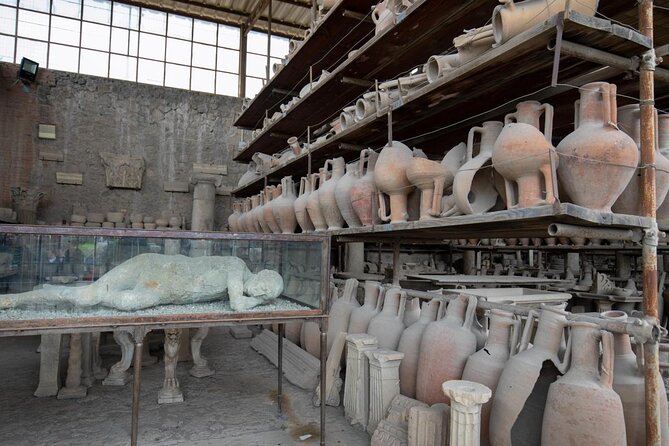
The granaries are more than a building. They help you understand the logistics of a large Roman city. Marble tables and fountain basins at house entrances, plus some of the plaster casts of victims and even items like a dog and a tree, make this stop emotionally heavy and visually specific. Plan for a moment here where you slow down mentally.
House of Menander: luxury you can see in the layout
This is one of the richest houses in Pompeii for architecture, decoration, and contents. In a short visit, a house like this gives you quick perspective on social class. It also helps you realize that Pompeii was not just streets and ruins, it was art, design, and private domestic life.
Stabian Baths: the oldest thermal complex vibe
The Stabian Baths take you into routine Roman leisure and health culture. These baths sit on a vast area, so even a short stop points you toward how big communal life was. It is also a visual reminder that Pompeii was a place people used, not just a city that existed before an eruption.
Lupanar: Pompeii’s famous brothel stop
This stop is one of the most talked-about pieces of Pompeii. You get a chance to see the Lupanar, the well known brothel site. It is not everyone’s favorite part emotionally, but it is historically important because it shows how even taboo or commercial spaces were part of the urban fabric.
House of the Faun: scale and impression
The House of the Faun is another “wow, this was big” stop. It helps you grasp how elite residences contrasted with everyday spaces. If you are the type who likes noticing thresholds, courtyards, and how rooms flow, you will probably enjoy this more than you expect.
Teatro Piccolo and Teatro Grande: what people watched
You get a look at the smaller theater, then a visit to Teatro Grande, the most important theater in Pompeii. Even briefly, theaters help you understand the social energy of the city. It is one of the easiest places to connect ruins to the idea of crowds and culture.
A heads up: because this route is time-managed, you will not see Pompeii at a leisurely pace. The upside is you will hit major stops without wasting half your day just locating them.
Lunch and Food Planning During the Long Day
Food is not included. So you will need your own plan between Pompeii and Vesuvius.
In practice, you usually have a break where you can grab something quickly. One helpful detail from people who have done this day is that there are cafes down the hill around the break window where you can pick up a sandwich and a drink. If you are prone to getting lightheaded when hiking, pack a snack or plan your lunch timing carefully.
Also, keep hydration in mind. Vesuvius is open air and can get hot. Bring water if you can, or buy it where possible during the stop times.
Mount Vesuvius: National Park, Crater Edge, and the Real Climb

This is the part where you earn the views.
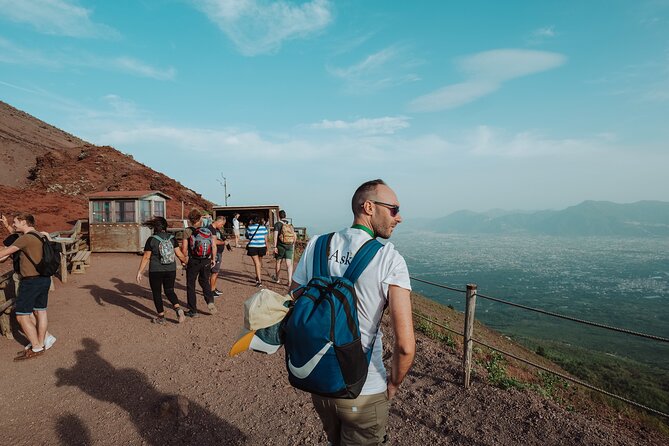
You transfer to Vesuvius and then get up onto the volcano to see the crater that still smokes slightly. The crater experience is about the view and the geology explanation, not just standing at a rail.
Two important walking realities are built into the route:
- The first part of reaching the crater includes step walking for about the first 30 minutes.
- The last 500 meters is a very steep uphill walk, so closed-in shoes are essential.
People who rated the tour highly often mention how guided pacing helps. Mario is a frequent guide name for the Vesuvius segment, and many describe him as friendly, patient, and focused on keeping people going at a comfortable rhythm. There is also mention of learning at the summit from a volcanologist or scientist in some cases, which adds a science layer beyond just the scenery.
Weather is the wild card. If it is foggy, windy, or rainy, you may get very limited visibility. Even then, the guide can still help you track what you are looking at, and you can still understand the eruption mechanism and what Vesuvius means for the region.
One thing I would do differently next time: bring a light layer even in warm months. Top conditions can turn windy and chilly.
When Vesuvius Is Closed: Herculaneum as the Weather Backup
This tour has a practical backup. If Vesuvius is not accessible due to force majeure, the tour includes a visit to Herculaneum instead.
That is not just a consolation prize. Herculaneum can feel more intimate because it is smaller and often better preserved in the areas visitors see. If you end up with limited visibility at the top, this replacement helps keep the day from feeling like a total loss.
In the best-case scenario, you get both Pompeii and Vesuvius. In the weather-challenged scenario, you still leave with a day that teaches you how the eruption affected multiple towns.
My advice: mentally commit to the idea that the volcano gets the final vote. When you do that, you enjoy the day more and get less hung up on what you cannot control.
Guides Matter Here: Storytelling and Pacing That Make the Ruins Click
What repeatedly comes through is that the tour stands or falls on guide quality, and this one has a strong track record.
On the Pompeii side, people highlight archaeologist guides like Teresa, Daniela, Guilia, Benedetto, and Sergio. In several accounts, guides are described as warm, engaging, and able to explain both everyday life and the more technical aspects of excavation. Some even mention guides actively involved in uncovering the site and sharing tips about where to eat and what to look for during breaks.
On the Vesuvius side, Mario shows up in many positive experiences. People praise him for being encouraging for those who struggle a bit, transparent about changing conditions, and attentive at breaks. Some accounts also mention that you learn about eruption mechanisms and the current state of Vesuvius, plus why the surrounding region faces ongoing risk.
There is also a small but meaningful bonus when logistics go smoothly. At least some departures include a drop near Napoli Centrale, which can save you time hopping back to public transit.
The takeaway: you are not buying only access to two sites. You are buying how the day makes sense.
Price and Tickets: Is This $119.77 a Good Deal?
At $119.77 per person, you are not paying for a long, slow luxury day. You are paying for a well-structured, guided hit of two major sites, with transport and included admissions for the key parts.
From the tour details, what is included is:
- Pompeii ruins guidance for about 2 hours by an archaeologist (small group, up to 20)
- Admission fees labeled as Pompei Express and Mount Vesuvius access fees
- Transportation by modern minibus
- Hiking licensed guide for Mount Vesuvius
One detail to watch closely is the Mount Vesuvius entry ticket amount listed as 11.00 euros. The tour description also says admission fees are included. That usually means the ticket is covered, but because both statements exist, I would confirm at booking or in your confirmation message whether you need to pay the 11 euros onsite.
Value-wise, this tour often makes sense if:
- You want guided Pompeii so you do not waste time guessing.
- You want someone managing the move to Vesuvius and the hike pace.
- You would rather pay for structure than figure out buses, lines, and timing yourself.
If you already know Pompeii well and want a free, self-paced day, this might feel too scheduled. But for most first-timers, the price-to-effort ratio is strong.
How Challenging Is the Vesuvius Hike and Who Should Skip It?
The tour is labeled for travelers with moderate physical fitness. It is also explicitly not recommended for mobility or walking impairments.
You should take the walking demands seriously:
- Step walking for about the first 30 minutes on the way to the crater area.
- A very steep uphill segment for the last 500 meters.
- A hiking climb in open air that can become hot, windy, or rainy depending on the day.
One review specifically called out difficulty in extreme heat around 100 degrees, and another mentioned that guides are sensitive to different fitness levels, which helps. Still, difficulty depends on your own body, not the group average.
Practical gear matters. Wear shoes with solid grip, not just comfy sneakers. Loose sand and steep sections can make footing slippery in summer conditions. Sunglasses and sunscreen are smart in warm months.
Children under 6 are not allowed.
If you are unsure, treat this as a hike, not a stroll. Decide based on your ability to walk uphill for a sustained stretch.
If You Want the Best Day: My Booking Advice
Here is how I would decide.
Book this tour if you want:
- A time-saving plan that hits Pompeii and Vesuvius in one day.
- Pompeii guidance that helps you connect stops like the Forum, baths, brothel, and theater spaces.
- A guided crater climb with clear explanations, and you do not mind that weather can change plans.
Consider a different approach if you:
- Want a slow, unstructured Pompeii day where you can linger for hours in one neighborhood.
- Have difficulty with steep uphill walking and step-heavy sections.
- Are sensitive to fog and rain, and you would feel disappointed if crater visibility is limited.
Most importantly, pack for two possibilities: sunshine with big views, or weather that forces the volcano portion to be shorter or swapped to Herculaneum. When you show up ready for both, this becomes one of those days you remember for the right reasons.
FAQ
How long is the Pompeii and Mount Vesuvius small group tour?
It runs about 8 hours in total.
What is the meeting point for the tour?
The tour starts at Via Villa dei Misteri, 2, 80045 Pompei NA, Italy, and it ends back at the same meeting point.
Do I need to buy Pompeii and Vesuvius tickets separately?
Admission fees for the Pompeii and Vesuvius parts are listed as included. The Mount Vesuvius entry ticket is also stated as 11.00 euros, so it is worth checking your confirmation to confirm what you personally need to pay.
What kind of guide will I have in Pompeii?
You get a 2-hour Pompeii guidance by an archaeologist, for a small group up to 20 people.
How hard is the walk on Mount Vesuvius?
The tour is for travelers with moderate physical fitness. The route includes step walking for the first 30 minutes and a steep uphill walk on the last 500 meters.
What should I wear for the Vesuvius portion?
Wear closed-in shoes with good traction. Closed-in shoes are specifically recommended, and good walking footwear helps for the steep and potentially slippery sections.
Is food included?
No. Food and drinks are not included.
What happens if Vesuvius is closed due to weather?
If Vesuvius is not accessible due to force majeure, the tour will include a visit to Herculaneum instead.
What languages is the tour offered in?
It is offered in English.
Are young children allowed?
Children under 6 years old are not allowed.
Should You Book This Tour?
If you are a first-timer trying to make sense of Pompeii and still want the crater views of Vesuvius, this is a strong pick. The real value is the guided Pompeii structure plus a guided hike that helps you manage a tough last stretch. Just be honest with yourself about walking uphill and steps, and accept that weather can change what you see at the top. If that sounds like your kind of day, book it.
Latest reviews around Pompeii
- Guided Day Tour of Pompeii and Herculaneum with Light Lunch★ 4.5 · 311 reviews
- Skip-the-Line Pompeii Guided Tour from Sorrento★ 4.5 · 722 reviews
- Pompeii Express Guided Tour by Train from Sorrento★ 4.5 · 770 reviews
- Pompeii & Mount Vesuvius Tour with Guided Visit, Tickets & Lunch★ 4.5 · 155 reviews
- Pompeii and Amalfi Coast Private Day Trip with Pick Up★ 5.0 · 312 reviews
- Mt Vesuvius and Pompeii Tour by Bus from Sorrento★ 4.5 · 170 reviews
- Pompeii Ruins Half-Day Tour from Sorrento with Guide★ 4.0 · 714 reviews
- Pompeii Guided Tour From Sorrento Coast★ 5.0 · 143 reviews
Pompeii & Vesuvius Tours, compared.
Pompeii: Entry Ticket and Guided Tour with an Archaeologist
Read our review →
Pompeii: Entry Ticket with Optional Audio Guide
Read our review →
Pompeii: Small Group Tour with an Archaeologist
Read our review →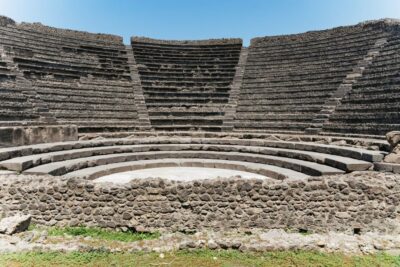
Pompeii Small Group Tour with an Archaeologist
Read our review →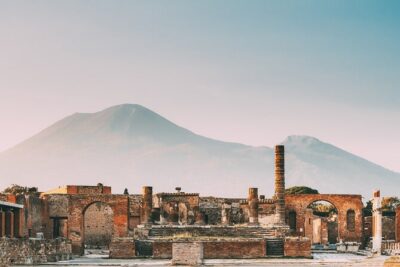
Pompeii, Amalfi Coast and Positano Day Trip from Rome
Read our review →Browse the lists this tour appears in