
Reviewed · POMPEII & VESUVIUS TOURS
Pompeii 3 Hours Walking Tour Led by an Archaeologist
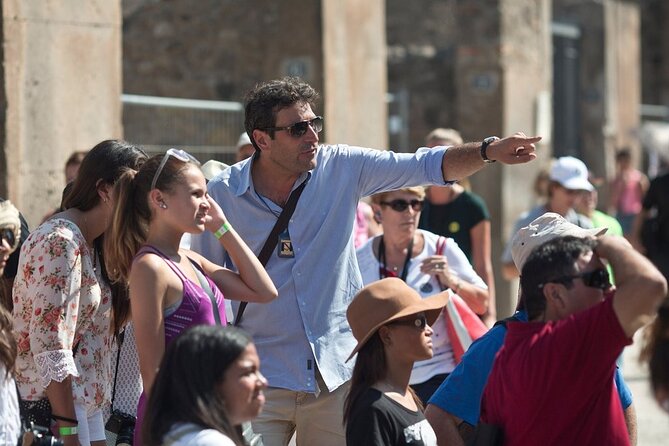
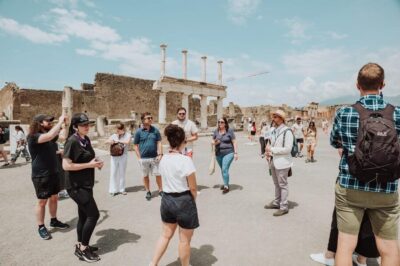
Pompeii turns from ruins into a story. On this private walking tour, you cover the big Roman highlights in about 3 hours, guided by a professional archaeologist who helps you see what life looked like before Vesuvius changed everything. I like that the pacing is efficient, so you spend less time wandering and more time really understanding what you are looking at.
My favorite part is the mix of famous monuments and the details that most people miss, like the casts and unusual objects tied to the eruption you can see at the granary area. One heads-up: the site is huge and mostly exposed, with minimal shade, so a hot day means you will feel it even with the breaks and stop times built in.
In This Review
- Key Things to Know Before You Go
- How a 3-Hour Archaeologist Walk Changes Pompeii
- Meeting at Porta Marina Superiore, Plus Luggage and First Steps
- Forum Sights: Basilica, Main Square, and the Granaries
- Main Street to Big Houses: Menander and the Faun’s World
- Oldest Baths First: Stabian Baths and Why They Matter
- Brothel Lane and the Lupanar: Pompeii’s Most Famous Edge
- Theaters: Teatro Piccolo and Teatro Grande
- Price, Tickets, and Whether It Feels Like Value
- Who This Tour Suits Best (and Who Should Reconsider)
- Quick Reality Check: What to Expect During the Walk
- Should You Book This Pompeii Archaeologist Tour?
- FAQ
- Where do I meet the guide for this Pompeii tour?
- Is the tour private or shared?
- What language is the tour offered in?
- Are admission tickets included?
- How long is the walk?
- Does the tour run in rain?
- Is there a place to store luggage before the tour?
- Is transportation to and from Pompeii included?
- What should I bring for Pompeii?
- Can children join the tour?
- What is the cancellation refund window?
Key Things to Know Before You Go
- Professional archaeologist guide in English, focused on what you can see in front of you
- Private group only, so it stays conversational instead of a race through the ruins
- Forum-to-baths-to-theaters flow that keeps you oriented and cuts backtracking
- Admission included on key stops, plus several major areas are free to enter on this route
- Free luggage storage near the meeting point, useful if you arrive with bags
- Rain or shine operation, so wear something practical for weather and heat
How a 3-Hour Archaeologist Walk Changes Pompeii
Pompeii is one of those places where first impressions can go either way. You might feel overwhelmed by how much there is, or you might miss the point and just see walls. A guide trained to read the site fixes that fast, because the tour is built around Roman spaces you can interpret: markets, baths, homes, and theaters.
I love that this tour is short enough to feel doable yet long enough to connect the dots. You will see public buildings, then move into everyday life spaces like bath complexes and a brothel, then end with the performing venues. That arc makes Pompeii feel less like a museum and more like a town where people actually lived, argued, bathed, shopped, flirted, and watched plays.
The private format matters too. When you can ask follow-up questions, you stop collecting random facts and start building a real picture of how the city worked. That is also why people consistently rank this experience highly for staying attentive throughout the walk.
More Pompeii digs and Vesuvius climbs:
- Pompeii: Entry Ticket and Guided Tour with an Archaeologist
★ 4.8 · 19,459 reviews - Pompeii: Entry Ticket with Optional Audio Guide
★ 4.2 · 12,360 reviews - Pompeii: Small Group Tour with an Archaeologist
★ 4.8 · 12,264 reviews
Meeting at Porta Marina Superiore, Plus Luggage and First Steps
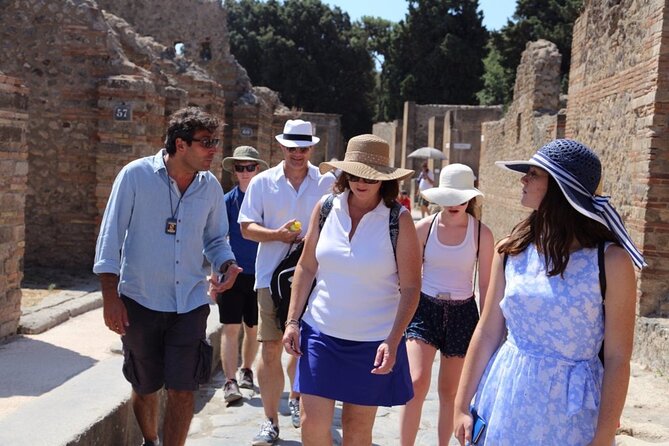
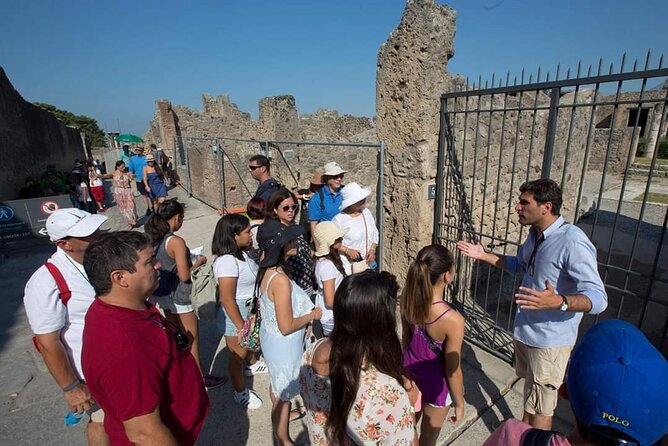
Your tour starts at the Pompeii Archaeological Park main entrance area called Porta Marina Superiore. The guide will hold a sign for Askos Tours, so you should find them quickly and get moving instead of doing a meet-and-greet scramble.
The meeting address is Via Villa dei Misteri, 1, 80045 Pompei NA, Italy, and the tour ends at the same place. Near the meeting point there is a safe luggage store for free, which is a lifesaver if you are traveling light or you arrived by train with bags and want to avoid lugging them through the ruins.
Come ready for real walking and sun. Pompeii’s main areas can be brutally bright, and the tour makes clear that there is very little shade. I strongly recommend sunscreen and a hat, and I would also bring water even if you think you will only be out for three hours.
Also good to know: the tour runs rain or shine. If weather changes, you still follow the same route and timing, so pack a light layer and footwear that handles slick ground.
Forum Sights: Basilica, Main Square, and the Granaries
The first cluster of stops is all about the city’s public face, and that is the smartest way to orient yourself. You begin at the park entrance, then head into areas where you can see how Pompeii worked socially and economically.
At the Basilica, you are looking at an open portico that sheltered merchants and other activity. Even if you are not an architecture person, it becomes clear why covered walkways mattered: people could meet, transact, and stay functional while the rest of the city did its thing under a mix of sun and weather. Think of it as a social and business hub that happened along a sheltered walkway.
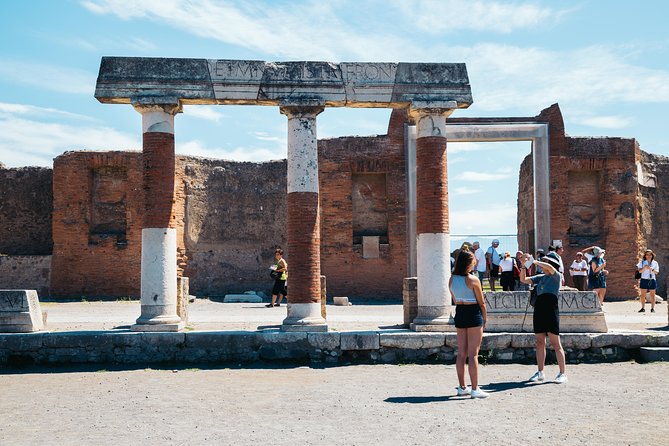
Next comes the Foro de Pompeya, the ancient main square. This is where you connect the dots between the political, commercial, and daily-life energy of the city. When you stand in these spaces, you can almost feel how movement would have flowed through the center.
Then you pass through the main street, which is where Pompeii can suddenly stop feeling like a list of landmarks and start feeling like an actual town. The street-level view helps you understand sightlines, entrances, and how people would have navigated the urban grid.
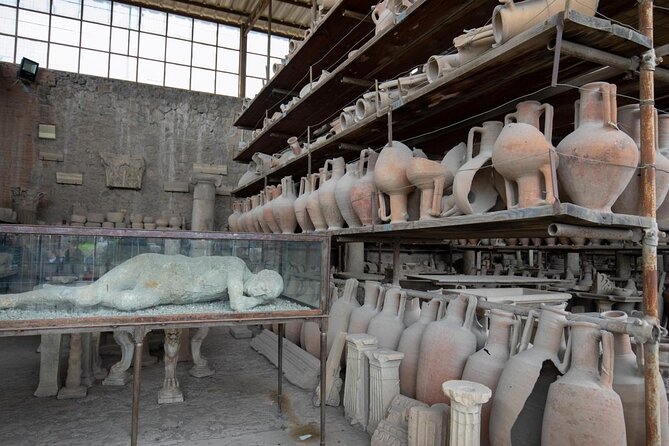
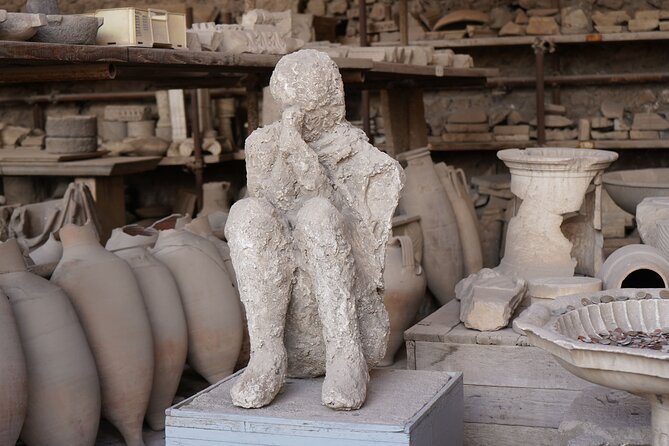
The standout stop here is the Granaries of the Forum. You get to see marble tables and baths for fountains that once decorated entrances of houses, plus you can view casts connected to the eruption victims, along with a cast of a dog and a tree. That combination is powerful because it ties everyday design details to the human cost of the disaster. It is not just tragedy, it is also proof of how carefully the city blended beauty, function, and routine.
One practical consideration: some of these areas are marked for shorter stop times, so if you want extra time to ask questions, tell your guide early. In a private format, you can usually focus longer on the pieces that catch your eye.
Main Street to Big Houses: Menander and the Faun’s World
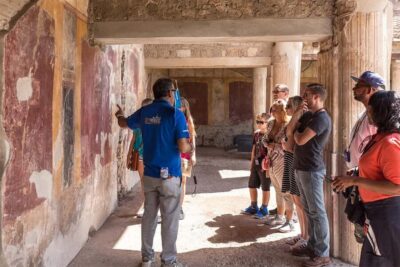
After the public core, the tour turns toward elite domestic life, where you can see how wealth translated into space and decoration. This is where Pompeii becomes more personal because you get closer to the idea of private rooms, courtyard life, and how homes were designed for status.
The House of Menander is one of the richest in Pompeii, known for architecture, decoration, and contents. Standing there helps you understand that Roman wealth was not just about having money, it was about how you displayed it through art, layout, and thoughtful details. Even with limited time, this stop is a reminder that Pompeii was a lived-in city with households that looked and operated in distinct ways.
Then you move to the House of the Faun, one of the largest and most impressive private residences. It is the kind of place that makes you realize scale matters. When a home is this big, you start imagining how many people were likely involved in its upkeep, cooking, cleaning, and day-to-day movement. The layout and scale do not just show taste, they show how labor and social order worked in Roman life.
These house stops can feel like a different Pompeii chapter than the Forum. If you love art and interiors, you will appreciate the domestic focus. If you only care about big public monuments, you might want to slow down and ask the guide how the household spaces connected to the wider city routine.
A few more Pompeii options to weigh
- Pompeii: Guided Walking Tour with Entrance Ticket
★ 4.3 · 1,423 reviews - Discover Pompeii: French Walking Tour of the Buried City
★ 4.8 · 253 reviews - From Salerno: Pompeii Guided Walking Tour
★ 4.5 · 235 reviews - Milan: Guided Walking Tour & Last Supper Visit with Ticket
★ 4.7 · 5,409 reviews
Oldest Baths First: Stabian Baths and Why They Matter
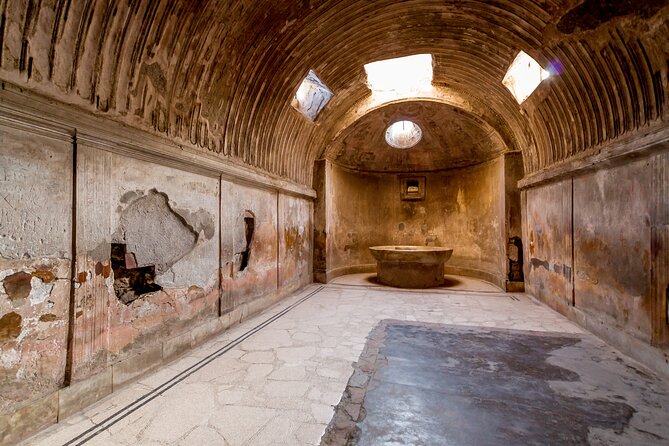
Next up: the Stabian Baths, also called Terme Stabiane. This sprawling complex occupies a large area and is described as the oldest thermal complex in the city. That detail alone gives this stop weight, because it is not just any bathhouse. It is part of the longer evolution of how Pompeii treated bathing as daily life, not a special event.
Bath culture in Roman cities was about more than hygiene. You should expect spaces that supported relaxation, social mixing, and movement through different temperatures and rooms. Even if your guide keeps it simple, the physical layout makes the point quickly: baths were built for routine, and that routine shaped the rhythm of the city.
One thing I like about putting the baths mid-tour is that it gives your brain a break from constant public-square intensity. It also helps you understand Pompeii as a place with leisure and community, not only marketplaces and politics.
Brothel Lane and the Lupanar: Pompeii’s Most Famous Edge
Then comes one of the most talked-about locations in Pompeii: the Lupanar, the famous brothel in the ruined Roman city. This stop can feel uncomfortable depending on your taste, but it also completes the picture of daily life. A city is not only its temples and theaters. It is also its human reality, including behavior that outsiders today might prefer to ignore.
If you go in with curiosity and a bit of emotional distance, this stop can actually be educational. The value is in how your guide frames the space, including how the city’s social ecosystem functioned and how people would have encountered places like this during their normal routines.
Because the brothel is well known, you might think you already know what you will see. The benefit of the archaeologist-led explanation is that it turns a single famous label into a clearer understanding of context and how the room layout worked in practice.
Theaters: Teatro Piccolo and Teatro Grande
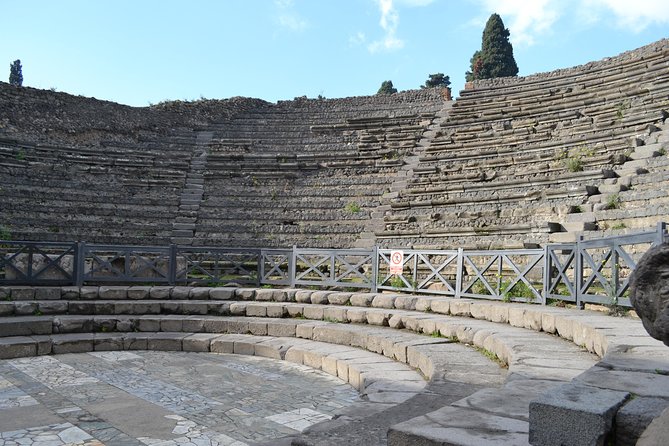
The tour ends with the performing arts, starting with the Odeon, also called Teatro Piccolo. This is the smaller theater, and your short stop helps you spot the venue’s role in Pompeii’s entertainment culture without the walk getting too heavy at the end.
Then you visit Teatro Grande, described as the most important theater in Pompeii. This is where Pompeii shows off its public gathering energy in a different way. Theaters were big social engines. People came to watch, talk, and share attention in the same space, and the scale of Teatro Grande helps you understand why it mattered.
Even with the shorter stop times, the theater sequence gives you a sense of closure. You start in the public core, move through life routines, and end where crowds gathered for stories and performances.
Price, Tickets, and Whether It Feels Like Value
At $256.99 per person for a private 3-hour walk, this is not a budget option. The big question is what you are paying for. In this case, you are paying for two things: a professional archaeologist guide, and admission ticket fees that are included as part of the experience.
Some stops include ticket admission, while others are free to enter on this route. That matters because it reduces the mental load of figuring out what costs extra. More importantly, the price reflects the real value of guided interpretation, not just entry into ruins.
Here is how I think about it in practical terms. If you are traveling as a pair or small group and you want Pompeii to feel coherent, the cost per person often feels easier to justify. If you are going solo and you are mostly fine wandering with a guidebook, you might find a less expensive format better suited.
Also, consider timing. This tour is typically booked about 50 days in advance, so it is smart to reserve early if your dates are fixed.
Who This Tour Suits Best (and Who Should Reconsider)
This is a strong choice if you:
- want a private, conversational experience rather than a large-group shuffle
- like archaeology explained in plain language tied to what you can actually see
- care about connecting Roman daily life to the physical spaces, from baths to theaters
- want to focus on major stops without spending your whole day figuring routes
It is especially appealing if you value high-caliber communication. The guides associated with this tour are repeatedly highlighted for being able to explain both the technical and human sides of Pompeii, with examples including Monica, described as having a PhD in archaeology; and Daniela Mantice, noted as an art historian who helped bring Pompeii to life through how painted surfaces and broader history fit together. Other named guides include Antonella, Nicoletta, Anna Sorrento, and Lia, each praised for clarity, humor, and staying engaged during the whole walk.
You might want a different option if:
- you are extremely heat-sensitive and hate exposure, since Pompeii has limited shade
- you want to spend most of the day roaming without structure
- you are looking for round-the-clock museum-style time in one building
Quick Reality Check: What to Expect During the Walk
This tour takes about three hours and is designed to keep you moving through a curated route. Many major sites in Pompeii are open-air, and even if each stop is short, your time adds up.
Expect the guide to point out what is functional and what is decorative. The Basilica portico is not just a pretty structure, it was built to shelter merchant activity. The granary pieces are not just objects, they include details like marble tables and water features and also connect to the eruption through casts. That is the key shift you are buying: interpretation.
And yes, it is private, so you can pace your questions. If you want extra context at the theaters or more time at the bath complex, it is the kind of situation where you can usually ask.
Should You Book This Pompeii Archaeologist Tour?
I would book it if you want Pompeii to click in a short time, and you want an archaeologist to translate what you see into daily-life meaning. The route hits the Forum core, elite homes, the Stabian Baths, the Lupanar, and the theaters, which is a pretty complete “town in one visit” view.
I would hold off only if heat exposure is a major problem for you, or if you prefer independent exploration with minimal guidance. Otherwise, the combination of private attention, an archaeologist-led approach, and included admission for key stops makes this feel like a practical way to get the most out of a three-hour window.
FAQ
Where do I meet the guide for this Pompeii tour?
You meet at Via Villa dei Misteri, 1, 80045 Pompei NA, Italy, and the meeting at the park is at the main entrance called Porta Marina Superiore. The guide will be holding a sign for Askos Tours.
Is the tour private or shared?
It is a private tour, and only your group participates.
What language is the tour offered in?
The tour is offered in English.
Are admission tickets included?
Admission ticket fees are included as part of the experience. Some stops specify admission ticket included, while several other stops are listed as admission ticket free.
How long is the walk?
It is approximately 3 hours.
Does the tour run in rain?
Yes, the tour takes place rain or shine.
Is there a place to store luggage before the tour?
Yes. Near the meeting place there is a safe luggage store for free.
Is transportation to and from Pompeii included?
No. Transportation to and from attractions is not included.
What should I bring for Pompeii?
Pompeii is vast and exposed with minimal shade, so sunscreen and a hat are recommended.
Can children join the tour?
Children must be accompanied by an adult.
What is the cancellation refund window?
You can cancel for free up to 24 hours in advance for a full refund. If you cancel less than 24 hours before the start time, the amount paid will not be refunded.
Latest reviews around Pompeii
- Guided Day Tour of Pompeii and Herculaneum with Light Lunch★ 4.5 · 311 reviews
- Skip-the-Line Pompeii Guided Tour from Sorrento★ 4.5 · 722 reviews
- Pompeii Express Guided Tour by Train from Sorrento★ 4.5 · 770 reviews
- Pompeii & Mount Vesuvius Tour with Guided Visit, Tickets & Lunch★ 4.5 · 155 reviews
- Pompeii and Amalfi Coast Private Day Trip with Pick Up★ 5.0 · 312 reviews
- Mt Vesuvius and Pompeii Tour by Bus from Sorrento★ 4.5 · 170 reviews
- Pompeii Ruins Half-Day Tour from Sorrento with Guide★ 4.0 · 714 reviews
- Pompeii Guided Tour From Sorrento Coast★ 5.0 · 143 reviews
Pompeii & Vesuvius Tours, compared.
Pompeii: Entry Ticket and Guided Tour with an Archaeologist
Read our review →
Pompeii: Entry Ticket with Optional Audio Guide
Read our review →
Pompeii: Small Group Tour with an Archaeologist
Read our review →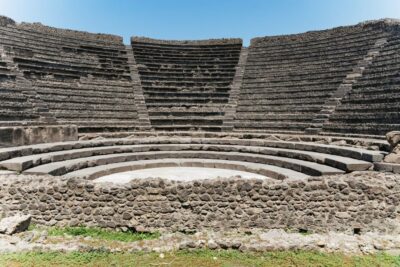
Pompeii Small Group Tour with an Archaeologist
Read our review →
Pompeii, Amalfi Coast and Positano Day Trip from Rome
Read our review →Browse the lists this tour appears in