
Reviewed · POMPEII & VESUVIUS TOURS
Pompeii 2h Small-Group Tour with Expert Archaeologist
Pompeii in two hours can actually work. This small-group tour strings together the big sights plus a few details most people miss, with an expert archaeologist guide and built-in time limits that keep you moving. I especially like the fast orientation it gives you, and the way stops connect into a picture of daily life. One possible drawback: because it is a highlights route, it will not replace wandering the whole site at your own pace.
You also get a smart mix of drama and routine, from theaters and grand houses to baths and the well-known brothel street. It is a family-friendly format too, and many guides clearly know how to keep younger visitors engaged, even when it is hot. If you come with a very specific archaeological wish list, ask questions during the tour so the guide can aim at what you care about.
In This Review
- Key things I’d bet you’ll notice on this tour
- Two hours in Pompeii: the best way to get oriented fast
- Small-group reality: what the size limit really means
- Meeting point at Piazza Esedra: start your visit with less stress
- Stop-by-stop Pompeii highlights (what you’ll see and how to read it)
- Stop 1: Archaeological Park of Pompeii
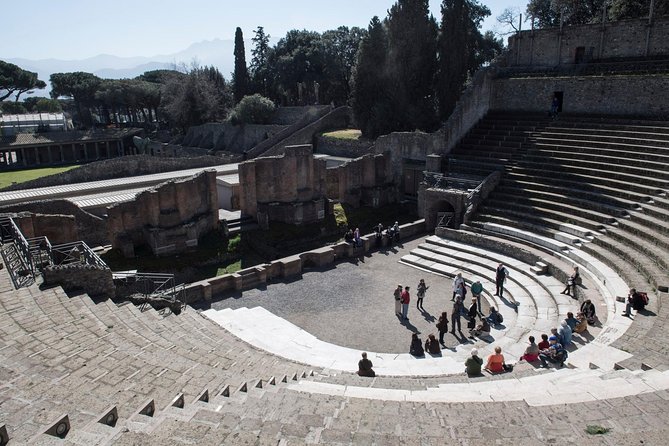
- Stop 2: Odeon, also called Teatro Piccolo
- Stop 3: Teatro Grande
- Stop 4: House of Menander
- Stop 5: Stabian Baths (Terme Stabiane)
- Stop 6: Lupanar
- Stop 6 (continued): Via dell’Abbondanza
- Stop 7: House of the Faun
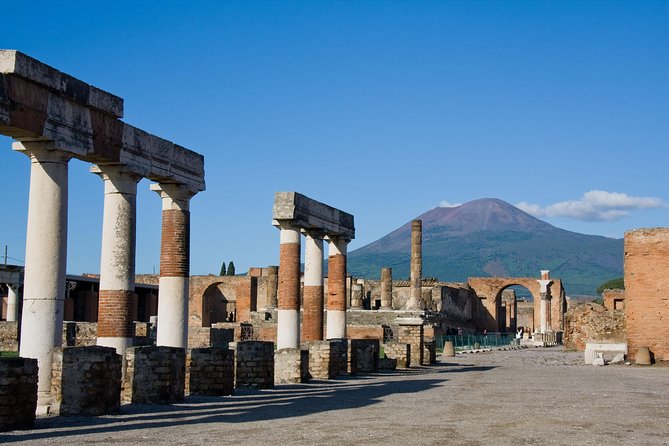
- Stop 8: Foro de Pompeya (main square)
- Stop 9: Basilica
- Why this exact mix is worth doing instead of walking on your own
- Heat, walking, and comfort tips that actually matter
- Family-friendly Pompeii: how to make it work for kids
- Price value at $32.67: what you are really paying for
- Tickets, free entry days, and the mobile ticket detail
- Should you book this 2-hour Pompeii highlight tour?
- FAQ
- How long is the Pompeii tour?
- What is the price per person?
- Is the tour guided in English?
- What is the meeting point?
- How big is the group?
- Are admission tickets included?
- Is this tour suitable for kids?
- Do I need a certain fitness level?
- Is Pompeii entrance ever free?
- What is the cancellation policy?
- Will I get a mobile ticket?
Key things I’d bet you’ll notice on this tour
- A tight highlights route that still hits the main neighborhoods you would otherwise bounce between randomly
- Theater focus (Odeon or Teatro Piccolo, then Teatro Grande) to understand how public life worked
- Homes with real decoration like the House of Menander and House of the Faun, not just outer walls
- Baths and everyday services at the Stabian Baths, which helps Pompeii feel lived-in
- High-interest stops like the Lupanar and Via dell’Abbondanza, explained in context
- Guides who adapt to the heat and pace, with shaded breaks when needed
Two hours in Pompeii: the best way to get oriented fast
Pompeii is huge, and your best plan depends on your time. If you only have a short window, a guided highlights route is one of the smartest ways to avoid the common mistake: walking for hours without really knowing what you’re looking at.
This tour is built for that problem. You get a guided pass through several of Pompeii’s signature areas, with timed stops that keep the day moving. At about two hours, it is ideal when you want Pompeii as part of a larger trip, or when you are trying to beat the heat and crowds with a clear structure.
I like that the route also includes places that explain social life, not just postcard scenery. You will see public space (forums and theaters), domestic space (major houses), and “infrastructure” space (baths and streets). In practice, that combination helps you build an understanding quickly, so later, when you roam on your own, you are not staring at ruins with zero context.
More Pompeii digs and Vesuvius climbs:
- Pompeii: Entry Ticket and Guided Tour with an Archaeologist
★ 4.8 · 19,459 reviews - Pompeii: Entry Ticket with Optional Audio Guide
★ 4.2 · 12,360 reviews - Pompeii: Small Group Tour with an Archaeologist
★ 4.8 · 12,264 reviews
Small-group reality: what the size limit really means
The tour is sold as a small-group experience, with a maximum of 30 people. That cap matters at Pompeii because the site can get crowded at the entrances, along main corridors, and near popular ruins.
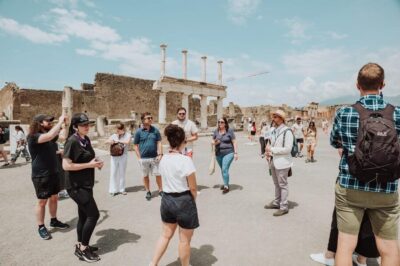
In a perfect world, your group feels manageable and your guide can steer conversation. In real life, you may still end up with headsets for clearer audio, especially if a group runs on the larger side. One important detail for you: your guide’s pacing can make or break the experience. Some guides have a naturally slow, patient rhythm, which helps if you have older family members or kids who need breaks.
For what it’s worth, guides mentioned in past tours include Luca, Gianluca, Roberta, Manuela, Patrizia, Mafilda, Clare, Enzo, and Barbara. That range usually means you can find a style that clicks, but also that delivery will vary. If you prefer more technical archaeology, ask direct questions early so the guide can lean into that.
Meeting point at Piazza Esedra: start your visit with less stress
The tour meets at Ristorante Suisse, Piazza Esedra 10/13, 80045 Pompei NA, Italy. It also says the meeting spot is near public transportation, which is a big help because Pompeii days often involve trains, buses, and timed tickets.
I recommend arriving a little early. Pompeii is one of those places where delays at the gates can snowball, and a good guide will want everyone together before you begin walking. Once you start, you will not have to worry about re-routing yourself between the major stops.
The good news: the tour ends back at the meeting point, so you do not need to plan a complicated endpoint. That matters if you are pairing Pompeii with Naples or with a train back.
Stop-by-stop Pompeii highlights (what you’ll see and how to read it)
This route moves through the most famous zones in a logical order, with a timed stop at each. Admission tickets for the listed stops are included, so you can focus on the ruins instead of paperwork.
Nearby, and just as well reviewed:
- From Naples: Pompeii Ruins & Mount Vesuvius Day Tour
★ 4.3 · 11,459 reviews - From Rome: Pompeii, Amalfi Coast, and Sorrento Day Trip
★ 4.6 · 7,031 reviews - From Rome: Pompeii, Amalfi Coast and Positano Day Trip
★ 4.6 · 6,620 reviews - Pompeii Small Group Tour with an Archaeologist
★ 5.0 · 6,593 reviews
Stop 1: Archaeological Park of Pompeii
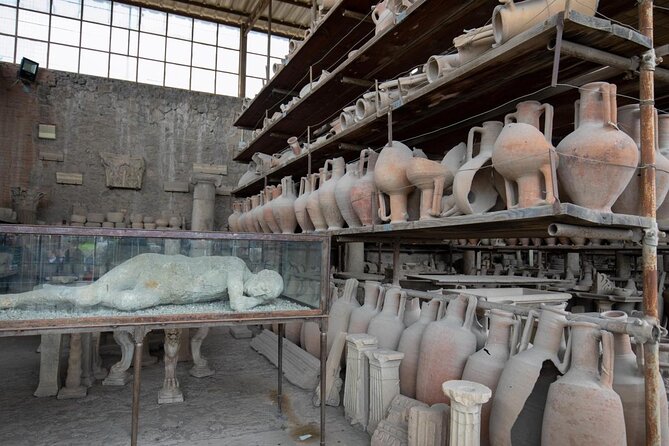
You start in the Archaeological Park of Pompeii, where you get the big picture fast. Pompeii was preserved by the eruption of Mount Vesuvius in 79 AD, and the guide uses that foundation to help you interpret what you see.
For this first stop, what to watch is how the guide frames the city. You’re not just looking at stone rooms. You are learning why frescoes survive, how streets and buildings were organized, and what daily life looked like when the city was still active. This is where you either get hooked or you feel lost. A good guide turns confusion into curiosity.
Stop 2: Odeon, also called Teatro Piccolo
Next comes the Odeon or Teatro Piccolo. This is a smaller theater setting, and it helps you see that Pompeii’s entertainment life was not only about the grand stage. Public performances and gatherings were part of how people spent time and built community.
A quick way to enjoy this stop more: look for the shape and design of the seating area and imagine the sound traveling through the space. Even without technical details, you can understand why theaters mattered.
Stop 3: Teatro Grande
Then you move to Teatro Grande, the main theater in Pompeii. This is one of the easiest places to grasp from a distance because the structure is so recognizable.
The guide’s job here is to connect theater design to social life. Who used these spaces? What kind of events would draw crowds? Why would it be important to build such a large public room in a city like this? When the explanation lands, you start seeing the ruins as an active machine, not a museum display.
Stop 4: House of Menander
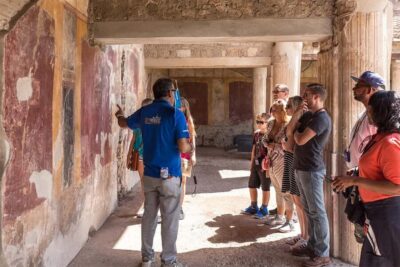
The House of Menander is a standout because it represents elite domestic wealth, not just a generic home. The tour highlights it for its architecture, decoration, and contents.
When you look at a rich house like this, focus on the contrast. Think about how someone’s public status would show up through wall paint, layout, and indoor spaces. Even if you cannot read every detail in the rooms, the guide can help you understand what parts were meant for display versus private life.
Stop 5: Stabian Baths (Terme Stabiane)
From grand homes, you shift into one of the most “everyday” parts of the city: the Stabian Baths. These baths occupy a vast area and are described as the oldest thermal complex in the city.
Baths are where Pompeii starts to feel practical. People came to wash, socialize, and spend time. The best guided explanation connects rooms and movement patterns, so you can picture how a visit would have unfolded.
If you are visiting in hot weather, this stop can also be psychologically helpful. It breaks up the day because you are shifting from street walking to ruins that feel more structured.
Stop 6: Lupanar
Next is the Lupanar, the most famous brothel in Pompeii. It is a high-interest stop because it is famous, but you get value when the guide places it in context rather than treating it like a scandal.
If you are bringing kids, this is the stop to think about. Even if your children are fine with learning, you will want to decide how much detail you feel comfortable with. The tour is billed as family-friendly, and many guides handle sensitive subjects thoughtfully, but you should not ignore this part of the itinerary.
Stop 6 (continued): Via dell’Abbondanza
You’ll also pass along Via dell’Abbondanza, one of the key streets that helps show how the city connected neighborhoods and foot traffic.
This stretch is useful because streets are often where you understand scale. You start to see how the city would flow, where shops might have sat, and why certain spots became central.
Stop 7: House of the Faun
The House of the Faun is one of the largest and most impressive private residences in Pompeii. On this tour, it is a quick but meaningful look at what elite space looked like.
Use this stop to compare to the House of Menander. One house can feel different in layout and decoration focus, and that comparison helps you understand that wealth was not one-size-fits-all.
Stop 8: Foro de Pompeya (main square)
Then you reach the main square, the Foro. This is where the guide’s explanation matters, because the forum is not just a big open space. It was a central hub for commerce, politics, and public life.
If you want Pompeii to feel real fast, this stop helps. You can almost picture the rhythm of people moving through it. Even a short look can do a lot when you have the guide pointing out the purpose of the space.
Stop 9: Basilica
Finally, you visit the Basilica. The description here is practical: an open portico that provided shelter to merchants and other activities.
The Basilica stop ties the route together. You have seen entertainment, elite houses, public services, and key streets. Now you see the built space that supported trade and movement. It’s the kind of ending that leaves you understanding how the city worked, not just what it looked like.
Why this exact mix is worth doing instead of walking on your own
Yes, you can navigate Pompeii on your own. English signage exists, and you can purchase self-guided audio. But a guided route like this often wins when time is limited.
Here’s what you gain with a guide:
- Connections between sites. The tour’s order helps you connect houses to forums, theaters to the idea of public life, and baths to everyday routines.
- Interpretation of details. You might notice fresco fragments or wall layouts, but you can miss what they meant. A guide turns visual hints into clear ideas.
- A pace that protects your energy. Pompeii punishes poor planning. You get a schedule, and you are not reinventing the day at every intersection.
One thing to keep in mind: not every guide will hit the same depth level. If you want heavy archaeology theory, choose your questions carefully. Ask what was daily life like, how rooms were used, and why certain decorations were important. That steers the tour toward the style you want.
Heat, walking, and comfort tips that actually matter
This tour is marked for moderate physical fitness. That usually means you should be ready for walking on uneven ground and standing for explanations at ruins.
The climate factor is huge at Pompeii. Guides in past tours have adapted by stopping in shaded areas to speak, which makes a big difference if you are visiting in summer. Use that as a reason to wear:
- breathable clothing,
- supportive walking shoes,
- a hat and sunscreen.
Also bring water. Two hours can still feel long in the sun, especially if you get stuck in crowds between stops. If you want an easier day, plan to start earlier in the day if your schedule allows, so your timing is not fighting peak heat.
Family-friendly Pompeii: how to make it work for kids
The tour is described as family-friendly, and many guides have a track record of keeping kids engaged. Past experiences include guides who were patient with children around 7 to 13 and who adjusted their teaching style to match different energy levels.
Still, Pompeii has stops that some families may find challenging. The Lupanar is the clearest example in this itinerary. If your kids are young or sensitive to adult topics, decide before you go how you want the guide to handle it, or whether you prefer to step back during that portion.
My practical suggestion: during the first minutes, tell your guide what ages you have and what boundaries you want. A good guide will treat that as normal information, not an inconvenience.
Price value at $32.67: what you are really paying for
At $32.67 per person, the price feels reasonable for two main reasons.
First, your admission is built into the experience. That reduces hassle, especially if you are timing tickets around the rest of your day. Second, you are paying for a guided route that saves time and turns a chaotic site into something you can actually process.
Could you do it cheaper on your own? Sure, if you have time to plan and stamina to roam. But if your real goal is: see the highlights, learn what you are seeing, and still have energy left afterward, this price point often makes sense.
Also note that this tour has been booked about 39 days in advance on average. That tells me it is a popular way to do Pompeii in a short time window, and you should not count on last-minute availability.
Tickets, free entry days, and the mobile ticket detail
You get a mobile ticket, which is convenient. The information also says Pompeii entrance ticket is free on the first Sunday of each month, and entry is free for people under 18 as long as they show valid ID on the day of the tour.
Because this specific experience includes admission tickets for the listed stops, you should confirm how free-entry rules apply to your booking. If you are eligible for free entry, the main win might be avoiding extra charges, but you will want clarity rather than assumptions.
Should you book this 2-hour Pompeii highlight tour?
Book it if:
- you have limited time and want a structured route through key Pompeii zones,
- you prefer learning with a guide instead of guessing what you are looking at,
- your group includes kids or mixed ages and you want pacing that can adapt,
- you want to finish with enough clarity to roam on your own after.
Consider skipping it if:
- you want to spend most of your day wandering quietly without timing,
- you are chasing deep technical archaeology and would rather spend longer with fewer stops,
- your family strongly prefers to avoid adult-themed content, since the itinerary includes the Lupanar.
If you fall in the middle, this tour is a solid start. Two hours is short, but it is enough time to get your bearings and leave with Pompeii feeling understandable.
FAQ
How long is the Pompeii tour?
The tour runs for about 2 hours.
What is the price per person?
The price is $32.67 per person.
Is the tour guided in English?
Yes, the tour is offered in English.
What is the meeting point?
It meets at Ristorante Suisse, Piazza Esedra, 10/13, 80045 Pompei NA, Italy.
How big is the group?
The tour can have a maximum of 30 travelers. It also applies a minimum number of 6 people.
Are admission tickets included?
Admission tickets are included for the listed stops during the tour.
Is this tour suitable for kids?
It is described as family-friendly, and it is offered in a way designed to keep kids engaged, but the route does include the Lupanar.
Do I need a certain fitness level?
You should have a moderate physical fitness level.
Is Pompeii entrance ever free?
Yes. The Pompeii entrance ticket is free on the first Sunday of each month, and it is free for people under 18 with valid ID.
What is the cancellation policy?
Free cancellation is available up to 24 hours in advance for a full refund.
Will I get a mobile ticket?
Yes, it includes a mobile ticket.
If you tell me the ages in your group and what time of day you plan to go, I can help you decide whether this route is the right fit for your day.
Latest reviews around Pompeii
- Guided Day Tour of Pompeii and Herculaneum with Light Lunch★ 4.5 · 311 reviews
- Skip-the-Line Pompeii Guided Tour from Sorrento★ 4.5 · 722 reviews
- Pompeii Express Guided Tour by Train from Sorrento★ 4.5 · 770 reviews
- Pompeii & Mount Vesuvius Tour with Guided Visit, Tickets & Lunch★ 4.5 · 155 reviews
- Pompeii and Amalfi Coast Private Day Trip with Pick Up★ 5.0 · 312 reviews
- Mt Vesuvius and Pompeii Tour by Bus from Sorrento★ 4.5 · 170 reviews
- Pompeii Ruins Half-Day Tour from Sorrento with Guide★ 4.0 · 714 reviews
- Pompeii Guided Tour From Sorrento Coast★ 5.0 · 143 reviews
Pompeii & Vesuvius Tours, compared.
Pompeii: Entry Ticket and Guided Tour with an Archaeologist
Read our review →
Pompeii: Entry Ticket with Optional Audio Guide
Read our review →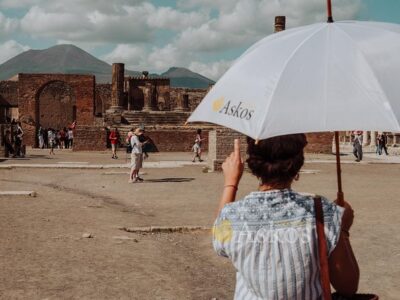
Pompeii: Small Group Tour with an Archaeologist
Read our review →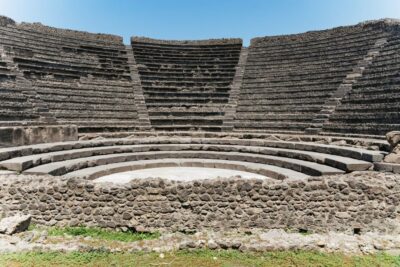
Pompeii Small Group Tour with an Archaeologist
Read our review →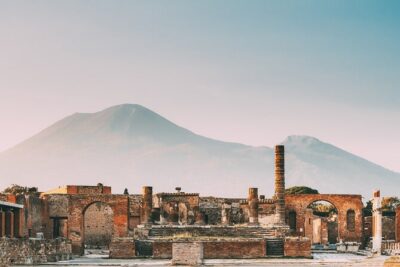
Pompeii, Amalfi Coast and Positano Day Trip from Rome
Read our review →Browse the lists this tour appears in