
Reviewed · POMPEII & VESUVIUS TOURS
Pompeii 2-hour Private Tour with an Archaeologist-Ticket included
A strange city under the sun. This 2-hour private Pompeii tour with an archaeologist keeps things tight, focused, and paced for real people, not a herd. You start at Porta Marina Superiore, follow the Forum area, then swing through the baths, brothel lane, top houses, and finish at Pompeii’s theaters.
I especially love the private setup. You get your own guide, in English, and the itinerary is built around the highlights without you getting lost in the crowd maze. I also like that admission to Pompeii is included, so you are not doing ticket math while you are standing in front of ancient stone.
One consideration: Pompeii is a lot of walking on uneven ground. The tour is marked for a moderate fitness level, and you will want comfortable shoes, since the route includes multiple stops packed into about two hours.
In This Review
- Key takeaways before you go
- A 2-hour Pompeii route that works in real life
- Meeting at Via Villa dei Misteri, entering at Porta Marina Superiore
- Stop-by-stop: how each Pompeii highlight tells a bigger story
- Basilica: an open portico for merchants and daily action
- Forum square moments: the main square of Pompeii
- Granaries of the Forum: marble tables, fountain baths, and eerie casts
- House of Menander: luxury you can actually see in the details
- Stabian Baths (Terme Stabiane): Pompeii’s older thermal complex
- Lupanar: the famous brothel, explained as a city space
- House of the Faun: one of the largest private residences
- The theaters: Teatro Piccolo and Teatro Grande
- Why the guide is the real value: PhD-level storytelling in plain language
- Price and value: $214.75 per person with admission handled
- Who should book this Pompeii private tour
- Should you book? My practical take
- FAQ
- Is Pompeii entry included in this private tour?
- How long is the Pompeii private tour?
- Where do I meet the guide?
- Where does the tour end?
- What language is the tour offered in?
- Does the tour run in bad weather?
- What should I wear or bring for the tour?
- Is lunch included?
- Is the tour private, or will I be with other groups?
- What is the cancellation policy?
Key takeaways before you go
- Private, English-guided pacing that helps you slow down at the best parts instead of sprinting to the next photo line.
- Tickets included to the Archaeological Park, so your entry is handled as part of the experience.
- A stop-by-stop route that hits the Forum, Stabian Baths, Lupanar, major houses, and Pompeii’s biggest theater.
- A sign-based meeting at Porta Marina Superiore (Askos Tours), which keeps logistics simple.
- Guides with real excavation credibility show up in the reviews, including PhD archaeologists like Silvia and Alessandra.
A 2-hour Pompeii route that works in real life
Pompeii is huge, and most people arrive with big dreams and limited time. This tour is built for a two-hour window, which means you get a smart route through the most meaningful zones without turning your day into a marathon. It is not trying to cover everything. It is trying to help you see the city clearly.
The private format matters more than you might think. With only your group, you can ask questions as they come up, pause when something catches your eye, and move at a pace that feels comfortable. I like how reviews reflect that guides keep you from feeling rushed, even when arrival timing gets messy. For example, Giovanni is praised for staying patient and giving clear directions.
Also, because the tour operates in all weather, you are not stuck thinking Pompeii equals sunshine only. Wear what keeps you steady, not what looks best in photos. Comfortable shoes are recommended for a reason, and the site has slopes and uneven surfaces.
More Pompeii digs and Vesuvius climbs:
- Pompeii: Entry Ticket and Guided Tour with an Archaeologist
★ 4.8 · 19,459 reviews - Pompeii: Entry Ticket with Optional Audio Guide
★ 4.2 · 12,360 reviews - Pompeii: Small Group Tour with an Archaeologist
★ 4.8 · 12,264 reviews
Meeting at Via Villa dei Misteri, entering at Porta Marina Superiore
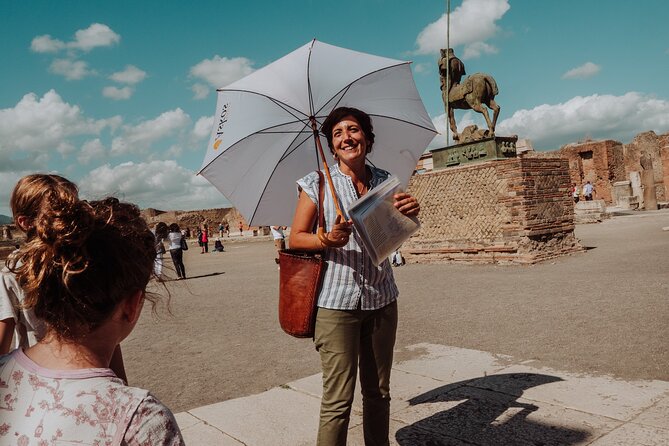
Logistics can make or break a first visit. Here, the meeting points are clear. You start at Via Villa dei Misteri, 2, 80045 Pompei NA, and you meet your guide at the main entrance of the archaeological site called Porta Marina Superiore. The guide holds a sign with the company name Askos Tours, which is a simple way to avoid wandering around looking for the right person.
The tour ends at Piazza Esedra, still in Pompeii’s main area. Your guide will help you with directions back to your accommodation or to the nearest train station, so you are not left to figure out the last mile alone. That kind of handoff is especially useful if you are doing Pompeii as a day trip.
One more practical detail: the tour is near public transportation and does not include hotel pickup or drop-off. So, plan on getting yourself to the start area first. The upside is that you are not wasting half your tour time stuck in transit.
Stop-by-stop: how each Pompeii highlight tells a bigger story
This tour is timed with short stops that keep momentum. You will likely spend about 10 to 15 minutes at many points, plus some time walking the main street corridor between them. That structure is great for first-timers, because you get context, what to look for, and why it matters, without burning your brain on one single ruin too long.
Basilica: an open portico for merchants and daily action
You begin with a stop at the Basilica, described as an open portico that offered shelter to merchants and other activities. The value here is that your guide is not just naming a building. They help you picture how the space worked in everyday life, like it was a covered area where trade and movement happened.
In a place where many buildings are now roofless, this kind of explanation is a big deal. It turns stone into routine. And routine is what makes Pompeii feel like a real city, not just a museum of walls.
A few more Pompeii options to weigh
- Mount Vesuvius: Skip-the-Line Ticket and Smart Digital Guide
★ 4.2 · 2,780 reviews - From Naples: Pompeii Skip-the-Line Entry Ticket and Tour
★ 4.4 · 2,753 reviews - Pompeii: Skip-the-Line Entrance Ticket with Audio Guide
★ 4.0 · 2,509 reviews - Pompeii: Archaeological Park Tour with Ticket on request
★ 4.5 · 2,283 reviews
Forum square moments: the main square of Pompeii
Next up is the Foro de Pompeya, the ancient main square. This is one of those spots where your brain goes, Okay, where was everyone going? The guide’s job is to help you understand the layout and the role of the square in public life.
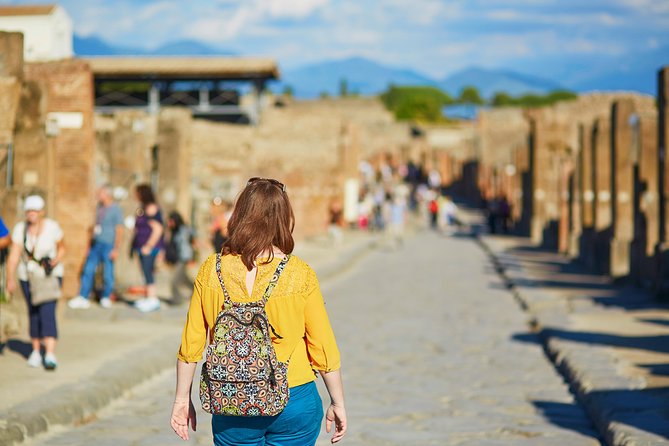
Then you walk through Pompeii’s main street, which is where the site starts to feel like a lived-in network rather than a set of disconnected stops. If you have ever felt Pompeii is too “fragmented” when you self-guide, this route helps stitch the pieces together.
Granaries of the Forum: marble tables, fountain baths, and eerie casts
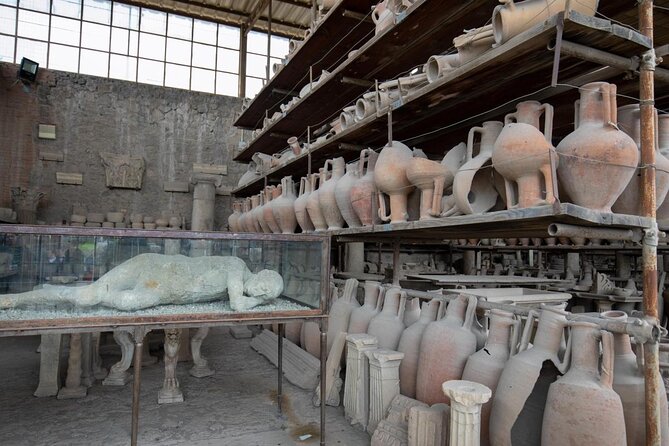
The Granaries of the Forum bring you into a part of Pompeii that feels practical, then suddenly unsettling. You are shown marble tables and baths for fountains that once adorned house entrances, plus casts of victims of the eruption. The tour description also notes a cast of a dog and a tree, which is a striking reminder that the tragedy reached beyond human lives.
This stop works best when you slow down a bit. The marble details and architectural bits are the easy part. The casts are what linger. A good guide makes sure you do not rush past the emotional weight, while still explaining the site’s meaning and what you are looking at.
House of Menander: luxury you can actually see in the details
The House of Menander is one of Pompeii’s richest homes, with a focus on architecture, decoration, and contents. This is where your perspective changes from public spaces to private life.
Even with limited time, a strong guide helps you notice the difference between impressive and important. Menander’s house is described as magnificent in multiple ways, and you will likely spend enough time here to understand why people singled out these homes as symbols of wealth and status.
Stabian Baths (Terme Stabiane): Pompeii’s older thermal complex
The Stabian Baths cover a vast area and are described as the oldest thermal complex in the city. Baths were not just for bathing. They were social hubs, and they show how daily routines were built around public spaces.
The “oldest” detail is useful because it gives you a scale for how long bath culture was part of Pompeii’s rhythm. If you like thinking about how cities function, this stop is a highlight for you. It also helps balance the heavier sections, like the casts in the granaries.
Lupanar: the famous brothel, explained as a city space
The Lupanar is listed as the most famous brothel in the ruined Roman city of Pompeii. This can be a sensitive topic, but it also connects directly to urban life. The key is how it is framed: as a building with a function inside a city, not just as shock value.
Your guide should help you look at it like architecture and layout, then connect it to what it meant in the social world of the time. This is one of the stops where a guide’s approach makes the difference between “I saw it” and “I understood it.”
In reviews, guides like Diego and Luca are praised for bringing context that makes Pompeii feel alive. That sort of framing matters here more than you might expect.
House of the Faun: one of the largest private residences
The House of the Faun is described as one of Pompeii’s largest and most impressive private residences. This stop is about scale and what that scale implies: wealth, influence, and household life.
If you enjoy seeing how the wealthy lived, this is a great match. It is also an important counterpoint to the public buildings you have seen. After the Forum, baths, and brothel lane, the house stop helps you understand Pompeii as both public theater and private world.
The theaters: Teatro Piccolo and Teatro Grande
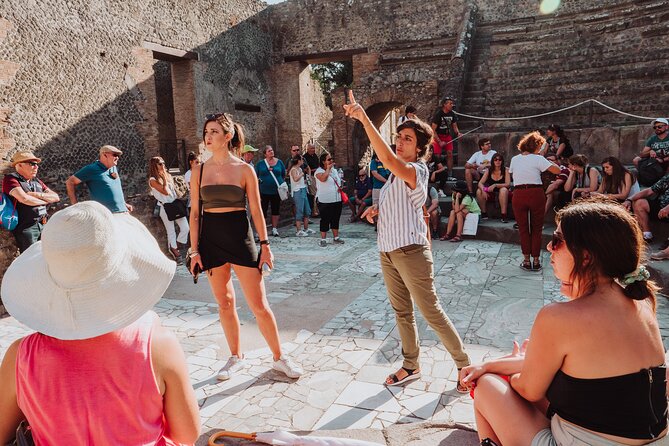
The route includes a quick look at the Teatro Piccolo, then a visit to Teatro Grande, described as Pompeii’s most important theater. Even if you only get short time here, theaters are powerful because they show what a city did for entertainment and public gatherings.
Teatro Grande is the one you remember. The stop is short, about 10 minutes, but it is timed as a capstone to your walking loop. By the time you reach it, you understand more about where people moved, what they used, and how public life played out in stone.
Why the guide is the real value: PhD-level storytelling in plain language
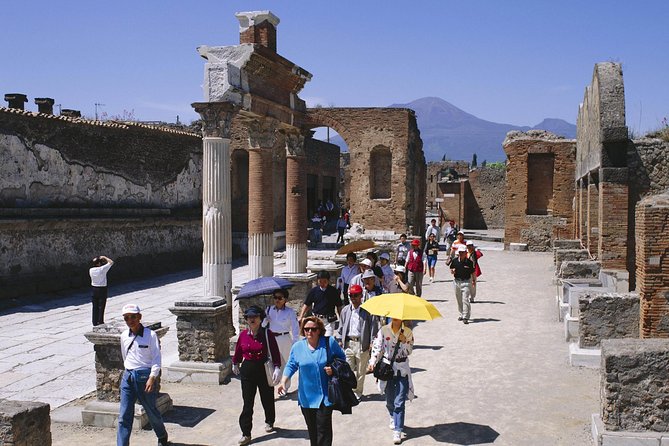
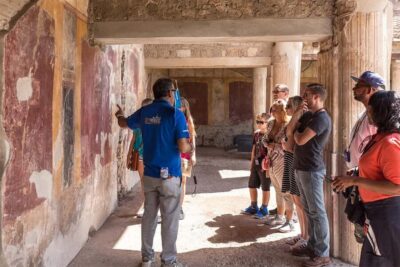
The tour is led by a professional archaeological guide, and the reviews give you a clear pattern: guides who teach in a way you can actually follow. People specifically mention passion, clarity, and the way the guide connects details you would otherwise miss.
A few guide names that show up strongly include:
- Amedeo, praised for being passionate and sharing more than you would find wandering alone
- Alessandra, praised as a PhD archaeologist who has worked on excavating Pompeii and answers questions
- Silvia, also described as a PhD archaeologist, with a calm approach and attention to pacing for older members
- Luca and Diego, praised for helping Pompeii feel real, not just historic
- Paolo, praised for making logistics easier with detailed instructions
You should not expect every guide to be exactly like those specific examples, but the overall “how it feels” is consistent: you are walking, but you are also learning why each stop is where it is and what it reveals.
If you are the type who asks why something was built, who used it, and what you should look for, you are going to get a lot out of this style.
Price and value: $214.75 per person with admission handled
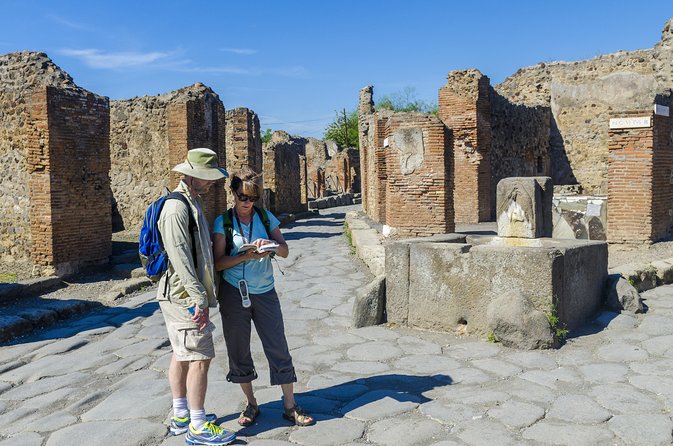
At $214.75 per person for about 2 hours, the price is not “cheap,” but it does come with clear value. You get:
- A private tour
- Guidance from a professional archaeological guide
- Admission fees to Pompeii included
- A mobile ticket
For many Pompeii visits, the headache is ticket entry plus time wasted figuring out the best route. Here, admission is part of the package, and the route is planned so you hit the big parts in a short window.
You also get flexibility in a practical way. Private tours are easier to tailor on the fly, and the reviews show guides adjusting pace without making it feel awkward. One review notes patience when the group was running late, which matters because Pompeii days can be chaotic.
If you are traveling solo or as a couple and you want maximum learning per hour, this price can make sense. If you are trying to do Pompeii on the absolute tightest budget, you might choose self-guided. But if you want to understand what you are seeing, this is a strong “time well spent” option.
Who should book this Pompeii private tour
This tour fits best if you:
- Want a first-timer friendly route that hits major sites fast
- Prefer a private guide over big-group pacing
- Like learning context, not just reading plaques
- Are comfortable with moderate walking and uneven terrain
It is also a good pick for families who need structure. One review specifically calls out that kids (ages 7 and 9) stayed engaged with stories during a private tour.
If you are visiting in poor weather, the all-weather operation helps. Just remember that “operates in all weather” still means you are walking, so dress appropriately.
Should you book? My practical take
Book this tour if you want Pompeii to feel understandable in two hours. The route is focused, the admissions are handled, and the guides in the reviews are clearly good at turning ruins into daily life.
Skip it if you are determined to wander slowly on your own and you enjoy learning by reading everything at your own pace. Also, if walking uneven ground is hard for you, make sure you are comfortable with the moderate fitness level and plan your shoe choice carefully.
In my opinion, the sweet spot is this: you have limited time, you care about context, and you want the best parts without the big-group scramble.
FAQ
Is Pompeii entry included in this private tour?
Yes. Admission fees to Pompeii are included, and the tour includes admission at the first stop.
How long is the Pompeii private tour?
The duration is about 2 hours.
Where do I meet the guide?
You start at Via Villa dei Misteri, 2, 80045 Pompei NA, Italy. The guide meets you at the main entrance of the archaeological site called Porta Marina Superiore, holding an Askos Tours sign.
Where does the tour end?
The tour ends at Piazza Esedra, 80045 Pompei NA, Italy.
What language is the tour offered in?
The tour is offered in English.
Does the tour run in bad weather?
Yes. It operates in all weather conditions, and you should dress appropriately.
What should I wear or bring for the tour?
Comfortable shoes are recommended, and the route involves walking with a moderate physical fitness level.
Is lunch included?
No. Lunch is not included.
Is the tour private, or will I be with other groups?
It is private. Only your group will participate.
What is the cancellation policy?
You can cancel for free up to 24 hours in advance for a full refund. Cancellations made less than 24 hours before the start time are not refunded.
Latest reviews around Pompeii
- Guided Day Tour of Pompeii and Herculaneum with Light Lunch★ 4.5 · 311 reviews
- Skip-the-Line Pompeii Guided Tour from Sorrento★ 4.5 · 722 reviews
- Pompeii Express Guided Tour by Train from Sorrento★ 4.5 · 770 reviews
- Pompeii & Mount Vesuvius Tour with Guided Visit, Tickets & Lunch★ 4.5 · 155 reviews
- Pompeii and Amalfi Coast Private Day Trip with Pick Up★ 5.0 · 312 reviews
- Mt Vesuvius and Pompeii Tour by Bus from Sorrento★ 4.5 · 170 reviews
- Pompeii Ruins Half-Day Tour from Sorrento with Guide★ 4.0 · 714 reviews
- Pompeii Guided Tour From Sorrento Coast★ 5.0 · 143 reviews
Pompeii & Vesuvius Tours, compared.
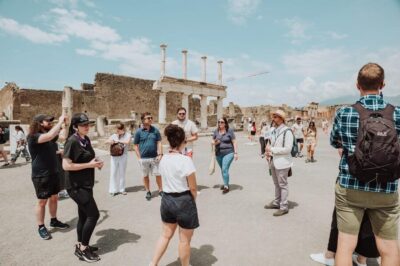
Pompeii: Entry Ticket and Guided Tour with an Archaeologist
Read our review →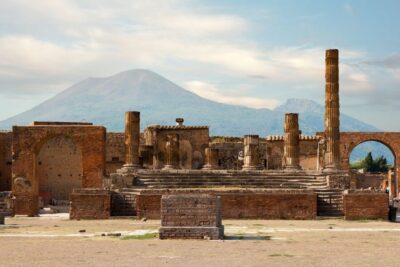
Pompeii: Entry Ticket with Optional Audio Guide
Read our review →
Pompeii: Small Group Tour with an Archaeologist
Read our review →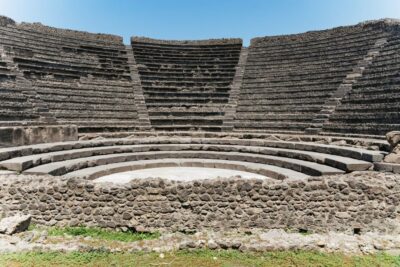
Pompeii Small Group Tour with an Archaeologist
Read our review →
Pompeii, Amalfi Coast and Positano Day Trip from Rome
Read our review →Browse the lists this tour appears in