
Reviewed · POMPEII & VESUVIUS TOURS
Explore Pompeii with an Archaeologist
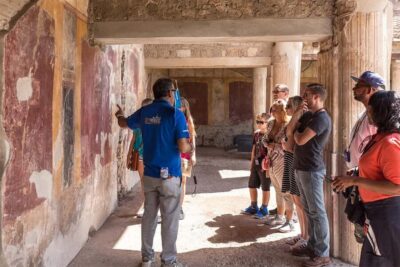
Pompeii hits you fast, even before the first ruins. This 2 hour walk with an archaeologist uses skip-the-line entry and a small group format, so you can actually absorb what you see instead of just queueing. I like that you get real explanations at the key stops, including the Forum and major houses, not just random pointing.
I especially like the pace and structure. You move through big-name sites like the Lupanar (brothel), Stabian Baths, and Teatro Grande with a guide who stops often enough to answer questions, as shown by guides such as Mario Celentano, Alexandra, Diego, and Antonio. One drawback to plan for: it is still a lot of walking on uneven ground, and in busy seasons you may find it harder to hear even with the included headsets.
If you want a tight hit of Pompeii’s highlights, this tour is built for that. You start at Porta Marina Superiore, meet the Askos Tours guide holding a sign, then finish around Piazza Esedra, with time to keep exploring after the tour ends.
In This Review
- Key highlights you’ll feel right away
- Skip-the-line entry at Porta Marina Superiore
- A 2 hour route that hits the Forum, houses, and baths
- Stop 1: Foro de Pompeya (main square)
- Stop 2: Basilica (the court house)
- Stop 3: Lupanar (the brothel)
- Stop 4: Granaries of the Forum
- Stop 5: House of Menander
- Stop 6: House of the Faun
- Bathhouse and theater: the “people lived here” section
- Stop 7: Stabian Baths (Terme Stabiane)
- Stop 8: Via dell’Abbondanza (street stroll)
- Stop 9: Thermopolium VI (the quick-food stop)
- Finish with Teatro Grande and Casa dei Vettii
- Stop 10: Teatro Grande (the theatre)
- Stop 11: Casa dei Vettii (House of Vettii)
- What the best archaeologist guidance actually changes
- The real-world walking: plan for comfort
- Who this Pompeii tour is best for
- Price value: $35.67 for a guided ticketed route
- Should you book Explore Pompeii with an Archaeologist?
- FAQ
- What is the duration of the Pompeii with an Archaeologist tour?
- How much does the tour cost?
- Is admission to Pompeii included?
- What languages are offered?
- Is this tour a small-group experience?
- What is the cancellation policy?
Key highlights you’ll feel right away
- Skip-the-line admission gets you past the worst waiting, so you spend more time looking and less time standing
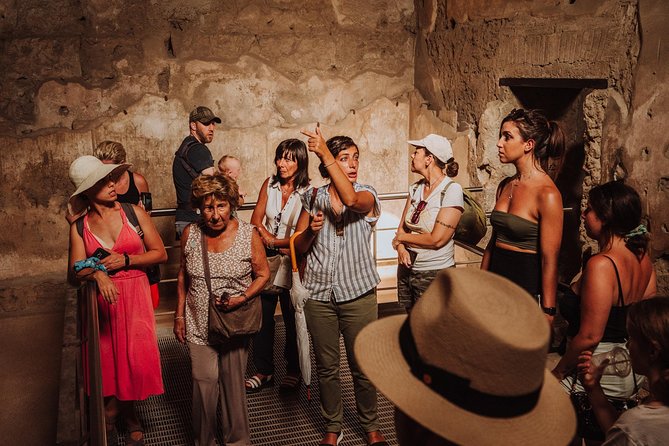
- Archaeologist guidance turns building names into understandable stories, with guides like Julia, Rosanna, and Rafaela often praised for clear explanations
- Small group size (max 20) makes it easier to ask questions and not get lost in the crowd
- Headsets for groups of 16+ help you hear the commentary while you walk between sights
- A high density route that checks off the Forum, major houses, baths, theater, and food-stop sites in about 2 hours
Skip-the-line entry at Porta Marina Superiore
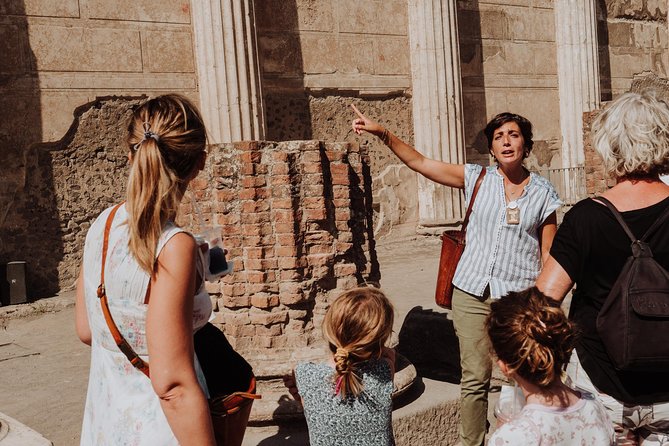
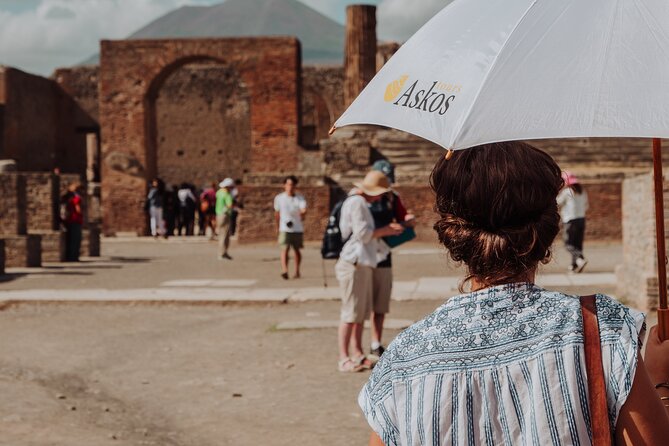
The tour kicks off at the Archaeological Park of Pompeii, meeting at the main entrance called Porta Marina Superiore. The guide holds a sign with Askos Tours on it, so it is pretty hard to miss the right group once you are inside the right gate area.
The practical magic here is timing. Pompeii can get packed, and standard entry lines can chew up your day. With skip-the-line admission tickets, you trade that delay for actual time inside the ruins. In a place this big, saving even 30 to 60 minutes matters.
From a value point of view, the tour price is not just paying for a walk. You are paying for fewer wasted minutes and a guide who can make your visit feel like more than a photo mission. If you only have a short window, this approach is very hard to beat.
More Pompeii digs and Vesuvius climbs:
- Pompeii: Entry Ticket and Guided Tour with an Archaeologist
★ 4.8 · 19,459 reviews - Pompeii: Entry Ticket with Optional Audio Guide
★ 4.2 · 12,360 reviews - Pompeii: Small Group Tour with an Archaeologist
★ 4.8 · 12,264 reviews
A 2 hour route that hits the Forum, houses, and baths
The tour is scheduled for about 2 hours, with frequent short stops. Each site is timed at roughly 10 minutes, which forces focus. You will not get the luxury of lingering at one mosaic for an hour. But you will cover a lot of Pompeii’s headline locations without having to plan every turn.
For many visitors, that is the sweet spot: see the major zones, get the context, then decide what you want to revisit on your own afterward. If you are traveling with kids, this structure also helps because it keeps the pace moving while still offering explanation, which guides often tailor to different ages.
Stop 1: Foro de Pompeya (main square)
Right away, you are in the heart of civic Pompeii: the Foro de Pompeya, the main square. This is a smart starting point because it gives you a reference grid for what comes next. When you later see buildings that sound important, like the Basilica, you already know they sit in the city’s public center.
A key benefit of having an archaeologist guide here is interpretation. The square is not just a big open area. Your guide’s explanations help you connect the location to daily public life, so the space stops feeling vague and starts feeling purposeful.
Stop 2: Basilica (the court house)
Next comes the Basilica, the court house. This stop is useful because it shows you Pompeii’s organized public systems. Again, the guide’s role is crucial: your time is short, so you need someone to translate the function of the building into what you should notice while you stand there.
One consideration: because this is a quick stop, you need to be active. If you want specific answers, ask them while you are at the Basilica, not after you move on.
Nearby, and just as well reviewed:
- From Naples: Pompeii Ruins & Mount Vesuvius Day Tour
★ 4.3 · 11,459 reviews - From Rome: Pompeii, Amalfi Coast, and Sorrento Day Trip
★ 4.6 · 7,031 reviews - From Rome: Pompeii, Amalfi Coast and Positano Day Trip
★ 4.6 · 6,620 reviews - Pompeii Small Group Tour with an Archaeologist
★ 5.0 · 6,593 reviews
Stop 3: Lupanar (the brothel)
Then you hit a site that always grabs attention, the Lupanar. It is often the kind of place people remember most, partly because of the name and partly because it highlights how varied city life could be.
Here is what I like about having a guide: you are not stuck with secondhand rumors. You get context and explanations that help you understand the role this building played in the urban fabric. The tour also moves past quickly enough that it stays part of a bigger story instead of turning into a one-topic detour.
Stop 4: Granaries of the Forum
After the more attention-grabbing stops, the granaries of the Forum shift the focus to supply and storage. This is a good balance point. It helps you think about the practical side of a city, not just the public spectacle.
This is also where the short stop structure works in your favor. You get the “why it mattered” version of Pompeii, without needing to become a full-time logistics student in 10 minutes.
Stop 5: House of Menander
Now the tour pivots to domestic life: the House of Menander. Houses are where you start seeing how space, layout, and daily routines shaped personal life in Pompeii.
The value of a guided visit at this point is the mental switch. In the Forum, you are thinking public. In the house, you are thinking private. When your guide points out what to look for, the experience turns from walking among walls into reading the structure like a map.
Stop 6: House of the Faun
The House of the Faun follows. Another house stop means you can compare what changes from one residence to the next, at least at the level you can observe in a short tour.
This is a strong moment for questions. If you ever wondered, How different were homes in Pompeii? this is your chance. With a group capped at 20 people, you are more likely to get answers instead of watching your question bounce around lost in a crowd.
Bathhouse and theater: the “people lived here” section
Stop 7: Stabian Baths (Terme Stabiane)
Next up: the Stabian Baths, the ancient baths. This stop is a great way to break up the residential sightseeing with a public leisure setting.
Even without spending an entire day here, the bathhouse works because it expands the idea of what public life looked like beyond squares and courts. It helps you visualize routine as something social, not only administrative.
Practical note: in summer, baths areas can feel hot and bright. Bring a hat and consider a small fan if you are sensitive to heat, a tip that shows up in guide advice from other visitors.
Stop 8: Via dell’Abbondanza (street stroll)
You then walk along Via dell’Abbondanza, the famous main street. This section is listed as admission ticket free on the route, which simply means you can treat it as part of the walk through key zones without extra gate hassles.
A street stop is more than scenery. It is your orientation tool. When you move along a major road, you start to understand how quickly people could move between neighborhoods and central areas. It is also a natural “breather” stop, since streets can be easier on your footing than climbing around building entrances.
Stop 9: Thermopolium VI (the quick-food stop)
Then comes Thermopolium VI. A thermopolium is a kind of food counter or snack shop, so this stop adds one of the most comforting parts of travel to the ruins: the idea that people ate street food right there.
Even if you do not have time to examine every corner, a guided stop keeps the concept clear. You learn why this matters. It is not just another room in a ruin. It is a window into everyday habits.
Finish with Teatro Grande and Casa dei Vettii
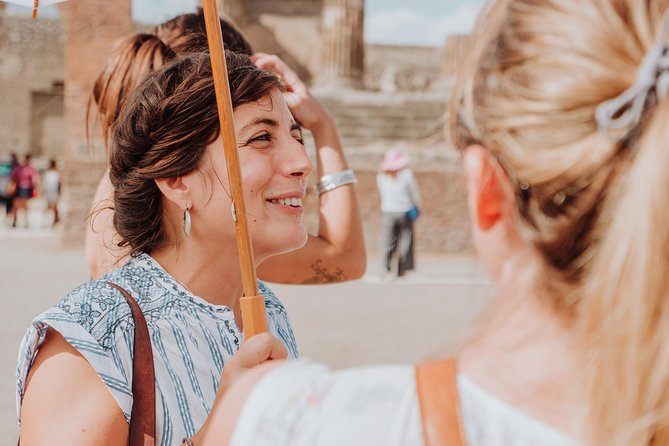
Stop 10: Teatro Grande (the theatre)
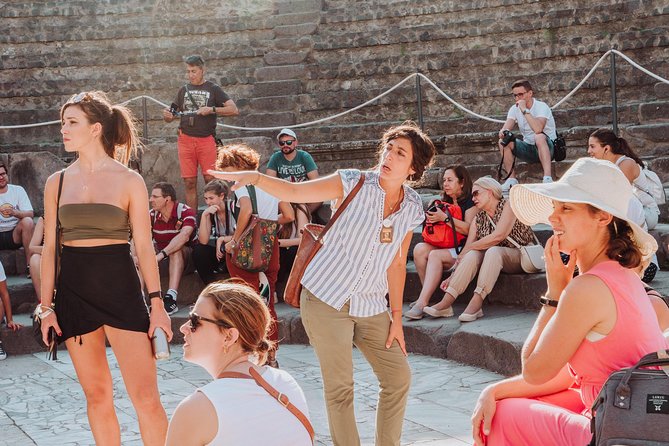
Next is Teatro Grande. A theatre stop shifts you again to communal entertainment. In other words, Pompeii was not only work and courts. It also had places for performance and shared experiences.
This is a good checkpoint stop. After you see the theatre, you can look at the surrounding layout and better understand how the city supported events and gatherings.
Stop 11: Casa dei Vettii (House of Vettii)
Finally, you reach Casa dei Vettii. Ending with a house can feel satisfying because it brings the tour back to intimate life. After seeing public spaces and entertainment, the residence gives you a personal scale.
The short timing still works because the guide can tie the last house stop into the earlier stops. The Forum, the court, the baths, the theatre, the food spot, and then the home, it all clicks into a single city portrait.
What the best archaeologist guidance actually changes
A guided Pompeii visit can be either “nice walk” or “real understanding.” This one is built for the understanding version.
Across the feedback, one theme comes through again and again: guides who know the site well can explain the ruins in a way that feels clear and practical, not like a lecture. People praised guides by name, including Mario Celentano, Alexandra, Julia, Ilaria, Diego, Antonio, Rosanna, Teresa, Rafaela, Jolanta, and Sergio. The best part is not that they can recite facts. It is that they can keep you moving and still answer questions.
You also get headsets for groups of 16 or more. That matters because Pompeii can be noisy and spread out. With headsets, you are less likely to lose the explanation while the group shuffles forward.
The real-world walking: plan for comfort
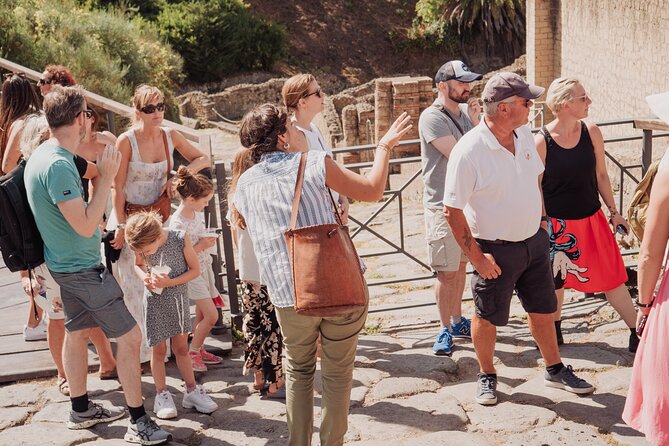
Two hours in Pompeii is not a stroll. Uneven surfaces are part of the deal. If you have limited mobility, this route may feel demanding even though the stop durations are short.
My practical advice:
- Wear shoes you trust on rough ground.
- In warm months, plan for heat. Some visitors recommend a fan and a refillable water bottle.
- Bring an umbrella or hat if the sun is intense. One simple hat can save your whole afternoon.
Also, the pace is timed. If you stop to take photos at the wrong moment, you may feel rushed. Keep your photo breaks short, and save your deeper exploration for after the tour when you can linger.
Who this Pompeii tour is best for
This is ideal if you want:
- A guided hit of the main highlights in about 2 hours
- Clear explanations from an archaeologist, with time for Q&A due to a small group
- A structured route that reduces decision fatigue, especially for first-timers
It is also a good fit for families. Reviews highlight guides who kept things engaging for kids, which is exactly what a timed, stop-heavy tour needs to succeed.
If you are the type who wants to study one house or one street for a long time, a longer self-guided visit might be better after you get the big picture from this tour.
Price value: $35.67 for a guided ticketed route
At $35.67 per person, the value comes from what you are getting together:
- Skip-the-line admission, which saves time at a place where time gets eaten by crowds
- An archaeologist guide, not just a generic interpreter
- Pompeii admission included, so you do not need to juggle multiple tickets
- Headsets for larger groups, which improves the listening experience
Is it the cheapest way into Pompeii? Usually not. But if you are factoring in the cost of your time, plus the value of expert interpretation, this price can feel very fair for a high-coverage route.
Think of it like buying focus. You are paying so you can see more and understand more without spending hours mapping the ruins yourself.
Should you book Explore Pompeii with an Archaeologist?
Book this tour if you want a fast, structured Pompeii experience where the ruins come with explanations you can actually use. The small group size, headsets for many groups, and the archaeologist-led stops make it a strong option for first-timers, families, and anyone who only has a morning or afternoon to spare.
Skip it, or consider a different format, if you prefer slow wandering, detailed room-by-room study, or if walking uneven surfaces is a deal-breaker for you. A timed route will always feel a little brisk, even with the best guide.
If you do book it, show up ready to move, bring water, and plan to stay on your own after. This tour is designed to help you understand Pompeii fast, then send you off to explore with better instincts.
FAQ
What is the duration of the Pompeii with an Archaeologist tour?
It runs for about 2 hours.
How much does the tour cost?
The price is $35.67 per person.
Is admission to Pompeii included?
Yes. Pompeii admission is included in the tour price, with skip-the-line admission tickets.
What languages are offered?
The tour is offered in English.
Is this tour a small-group experience?
Yes. The maximum group size is 20 travelers per guide. Headsets are provided for groups of 16 or more.
What is the cancellation policy?
You can cancel for free up to 24 hours in advance for a full refund. If you cancel less than 24 hours before the start time, the amount paid is not refunded.
Latest reviews around Pompeii
- Guided Day Tour of Pompeii and Herculaneum with Light Lunch★ 4.5 · 311 reviews
- Skip-the-Line Pompeii Guided Tour from Sorrento★ 4.5 · 722 reviews
- Pompeii Express Guided Tour by Train from Sorrento★ 4.5 · 770 reviews
- Pompeii & Mount Vesuvius Tour with Guided Visit, Tickets & Lunch★ 4.5 · 155 reviews
- Pompeii and Amalfi Coast Private Day Trip with Pick Up★ 5.0 · 312 reviews
- Mt Vesuvius and Pompeii Tour by Bus from Sorrento★ 4.5 · 170 reviews
- Pompeii Ruins Half-Day Tour from Sorrento with Guide★ 4.0 · 714 reviews
- Pompeii Guided Tour From Sorrento Coast★ 5.0 · 143 reviews
Pompeii & Vesuvius Tours, compared.
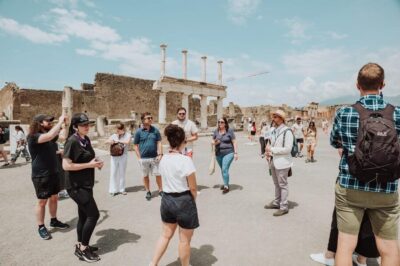
Pompeii: Entry Ticket and Guided Tour with an Archaeologist
Read our review →
Pompeii: Entry Ticket with Optional Audio Guide
Read our review →
Pompeii: Small Group Tour with an Archaeologist
Read our review →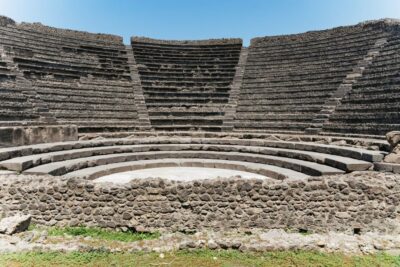
Pompeii Small Group Tour with an Archaeologist
Read our review →
Pompeii, Amalfi Coast and Positano Day Trip from Rome
Read our review →Browse the lists this tour appears in