
Reviewed · SICILY TOURS
Syracuse: Neapolis and Greek Theater guided tour
One cave, one theater, and a lot of stories. This Syracuse Neapolis guided tour takes you through the big names of the archaeological park in about 2 hours, with an expert local guide and skip-the-line entry. I love how much context you get for the myths and power struggles around Dionysius, and I love the views from the Greek Theater area, but a possible drawback is that the cave and theater spots are tight, so the group pace can feel a bit quick if you want extra time at one location.
You’ll walk between several major sights without having to plan every step yourself. Plus, since entrance to the Neapolis Archaeological Park is handled as part of the tour, you spend your energy on the ruins, not the ticket line.
In This Review
- Key things I’d prioritize on this Neapolis tour
- Why Neapolis in Syracuse is best with a guide
- Meeting points, timing, and how the walking usually feels
- Latomie del Paradiso: quarries turned strange, shaded gardens
- The Ear of Dionysius: acoustics, power, and the legend in one stop
- Greek Theater Syracuse: views, the Nymphaeum Fountain, and dramatic scale
- Altar of Hieron II: connecting myth, ceremony, and control
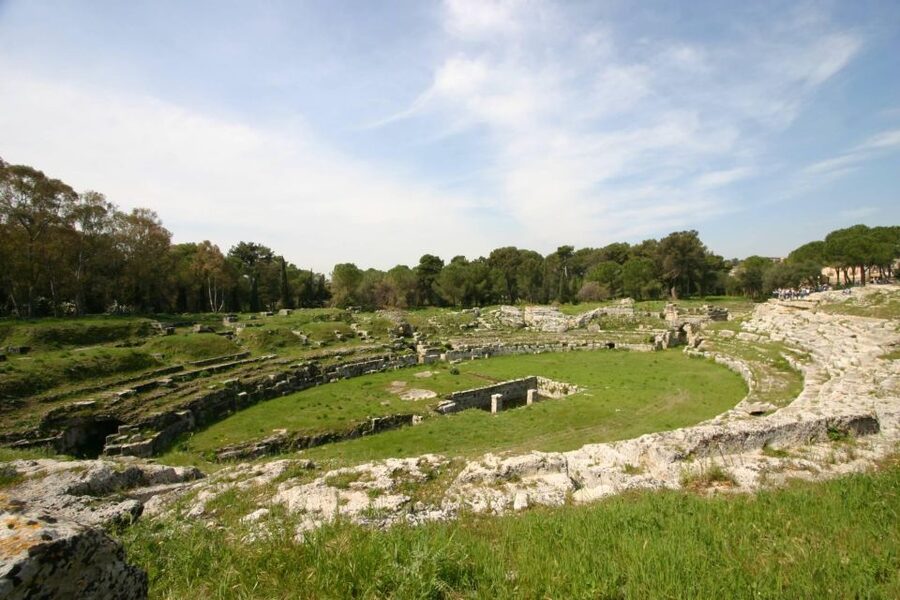
- Roman Amphitheater: gladiators and Syracuse under Rome
- Guides and languages: what you can count on during the tour
- Value check: what you get for $51 in 2 hours
- Who this Neapolis tour suits best
- Should you book this Syracuse Neapolis tour?
- FAQ
- How long is the Syracuse Neapolis guided tour?
- How much does the tour cost?
- What’s included in the price?
- Do I need to buy the Neapolis Archaeological Park ticket separately?
- Where is the meeting point?
- What sights are included?
- Is the tour offered in English?
- Do I need to arrive early?
- Is cancellation free?
Key things I’d prioritize on this Neapolis tour
- Skip-the-line entry into the Neapolis Archaeological Park, via a separate entrance
- Latomie del Paradiso (former stone quarries) that feel cool and haunting, not just scenic
- Ear of Dionysius and the legend, including how acoustics were used in the story
- Greek Theater viewpoints over the Grand Harbor, plus stops like the Nymphaeum Fountain
- Roman Amphitheater context, so you understand how Syracuse changed under Rome
Why Neapolis in Syracuse is best with a guide
Neapolis is the historic heart of Syracuse’s ancient power, and it can look like a pile of impressive stone from a map. With a guide, it becomes a route through meaning. You don’t just see famous spots, you learn why they matter, who used them, and what the myths are really pointing at.
This tour does a smart thing for your time: it concentrates on the most memorable stops inside the Neapolis Archaeological Park. You also get the benefit of live narration in Italian and English, so you can follow along even if your group includes different language comfort levels. And at a price like $51 per person for a 2-hour guided experience that includes your entrance ticket, you’re not overpaying for convenience, you’re paying for interpretation.
A few more Syracuse options to weigh
- Syracuse: Boat Tour with Captain Mirko, Snorkeling & Caves
★ 4.7 · 746 reviews - Siracusa: Ortigia Boat Tour with Marine Grotto
★ 4.7 · 617 reviews - Siracusa: Ortigia & Sea Caves Speedboat Tour with Swim Stop
★ 4.9 · 499 reviews
Meeting points, timing, and how the walking usually feels
You meet at one of two starting places depending on the option you booked: Biglietteria Parco Archeologico Neapolis or MOMENTO Ristorante. The key practical note is to arrive 20 minutes early, because the guide needs time to handle the group start, including providing the entrance ticket to the Neapolis Archaeological Park directly at the meeting point.
Once you’re in, the structure is built for flow. The core stops are typically around 20 minutes each at Latomie del Paradiso, the Ear of Dionysius, and the Greek Theater, then a final stop at the Roman Amphitheater. That pacing is great if you want “greatest hits” in one shot. If you’re the kind of visitor who loves to linger, take photos forever, and do everything slowly, you might feel you are being steered. One good way to handle this is to pick one stop where you’ll slow down and let the others guide you forward.
Latomie del Paradiso: quarries turned strange, shaded gardens
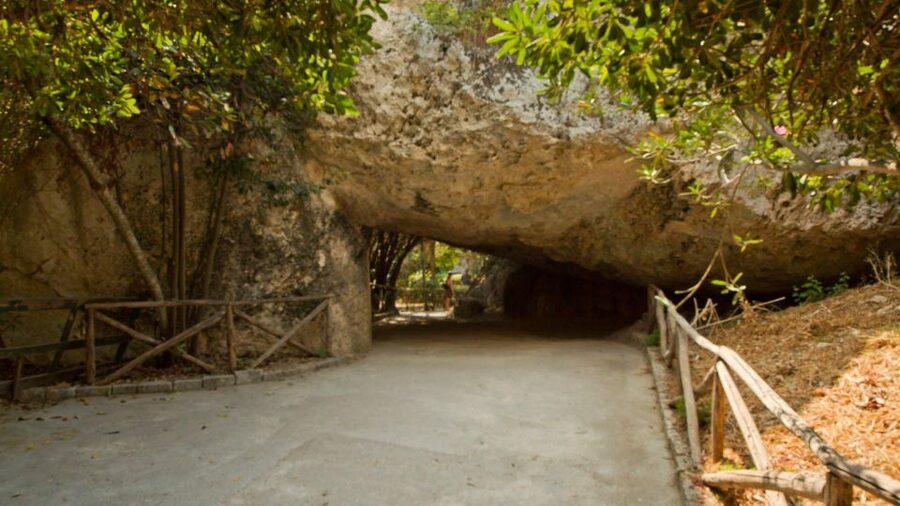
Latomie del Paradiso is one of those places where the setting does half the storytelling. These were stone quarries, carved by huge human effort, and they ended up like a natural garden with a moody atmosphere. Your guide’s job here is to connect the physical space to the human story: what was extracted, how the space was reshaped, and why the “dark secrets” idea matters in the way the site is remembered.
I especially like this stop for practical reasons. In hot Sicilian weather, quarry areas can feel cooler and more sheltered than open sections of the park. One reason the tour lands well for many first-time visitors is that it gives you variety in tempo: this is a walking and explanation stop, not a sit-and-watch stop. You get to slow down, hear the myth and history side, and then move on.
The Ear of Dionysius: acoustics, power, and the legend in one stop
Next comes the Ear of Dionysius, a cave tied to one of Syracuse’s best-known legends. The big theme is mysterious acoustics, which is exactly what makes the place memorable. Even if you know the outline of the story, a guide can turn it from a trivia fact into something you can picture: this is where sound, secrecy, and authority were mixed into a single physical space.
One detail that stands out from how guides handle this site is how they make it playful without turning it into a show. In at least one case, a guide reportedly even sang in the cave, and it’s the kind of moment that reminds you you’re inside a purpose-built space for atmosphere and sound. Still, don’t expect every guide to do the exact same thing. The consistent value is the way the guide explains what the cave was imagined to do, and why Dionysius is tied to intrigue rather than just a name in a textbook.
A practical note: caves can be echoey and darker than you expect. If you’re the type who struggles to hear in group settings, position yourself where you can see and hear the guide clearly as you enter.
Nearby, and just as well reviewed:
- Syracuse: Neapolis Archaeological Park Small Group Tour
★ 4.7 · 350 reviews - Syracuse: Pillirina, Ortigia, and Sea Caves Tour by Boat
★ 4.6 · 348 reviews - Syracuse: Ortigia Island and Sea Caves Boat Tour with Drinks
★ 4.6 · 337 reviews - Syracuse: Coast and Sea Caves Full Transparent Boat Tour
★ 4.8 · 330 reviews
Greek Theater Syracuse: views, the Nymphaeum Fountain, and dramatic scale
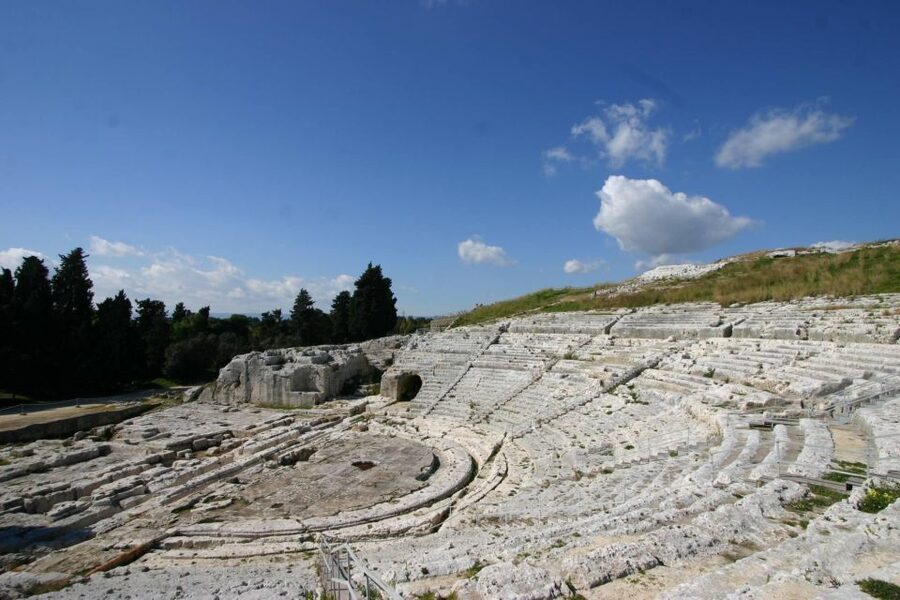
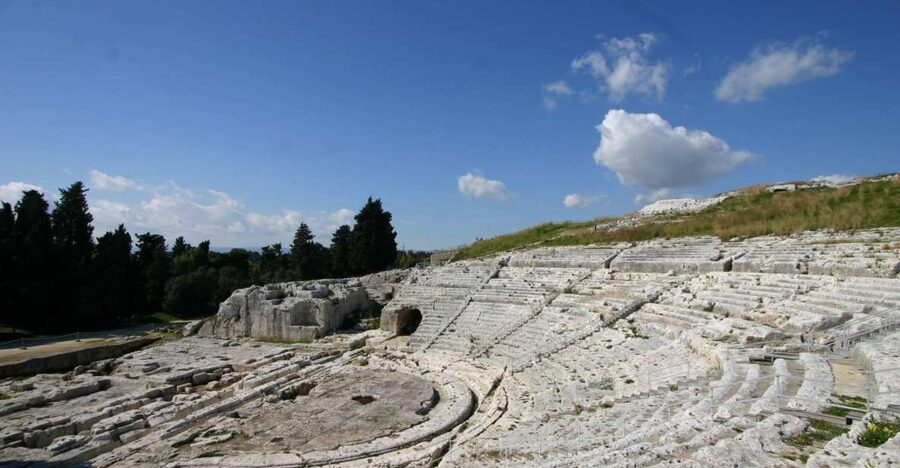
The Greek Theater is the headline act in a park full of standout moments. Here, you’re not just looking at seats in stone. You’re stepping into a design made for spectacle and sightlines. The tour also connects the theater to nearby elements like the Nymphaeum Fountain, and you get a moment to take in the view over the Grand Harbor.
I like the theater stop because it gives you a “sense of place.” You start to understand Syracuse as a real city tied to sea power and political life, not only as a museum of ruins. That’s where a good guide earns their fee. They help you read the space, from the structure of the theater to why the surrounding scenery is part of the story.
One small drawback to be aware of: some people say they’d have liked more time or access at lower areas of the Greek Theater. That’s not unusual in archaeological settings where safety and access can limit where a group can stand or go. If you’re hoping for floor-level time, plan to enjoy what the guide points out from the accessible viewpoints.
Altar of Hieron II: connecting myth, ceremony, and control
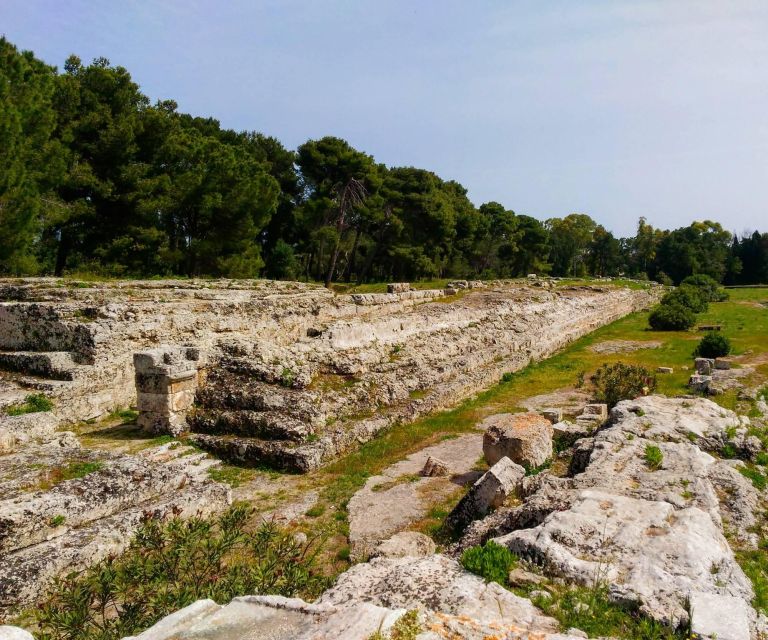
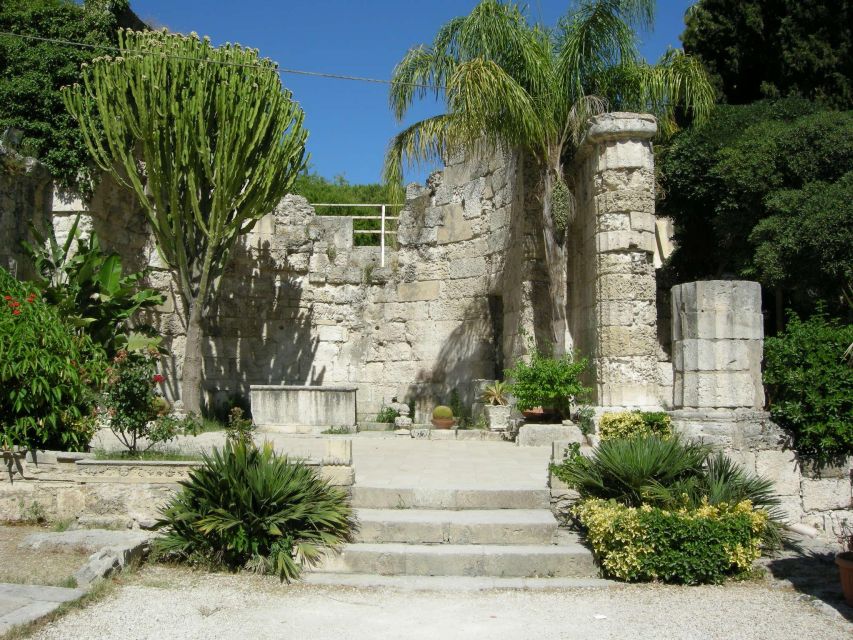
You’ll also be directed to the Altar of Hieron II as a major piece of Syracuse’s symbolic landscape. What I find useful about this stop is that it helps you stop thinking of Neapolis as separate attractions. Instead, you see connections between performance spaces, ceremonial spaces, and the kind of public authority that rulers wanted people to feel.
Even if you only get a short stop here, the explanation can change the way you look at the ruins. You start to notice how ancient cities used stone to communicate power. Guides tend to emphasize how structures like the altar fit into the larger story of Syracuse’s rise, and how later rulers viewed or reshaped that identity.
If you’re a classics student or just someone who likes patterns in ancient cities, this is one of the “aha” moments. It turns a list of sites into a single storyline.
Roman Amphitheater: gladiators and Syracuse under Rome
The last stop brings you to the Roman Amphitheater, where the story shifts from Greek dominance to Roman control. This is where the guide’s explanation matters most, because the amphitheater isn’t just a cool ruin. It’s a clue to how entertainment and power changed when Rome took over.
You’ll hear about the secrets of gladiatorial games and the nuances of Syracuse under Roman rule. That’s the difference between seeing architecture and understanding why the Romans would build, adapt, and stage public life the way they did. It also helps you realize that this area didn’t “freeze” in one era. It kept getting used, repurposed, and reinterpreted.
If you’re visiting in a time window where you’ve already hit several ancient sites, the Roman stop is a useful reset. It gives a distinct flavor: less mythic legend, more public spectacle and political messaging through entertainment.
Guides and languages: what you can count on during the tour
This is a live tour with a local, certified guide. Languages are listed as Italian and English, and the tour could run in both languages at the same time. That matters if you’re traveling with someone who wants one language consistently, since in multi-language setups the pace sometimes becomes about group listening, not one speaker projecting for one audience.
The most praised guides are the ones who keep the pace steady, answer questions, and slow down in the right places. Names that came up in the guide feedback include Giuseppe, Laura, Fabricio, and Luca, with notes about clear explanations and not rushing people, even when running in two languages.
One realistic consideration: not every guide can be heard equally well in every moment. There’s at least one reported issue where a guide was difficult to hear in a larger group, which is why being attentive to your position in the group helps. If you can’t hear well, moving closer to the guide usually solves it.
Value check: what you get for $51 in 2 hours
Let’s talk value, because $51 can sound either cheap or expensive depending on what’s included. Here, your ticket coverage is part of the package. The tour includes your entrance ticket to the Neapolis Archaeological Park plus the guided tour itself. You also get skip-the-line access through a separate entrance, which saves time when the park is busy.
Then there’s the big hidden value: interpretation. Neapolis sites can feel like “I’m looking at stones” unless you know what you’re looking at. With an expert guide, you’re not just walking past the famous points. You’re learning why Latomie del Paradiso is more than a pretty quarry, why the Ear of Dionysius is famous for acoustics, and why the Greek Theater and amphitheater are both part of Syracuse’s political story.
From a budgeting standpoint, this is good value if you’re doing Syracuse as a single, focused day activity. It’s also a smart use of time if you want the main highlights without building your own route on the fly.
Who this Neapolis tour suits best
I’d steer you toward this tour if you:
- Want greatest hits of Syracuse’s Neapolis area in a short window
- Like mythology tied to real places, not just general lectures
- Appreciate a guide who answers questions and sets a clear pace
- Are visiting in hot weather and value sheltered spots like quarry areas
It may not be ideal if you:
- Want lots of free time to explore independently without group timing
- Are sensitive to hearing issues in bigger groups, and you know you prefer very close, quiet narration
- Need extended time at one single site, like the very bottom areas of the theater (some people wish they could spend more time there)
Should you book this Syracuse Neapolis tour?
If you want a high-impact introduction to Syracuse’s most famous ancient settings, I think this is an easy yes. The combination of entrance ticket included, skip-the-line access, and a guide-led route through the Latomie, Ear of Dionysius, Greek Theater, and Roman Amphitheater makes your 2 hours count.
My practical recommendation: book it if you’re short on time or you want the ruins to come with real meaning. If you’re a slow explorer who wants long pauses at every viewpoint, you might still enjoy it, but go in with a plan to choose one or two moments where you slow down while the rest of the tour keeps you moving.
FAQ
How long is the Syracuse Neapolis guided tour?
The tour lasts 2 hours.
How much does the tour cost?
The price is $51 per person.
What’s included in the price?
You get an entrance ticket to the Neapolis Archaeological Park and a guided tour of the park.
Do I need to buy the Neapolis Archaeological Park ticket separately?
No. The entrance ticket is provided directly by the guide at the meeting point.
Where is the meeting point?
The meeting point can vary depending on the option booked. It may be Biglietteria Parco Archeologico Neapolis or MOMENTO Ristorante.
What sights are included?
The tour covers Latomie del Paradiso, the Ear of Dionysius, the Greek Theater, the Nymphaeum Fountain area, the Altar of Hieron II, and the Roman Amphitheater.
Is the tour offered in English?
Yes. The live tour guide works in Italian and English.
Do I need to arrive early?
Yes. You should arrive at the meeting point 20 minutes before the start time.
Is cancellation free?
Free cancellation is available up to 24 hours in advance for a full refund.
Latest reviews around Syracuse
- Syracuse: Pillirina, Ortigia, Sea Caves and snorkeling★ 4.6 · 133 reviews
- Syracuse: Ortigia Private Walking Tour★ 4.8 · 181 reviews
- Syracuse: Ortigia Sunset Cruise with Aperitif★ 4.8 · 291 reviews
- Syracuse: Ortigia Classic Walking Tour★ 4.7 · 167 reviews
- Syracuse: Ortigia and Sea Caves Excursion by Boat★ 4.7 · 112 reviews
- Syracuse: Ortigia Island and Sea Caves Boat Tour with Drinks★ 4.6 · 337 reviews
- Syracuse: Neapolis Archaeological Park Small Group Tour★ 4.7 · 350 reviews
- Syracuse: Coast and Sea Caves Full Transparent Boat Tour★ 4.8 · 330 reviews
Sicily Tours, compared.

Mount Etna Morning or Sunset Day Trip with Tasting
Read our review →

From Trapani: Cruise to Favignana and Levanzo with lunch
Read our review →
Sunset Jeep Tour of Mount Etna and Lava Flow Caves
Read our review →
Palermo Original Street Food Walking Tour by Streaty
Read our review →
Mount Etna: Trek to 3000m with cable car and jeep
Read our review →
Segesta, Erice and Salt Pans Full-Day Excursion from Palermo
Read our review →Browse the lists this tour appears in