Reviewed · MUSEUMS
Leonardo da Vinci Experience Museum Admission
Rome keeps it short, and Leonardo keeps it clever. The Leonardo da Vinci Experience sits in Vatican City area, just a short walk from St. Peter’s Basilica, with guaranteed admission and flexible arrival times inside a self-guided set of five rooms. I like that you move at your own pace, and the hands-on style makes the ideas feel usable, not just academic. One catch, the space is small and much of what you see is reproduction material, so it is not the place to expect original Renaissance masterpieces.
You are looking at an easy 1 to 2 hour visit, open daily from 9:00 AM to 6:00 PM during the listed season, and it usually sells through about a month in advance. You redeem your ticket at Via della Conciliazione 19, and the audio guide is offered in English plus several other languages, which helps if you are traveling with mixed language abilities. This is a smart add-on if you are already doing the Vatican Museums or want a lighter break between big churches and big lines.
In This Review
- Key points before you go
- Leonardo da Vinci Experience, right by St. Peter’s
- What you pay, and what you get for $19.22
- Timing that works, without a guide in your face
- Your room-by-room route: flying machines to the paintings
- Room I: Flying machines, plus the Last Supper model
- Room II: War machines and the physics of force
- Room III: Music, optics, and the room of mirrors
- Room IV: Everyday inventions born from genius
- Room V: Art reproductions in 20 works
- Audio guide and interactive stations: the fun factor
- How long it takes, and how to pace it
- Pairing it with Vatican Museums without turning your day into a march
- Who should book, and who might skip
- Should you book this Leonardo da Vinci Experience?
- FAQ
- Where is the Leonardo da Vinci Experience Museum Admission located?
- What is the ticket redemption point?
- What are the opening hours?
- How long does the visit take?
- Is this experience offered in English?
- Does the admission include the museum entrance?
- Do I get an audio guide, and what languages are available?
- Is there a tour guide included?
- Is the museum self-guided?
- What is the cancellation policy?
Key points before you go
- Guaranteed access means you can plan around your day instead of chasing availability.
- Five room route covers flying machines, war inventions, optics, everyday principles, and da Vinci art reproductions.
- Audio guide in many languages lets you pick English and still keep everyone listening without stopping for translation.
- Interactive stations are a big part of the fun, especially if you like pushing buttons and trying mechanisms.
- Good pairing with Vatican sights because it is so close to St. Peter’s Basilica area.
Leonardo da Vinci Experience, right by St. Peter’s
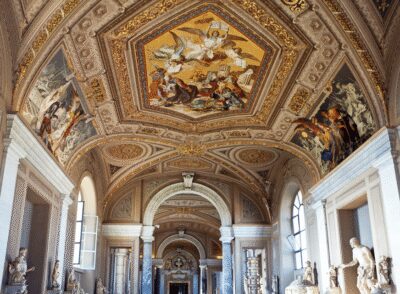
This museum experience is staged in the Vatican City area, and it is positioned for easy “walk it off” days. If your itinerary centers on St. Peter’s Basilica, you can treat this as a compact detour that does not add another bus ride or a whole different neighborhood.
The address matters because you will redeem at Via della Conciliazione 19, a very practical starting point when you are already navigating the St. Peter’s zone. It also helps that it is near public transportation, so if you are hopping between sights, you can keep your schedule flexible.
A few more Rome options to weigh
- Vatican: Museums & Sistine Chapel Entrance Ticket
★ 4.5 · 144,003 reviews - Vatican Museums & Sistine Chapel Tour with Optional Basilica
★ 4.3 · 67,413 reviews - Vatican Museums, Sistine Chapel & St Peter’s Basilica Guided Tour
★ 4.5 · 39,149 reviews
What you pay, and what you get for $19.22
At $19.22 per person, this is not trying to compete with the big-name museums in terms of scale. Instead, the value comes from format, not size: guaranteed entry, a self-guided path, and audio support that turns diagrams and inventions into something you can follow in real time.
The “deal” here is time. In about 1 to 2 hours, you can see a structured tour of da Vinci’s ideas across multiple themes. If your day is already stacked with the Vatican Museums and you want something that breaks the walking pace, this fits that role well.
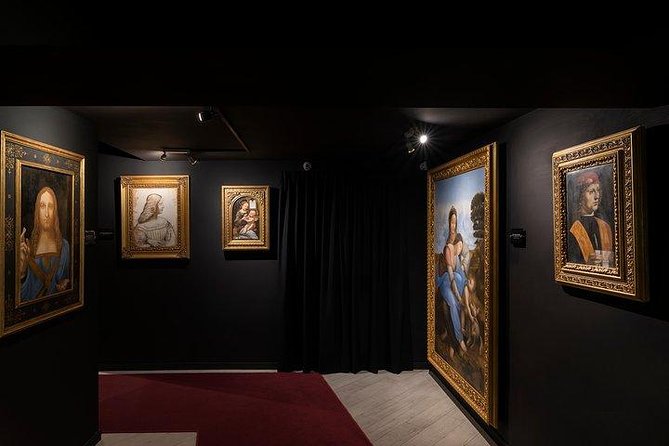
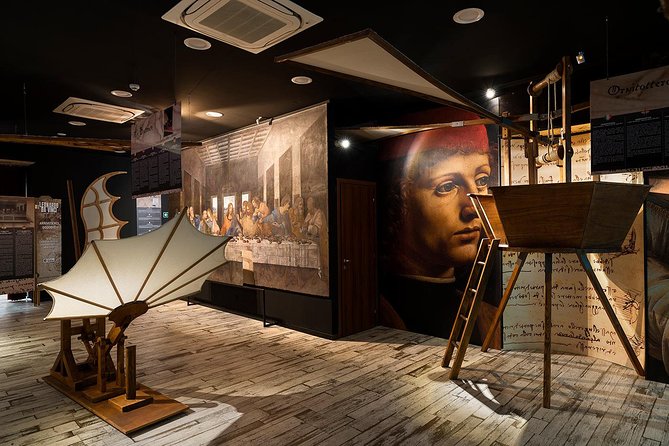
Do note the expectations set by the exhibit itself. There are reproductions, including a life-size reproduction of the Last Supper. Room V includes works of art that are presented as reproductions of some of da Vinci’s most famous paintings. If you are hoping for authentic originals, you may feel let down. If you want to understand how the mind works, the format is built for you.
Timing that works, without a guide in your face
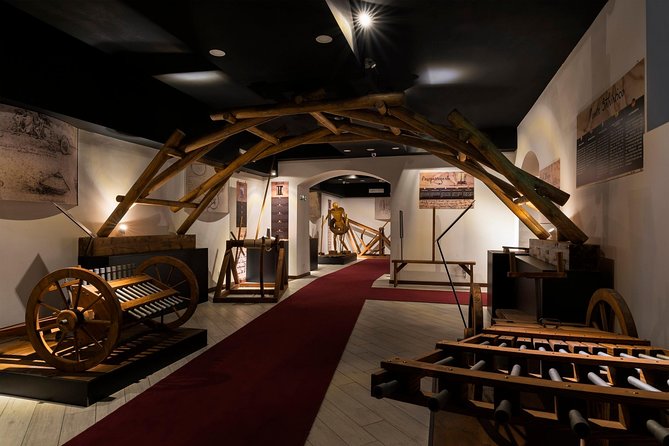
This is self-guided. You do not get a live tour guide included, which is great if you dislike groups slowing you down or if you like reading at your own speed. With flexible timing inside the opening hours, you can slot it in as early relief, or as a calm cooldown after Vatican sightseeing.
The museum is open daily, and the listed hours are 9:00 AM to 6:00 PM. The experience is sold as an easy visit window, often booked around a month in advance, so picking a time that matches your day plan is smart.
One more practical point: it is in Rome, not Florence. If you are planning a broader Italy route and you see similar Leonardo wording in different cities, double-check the Rome address and redemption point so your money lands in the right place.
Your room-by-room route: flying machines to the paintings
Think of the museum as a guided idea sampler. The rooms are arranged like a mini curriculum, and you can spend longer where you feel curious. Here is how the route typically unfolds.
Nearby, and just as well reviewed:
- Colosseum, Roman Forum & Palatine Guided Tour
★ 4.7 · 63,148 reviews - Rome: Colosseum, Palatine Hill and Roman Forum Guided Tour
★ 4.8 · 32,814 reviews - Rome: Guided Tour of Colosseum, Roman Forum & Palatine Hill
★ 4.7 · 27,897 reviews - Rome: Colosseum & Forum with Audio Guide App -Optional Arena
★ 4.2 · 24,770 reviews
Room I: Flying machines, plus the Last Supper model
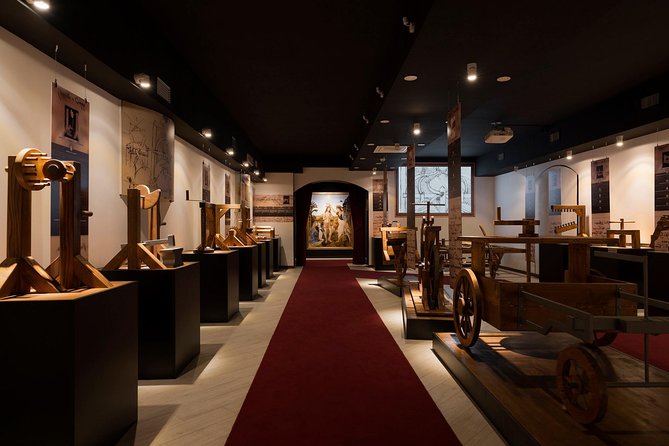
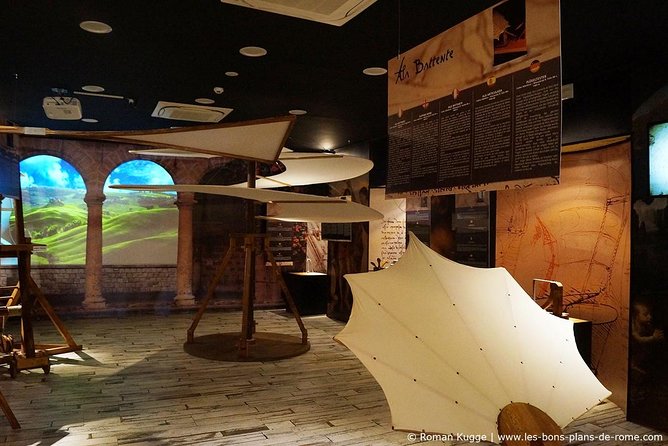
Room I is where the museum leans hardest into da Vinci as an inventor. You will see flying machines, including a prototype-style hang glider concept. You also encounter a life-size reproduction connected to the Last Supper.
This room is a good start because it sets two themes right away. First, da Vinci’s fascination with motion. Second, his talent as a painter and thinker about composition, not just mechanics.
If you like “wow” moments, this is where you tend to get them fast, because the shapes are dramatic and easy to understand even without deep technical background.
Room II: War machines and the physics of force
Room II shifts from flight to conflict. The focus here is drawings of artillery and war machines, including a multi-directional gun machine with twelve barrels and a catapult.
This section can feel intense in theme, but it is also where you can appreciate da Vinci’s problem-solving approach. You are seeing how he tried to turn strategy into mechanics, and how he used design logic rather than pure fantasy.
If you are traveling with kids or teens, this room often lands because the objects are tangible and visually “built.” If you hate heavy topic themes, you can keep this room shorter and move on.
Room III: Music, optics, and the room of mirrors
Room III is the turn toward “how you see and how you hear.” You will find devices tied to music and optics, including a projector and perspectograph, plus a Room of Mirrors.
This is often the most satisfying for people who like the hidden rules behind perception. A perspectograph-type device is basically about geometry and viewpoint, and a projector pushes you toward thinking about images as systems, not magic.
It also tends to be the room where you slow down. Mirrors are visual by nature, and optics concepts feel easier once you can look around and test what the exhibit implies.
Room IV: Everyday inventions born from genius
Room IV brings the ideas down to daily life. This room highlights principles behind inventions and includes items such as a bicycle, a spring concept, and a life preserver.
This is the room that makes the experience feel practical. Instead of only “big concept machines,” you get reminders that ideas from sketches can translate into real tools and objects.
Even if you only spend a few minutes here, it helps tie the other rooms together. It answers the unspoken question: so what did this genius actually change?
Room V: Art reproductions in 20 works
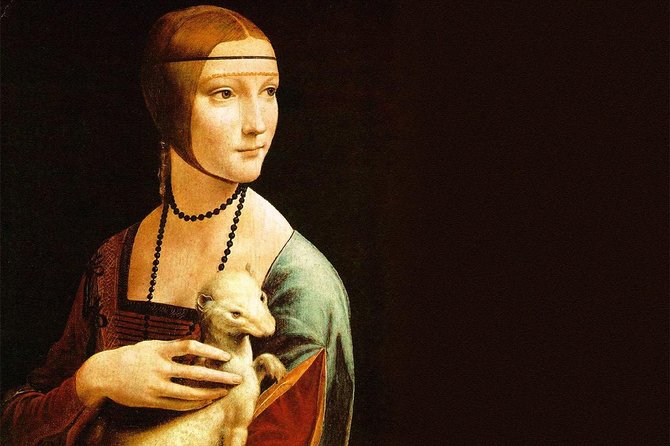
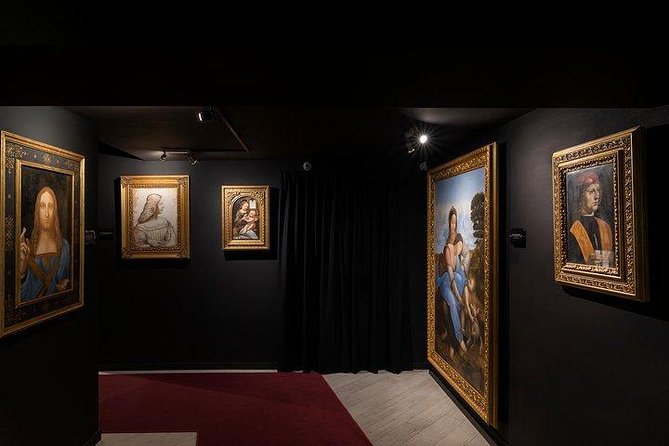
Room V is the art section, and it is usually where the tone softens. You will see 20 works presented as reproductions, including reproductions of some of da Vinci’s most famous paintings.
This is also where the museum’s format becomes clear: you are not doing a museum of original masterpieces. You are doing an exhibit that uses reproduction art to connect Leonardo’s inventions and artistic thinking.
If you are there mainly for the machines, you will still get something out of this room. If you are there mainly for paintings, you may wish the room offered more originals or deeper context about what was made and what remained sketches. Still, it can be worthwhile as a final stop that rounds out the big picture.
Audio guide and interactive stations: the fun factor
The included audio guide is a key part of how the exhibit works. It is available in multiple languages, including English, Italian, French, Spanish, German, Russian, Chinese, and Portuguese. That means you can keep one device running for your group without constant back-and-forth.
The style is self-guided, and the exhibit includes a “listen while you touch” feel through devices used to access details for specific items. In practice, this turns the museum into a series of mini explanations, which is great if you get impatient with long walls of text.
There is also a downside to this kind of setup: sound quality can vary by device and location. Some people prefer richer audio and extra storytelling, and a small cramped space can make it harder to hear if you stand close to other visitors. If you are sensitive to noise or smell, the smaller venue may not feel ideal.
There is also a note you may spot on certain models, since some displays come with disclaimers about whether a device was built exactly as shown. Expect the exhibit to focus on Leonardo’s ideas and drawings, not always a strict proof that every mechanism was made the same way in his lifetime.
How long it takes, and how to pace it
Most people plan about 1 to 2 hours, and you can absolutely do it faster if you like skimming. If you really enjoy interacting with stations and reading the audio prompts, you will likely sit closer to the longer end.
A practical approach is to pick one “slow room” and one “quick room.” For example, spend extra time in Room III for optics and mirrors, then keep Room II shorter if war themes make you less curious. That keeps the day from feeling like an assignment.
Also, because it is self-guided, you can step away if you need a breather. This is useful on Roman walking days when you want a break from nonstop churches and crowded streets.
Pairing it with Vatican Museums without turning your day into a march
This experience is easiest to place right after St. Peter’s Basilica area. Because it is so close, you can avoid crossing town and losing time to transit and traffic.
If you are doing the Vatican Museums, treat this as the “brain snack” after the marathon museum rooms. The themes are different enough that it feels like a reset, not repetition. Also, a self-guided format is a nice change when you have already spent hours following timed routes.
I like the idea of using this as a lighter activity day. One or two hours with hands-on objects, then back to dinner and rest, is a smarter rhythm than cramming in one more big museum when your legs are already done.
Who should book, and who might skip
This works best if you enjoy learning through objects and if you want a structured route without needing a guide. It is also a strong option for families because the exhibit includes hands-on elements and interactive displays.
It may not be the best match if you want a large, high-end museum with lots of original works. Since the paintings and many items are presented as reproductions, it is closer to an educational exhibit than a classic art gallery.
Also, if you are visiting with someone who strongly dislikes interactive crowds, keep an eye on timing. Small spaces can feel busy, and some people find the environment cramped.
Finally, if you are comparing cities, make sure you really want the Rome location. Some people get surprised when they realize they booked the Rome experience instead of a different Leonardo museum in another city.
Should you book this Leonardo da Vinci Experience?
Book it if you want a guaranteed, low-stress, self-guided visit near St. Peter’s, and you like seeing ideas turned into working mechanisms. It is good value for the time you spend, especially when you need a break from larger museums.
Skip it if your top priority is original artworks and large-scale exhibitions. In that case, you will likely prefer spending your money on a bigger museum where originals are the headline.
If you are trying to balance your Vatican day with something more hands-on, this one is a practical win.
FAQ
Where is the Leonardo da Vinci Experience Museum Admission located?
It is in Rome, Italy, at Via Conciliazione 19, 00193 Roma RM. It is next to St. Peter’s Basilica.
What is the ticket redemption point?
You redeem your ticket at Via della Conciliazione, 19, 00193 Roma RM, Italy.
What are the opening hours?
For the listed period, it is open Monday to Sunday from 9:00 AM to 6:00 PM.
How long does the visit take?
The experience is approximately 1 to 2 hours.
Is this experience offered in English?
The experience is offered in English, and the included audio guide is also available in several other languages.
Does the admission include the museum entrance?
Yes. Entrance to the Leonardo da Vinci Experience Museum is included.
Do I get an audio guide, and what languages are available?
Yes, an audio guide is included. It is available in English, Italian, French, Spanish, German, Russian, Chinese, and Portuguese.
Is there a tour guide included?
No. Hotel pick-up and drop-off are not included, and there is no tour guide included.
Is the museum self-guided?
Yes. The experience is self-guided, so you explore the rooms at your own pace.
What is the cancellation policy?
Cancellation is free. You can cancel up to 24 hours in advance for a full refund, but cancellations made less than 24 hours before the start time are not refunded.
Latest reviews around Rome
- Guided Walking Tour of Rome: Top Sights & Baroque Treasures★ 5.0 · 155 reviews
- Rome at Night: Small Group Guided City Walking Tour★ 5.0 · 249 reviews
- Private Walking Tour of the Squares and Fountains in Rome★ 5.0 · 130 reviews
- Rome Food Tour by the Vatican★ 5.0 · 308 reviews
- Vintage Fiat 500 Cabriolet: Rome’s Highlight Semi Private Tour★ 5.0 · 283 reviews
- Welcome To Rome Experience★ 4.5 · 679 reviews
- Vespa Rental in Rome 24 hours★ 5.0 · 196 reviews
- Vatican VIP Early Entrance 8:00 AM★ 4.5 · 141 reviews
Museums, compared.
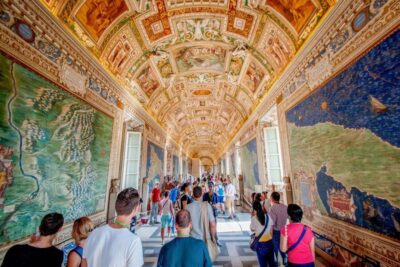
Vatican: Museums & Sistine Chapel Entrance Ticket
Read our review →
Vatican Museums & Sistine Chapel Tour with Optional Basilica
Read our review →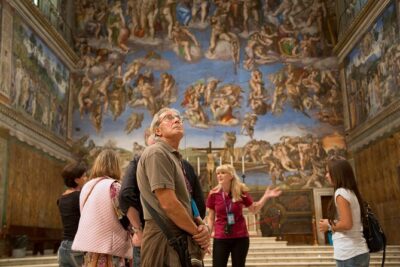
Vatican Museums, Sistine Chapel & St Peter’s Basilica Guided Tour
Read our review →
Skip-The-Line Uffizi Gallery Timed Entry Ticket
Read our review →
Vatican Museums, Sistine Chapel & Basilica Tour
Read our review →
Vatican Museums & Sistine Chapel Skip-the-Line Entry Ticket
Read our review →Vatican Museums, Sistine Chapel & Basilica Tour
Read our review →