
Reviewed · GOLF CART SIGHTSEEING TOURS
Golf Cart Small-Group Guided Tour: Rome City Highlights
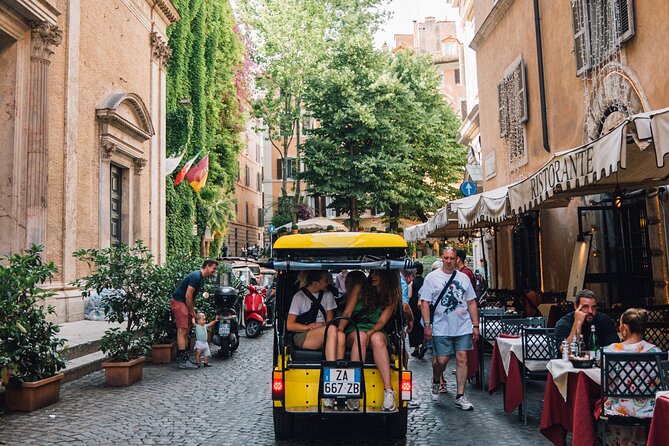
Rome works best with a smart shortcut. This small-group golf cart tour helps you cover big-name sights fast, with clear headsets so you do not miss the story as you roll through Rome’s tight streets. I like that the ride keeps you moving without turning your day into a long uphill slog, and I like that the route mixes major landmarks with a few streets locals actually hang out in.
The one drawback to plan around is time. Most stops are brief, so you’ll be grateful for photo ops and orientation, not deep, slow museum-style visits.
Why this tour feels worth it
- Electric golf carts that handle narrow streets well so you see more with less fatigue
- Headsets that keep the narration clear, even when the city is loud
- A small max of 14 people (and up to 2 carts) for better guide focus
- Gelato plus bottled water included, not an afterthought
- High-impact stops that help you decide what to revisit on your own
In This Review
- What this Rome highlights tour does really well
- Price and value: what $104 buys you
- Where you meet and how the tour flows
- What it feels like once you are seated
- The guide experience: headsets, style, and stop timing
- Stop 1: Start near Via Monterone and get your Rome orientation fast
- Stop 2: The Pantheon, brief but meaningful
- Drive-by moment: Piazza Colonna and the Column of Marcus Aurelius
- Trevi Fountain: the coin toss, the crowd energy, and gelato payoff
- Spanish Steps and Piazza di Spagna: what the steps connect
- Piazza del Popolo: the northern gateway feeling
- Drive past the Mausoleum of Augustus
- Piazza Navona: a quick look at a space that used to stage games
- Via Giulia drive: the city scale trick
- Largo Argentina: temples in the middle of a modern city
- Campidoglio: the grand staircase in front of Michelangelo’s design
- Piazza Venezia and the Victor Emmanuel II monument
- Finish in Monti, then the tour ends outside the Colosseum
- Who should book this golf cart highlights tour
- Should you book it or look for something else?
- FAQ
- How long is the Rome City Highlights golf cart tour?
- What does the tour cost?
- Is the tour offered in English?
- Are headsets included?
- What snacks and drinks are included?
- Where does the tour start and where does it end?
- Is hotel pickup included?
- Is admission included for the Pantheon?
- What is the maximum group size?
- Is gratuity included in the price?
What this Rome highlights tour does really well
Rome is big, and your time is usually not. This tour is built for the first day traveler, the jet-lagged traveler, and the anyone-wants-to-see-it-all traveler. In about 2 hours 30 minutes, you get a fast tour of central Rome’s biggest monuments, plus the kind of street context that makes your later self-guided wandering so much easier.
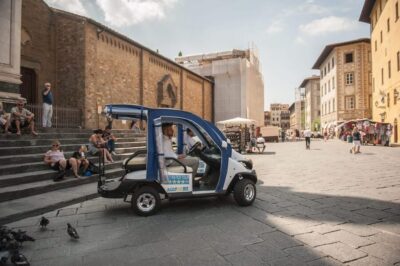
The golf cart part matters. Rome’s center is full of cobblestones, hills, and stop-and-go pedestrian crowds. Riding means you keep your energy for the moments that actually need standing around, looking up, and taking photos. You’ll still have quick stop time at each place, so it is not just a drive-by tour.
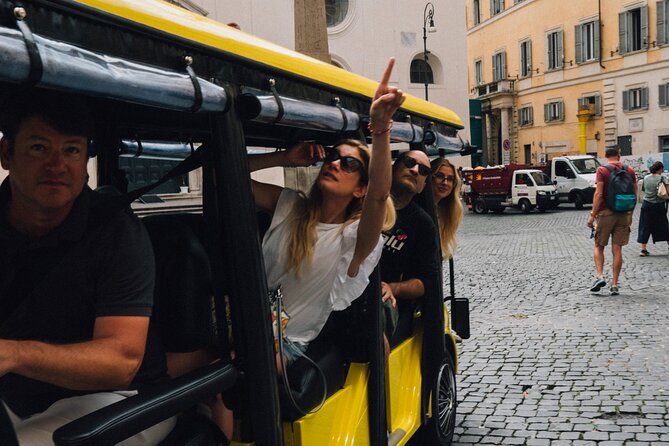
Also, the “small-group” setup is real here. This runs with a maximum of 14 travelers, using up to 2 vehicles, and the carts travel together like linked cars. You listen to the same guide through earpieces, so even if you are not sitting near the guide, you still get the narration.
Price and value: what $104 buys you
At $104 per person for roughly 2 hours 30 minutes, you are paying for three things at once:
- Transport in an electric golf cart (not a bus, and not a walking-only tour)
- Guiding plus audio headsets so you get context, not just views
- Included snacks and drinks, specifically one gelato per person and bottled water
That combination is what makes it feel like value. If you tried to recreate this on your own, you would likely spend a chunk of money on multiple taxis or ride shares, then lose the “big picture” explanation that helps you understand what you are seeing.
One practical note: Pantheon admission is not included, so think of that stop as an exterior and orientation moment unless you plan to pay separately. The rest of the planned sightseeing stops you do during the tour are free to view.
More golf cart circuits in Rome:
- Rome by Golf Cart Private Tour: Beyond the Landmarks
★ 5.0 · 4,361 reviews - Rome on a Golf Cart Semi-Private Tour Max 6 with Private Option
★ 5.0 · 2,502 reviews - Rome Highlights by Golf Cart Private Tour
★ 5.0 · 2,379 reviews
Where you meet and how the tour flows
You start at V. Monterone, 19, 00186 Roma RM, Italy. This is a central office meeting point, close to public transportation, which helps if you do not want to rely on taxis. You also finish at Colosseum, Piazza del Colosseo, 1, 00184 Roma RM, Italy, and the tour ends outside the Colosseum.
Because you end near a major landmark, this can work as a great day-setup. Many travelers use it as a launch pad, then return later for the sites they want more time in.
What it feels like once you are seated
You’ll hop onto an electric golf cart with a small group. Carts fit 7 seats per cart. The tour uses up to 2 carts, and they stay coordinated as you go. In some cases, people who booked together may be split between the carts, but you still hear the same guide via the earpieces.
That earpiece detail is not small. Rome has traffic noise, street chatter, and guide audio can be tough in open-air crowds. Multiple guides have been praised for clarity, fun delivery, and adding the “why” behind the monuments, and the headset system is what makes that easier to catch.
The guide experience: headsets, style, and stop timing
Guides can make or break a short tour, and the good news is that this one leans hard into explanation. Past guides called out by name in the experience feedback include Francesco, Andrea, Franco, Amber, Clare, Marco, Val, Leo, and Claire. The common thread: they connect Roman history to what you see today, and they keep things entertaining without turning it into a lecture.
You’ll also notice the tour’s pace is designed around quick “look, learn, move” blocks. Some stops are around 5 minutes, and a few are 10 minutes. That timing is great for getting your bearings, but it can feel rushed if you’re the type who likes to linger.
There is also one real-world technical consideration: earpiece problems can happen. One experience mentioned headphones not working for part of the tour. If you notice anything off, tell the team right away so they can fix it quickly.
A few more Rome options to weigh
- Vatican: Museums & Sistine Chapel Entrance Ticket
★ 4.5 · 144,003 reviews - Vatican Museums & Sistine Chapel Tour with Optional Basilica
★ 4.3 · 67,413 reviews - Colosseum, Roman Forum & Palatine Guided Tour
★ 4.7 · 63,148 reviews - Vatican Museums, Sistine Chapel & St Peter’s Basilica Guided Tour
★ 4.5 · 39,149 reviews
Stop 1: Start near Via Monterone and get your Rome orientation fast
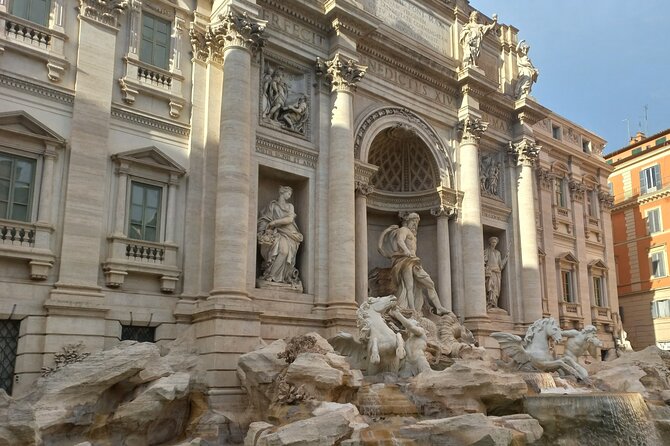
You begin at V. Monterone 19, then meet your guide and board the electric cart right there. This first segment is the “reset” moment of the day: you go from wandering alone into having a plan and a voice in your ear.
This tour is also timed well for orientation. Rome’s layout can be confusing, and you can lose half a day just trying to find the right street. Once you’re moving with a guide and earpieces, you start seeing patterns, like how different piazzas connect and where big monuments sit in the larger city grid.
Stop 2: The Pantheon, brief but meaningful
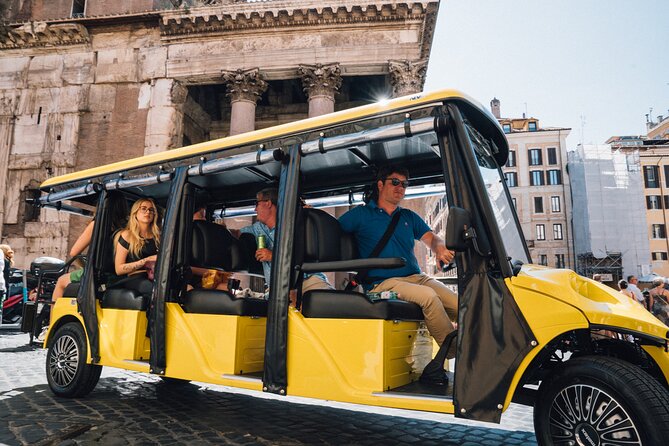
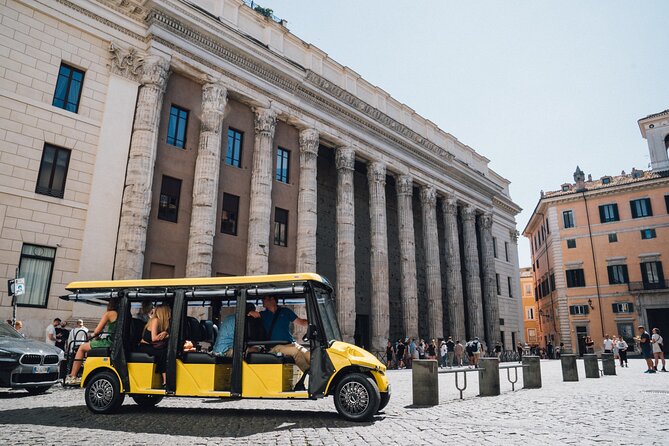
Your next stop is the Pantheon for a short visit. It is described as the best-preserved ancient Roman building in the world, still standing after about 1900 years. That kind of longevity is hard to absorb when you only see it from a distance, and this stop gives you the chance to look at it up close before moving on.
Admission is not included for the Pantheon, so plan for it as a quick orientation stop. If the Pantheon is a must for you, you’ll likely want to pair this tour with a separate ticket-based visit later.
How to get the most from the short time: stand where you can see the facade clearly, then look up. The Pantheon is famous for what you notice at the top as much as what you notice at eye level.
Drive-by moment: Piazza Colonna and the Column of Marcus Aurelius
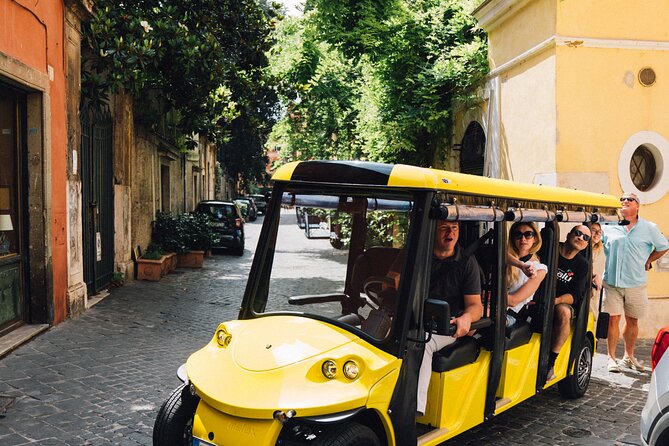
After the Pantheon, you head through the historic center and reach Piazza Colonna to see the Column of Marcus Aurelius. It is highlighted as one of only two preserved triumphal columns in Rome and roughly 1800 years old.
This is a classic example of why a golf cart route is useful. You can see the monument and still keep moving, instead of burning time trying to park, walk back and forth, or fight the crowd flow.
Also, if you like photo spots, the guide’s route knowledge matters. Several people mentioned that the guide knew where to stand for pictures.
Trevi Fountain: the coin toss, the crowd energy, and gelato payoff
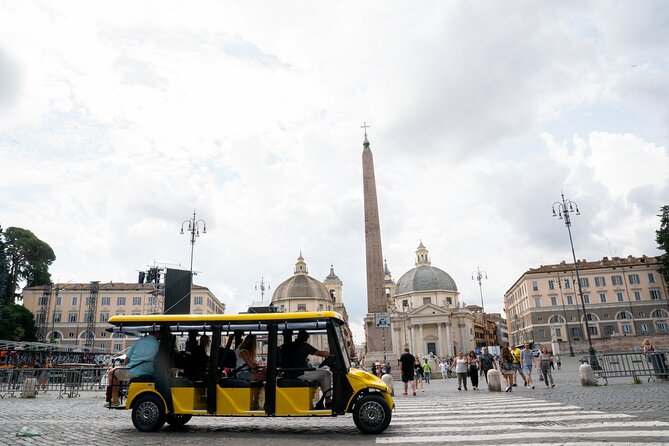
The tour’s most famous photo moment is the Trevi Fountain. You get about 10 minutes, and admission is free.
Yes, it’s crowded. But that’s also part of the point. Trevi is one of the most recognized fountains on earth, and it has the bonus of pop-culture reach too. The fountain appeared in Roman Holiday, and it is designed by Nicolo Salvi. It also traces its name back to the earlier Aqua Virgo system built around 19 BC by Marcus Vipsanius Agrippa.
Here’s the smart way to use your time: be ready for your coin toss, then take 30 seconds to look beyond the central scene. You can spot details that you would miss if you only focus on the steps and the filmer. Then, when your tour includes gelato, you’re warmed up for a sweet reset.
Gelato stop: One of the best values here is that gelato is included, and it tends to feel like a real treat instead of a token snack. One person specifically recommended flavors like almond with orange jam and butter crumble, which tells you they’re not just giving basic vanilla.
Spanish Steps and Piazza di Spagna: what the steps connect
Next up is the Spanish Steps and Piazza di Spagna, again with about 10 minutes. The steps are described as linking the Spanish embassy area to the Holy See at the base, and to Trinità dei Monti at the top.
That connection is key. You’re not just looking at a landmark for fashion photos. You’re seeing how diplomatic and religious power shaped city space. Even in short time, the guide’s explanation helps you understand why this spot became so important.
If you want one tip: when you get off the cart, take two minutes to locate the top and bottom viewpoints. That way, you can plan your photos without sprinting.
Piazza del Popolo: the northern gateway feeling
You then reach Piazza del Popolo, described as the northern gateway of the city and the starting point of Via Flaminia, the route north toward Ariminum, today’s Rimini.
This stop is shorter, around 5 minutes. But it gives you a sense of direction. Rome’s monuments can feel like isolated postcards. This stop helps you remember that Rome was also built as a system of routes and arrivals.
Drive past the Mausoleum of Augustus
You also pass the Mausoleum of Augustus, built by Emperor Augustus around 28 BC on the Campus Martius. Even without a long stop, a drive-by like this can be surprisingly effective when you learn what it is and why it mattered.
This is where a cart tour shines. You get the “heads-up” that this monument exists, what period it comes from, and what to look for. Later, if you walk this area again, it will feel less random.
Piazza Navona: a quick look at a space that used to stage games
Your next major square is Piazza Navona, with about 5 minutes. The tour explains that the square follows the form of the ancient stadium of Domitian, built in the 1st century AD. It connects to the old games, called agones, and how the name shifted over time toward Navona.
This is one of the stops where you can “see” the layers quickly. The square is lively and street-friendly, and the guide helps you understand why that shape still works. It’s not just a pretty plaza. It is a long-lasting public space.
Via Giulia drive: the city scale trick
Between stops, you drive along via Giulia, described as about a kilometer long and connecting Regola and Ponte Rioni. Even if you do not stop, it matters because it gives you a feel for Rome’s street engineering and how neighborhoods connect.
If you want to explore further later, this kind of drive route is useful. You’ll know what street to search for when you want to recreate the walk, but in your own time.
Largo Argentina: temples in the middle of a modern city
At Area Sacra di Largo Argentina you see the ancient Roman temples of Largo di Torre Argentina. The tour notes that the area was uncovered during demolitions in the late 1920s, revealing a paved square with remains of four Republican-era temples.
You get around 5 minutes here too. The main value is orientation and context. Largo Argentina can feel like “just ruins” if you don’t have the background, but the guide’s framing helps it connect to the story of Rome’s political and civic life.
If you like archaeology, this stop is often a highlight because it is so unexpected. The city becomes a layered museum without needing a ticket window.
Campidoglio: the grand staircase in front of Michelangelo’s design
Next is Piazza del Campidoglio. You’ll get a brief stop in front of the grand staircase, on Capitoline Hill. The tour explains that this was where an ancient village sat and where temples were dedicated to Roman gods. It also highlights that the square was built following Michelangelo’s criteria of uniform design.
Even with a short stop, this is a great photo and viewpoint moment. The position matters, and the guide’s commentary helps you see it as a curated viewpoint over the city, not just stairs.
Piazza Venezia and the Victor Emmanuel II monument
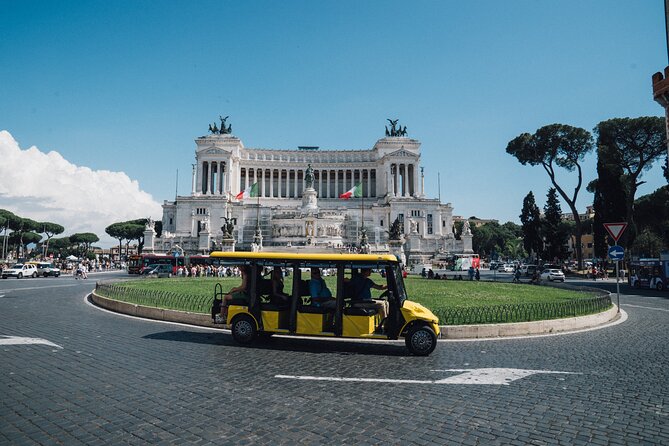
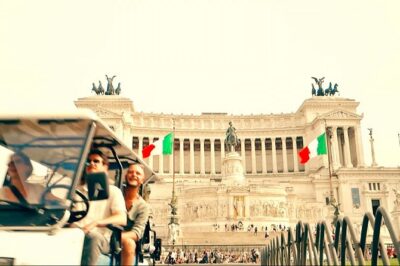
Then you reach Piazza Venezia and the monument to Victor Emmanuel II, known as the Altar of the Fatherland. You’ll also hear about Palazzo Venezia, a 15th-century palace once built by Cardinal Pietro Barbo, later tied to the Republic of Venice as an embassy seat.
This stop works well because it broadens the story. The route is heavy on ancient Rome, but Piazza Venezia brings you into modern national identity. It is a reminder that Rome did not stop after antiquity. The city kept reworking its center.
Finish in Monti, then the tour ends outside the Colosseum
You drive through the Monti neighborhood, described as Rome’s first ward and known for an old, vintage feel plus good food and bars. It is a nice way to end the tour because it nudges you toward the kind of evening wandering that feels local.
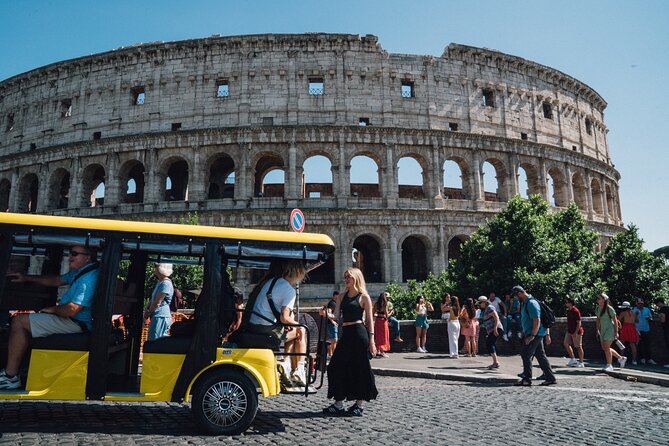
Then the tour finishes at the Colosseum area, ending outside the Colosseum. If you’re hoping for a dramatic final photo, keep an eye on the weather. One experience noted heavy rain starting near the end and affecting where they could stand for pictures. Rome weather can flip fast.
Who should book this golf cart highlights tour
This tour fits best if you:
- Want a first-day Rome plan that reduces decision fatigue
- Like the idea of a mix of short stops and driving, not only walking
- Are traveling solo or as a small group and want a guided route that still feels relaxed
- Appreciate clear explanations through headsets, especially in crowded areas
It may not be the best fit if you:
- Want long stays at a few sites, like true slow-time at the Pantheon or time inside the major museums
- Hate brief stops, since the schedule is built for coverage
- Are expecting the tour to include admission at every major stop, since Pantheon admission is not included
Should you book it or look for something else?
If you want a practical “see the highlights, get the story, then choose what to revisit” day, this is an easy yes. The value is strongest when you benefit from the cart time and the headset narration, and when you treat the stops as orientation that leads to deeper visits later.
My rule of thumb: book this early in your trip. Use it to learn where everything is, then come back on foot for the two or three places that truly grab you. If you do that, the short timing becomes a feature, not a flaw.
FAQ
How long is the Rome City Highlights golf cart tour?
It lasts about 2 hours 30 minutes.
What does the tour cost?
The price is $104.00 per person.
Is the tour offered in English?
Yes. The tour information is provided in English.
Are headsets included?
Yes. You receive headsets to hear your guide clearly.
What snacks and drinks are included?
You get one gelato per person and bottled water.
Where does the tour start and where does it end?
It starts at V. Monterone, 19, 00186 Roma RM, Italy and ends outside the Colosseum at Piazza del Colosseo, 1, 00184 Roma RM, Italy.
Is hotel pickup included?
No, hotel pickup and drop-off are not included.
Is admission included for the Pantheon?
No. Pantheon admission is not included.
What is the maximum group size?
The tour has a maximum of 14 travelers, with up to 2 vehicles.
Is gratuity included in the price?
No. Gratuities are not included, and you may want to budget for a tip for your driver guide.
Latest reviews around Rome
- Guided Walking Tour of Rome: Top Sights & Baroque Treasures★ 5.0 · 155 reviews
- Rome at Night: Small Group Guided City Walking Tour★ 5.0 · 249 reviews
- Private Walking Tour of the Squares and Fountains in Rome★ 5.0 · 130 reviews
- Rome Food Tour by the Vatican★ 5.0 · 308 reviews
- Vintage Fiat 500 Cabriolet: Rome’s Highlight Semi Private Tour★ 5.0 · 283 reviews
- Welcome To Rome Experience★ 4.5 · 679 reviews
- Vespa Rental in Rome 24 hours★ 5.0 · 196 reviews
- Vatican VIP Early Entrance 8:00 AM★ 4.5 · 141 reviews
Golf Cart Sightseeing Tours, compared.
Rome by Golf Cart Private Tour: Beyond the Landmarks
Read our review →
Rome on a Golf Cart Semi-Private Tour Max 6 with Private Option
Read our review →
Golf Cart Tour to Fiesole Roman Theatre and Museum
Read our review →
Eco-Friendly Golf Cart City Tour with Audio Guide
Read our review →
Rome Highlights City Tour by Golf Cart with Gelato
Read our review →
Browse the lists this tour appears in