
Reviewed · CITY TOURS
WalkingTour CATANIA – discovering the city of lava with a licensed guide
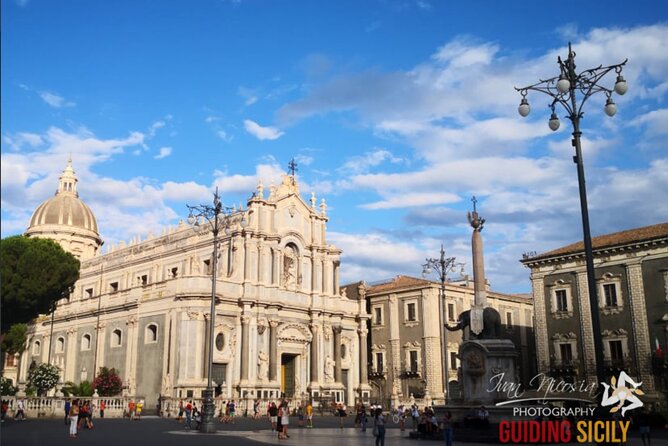
Catania’s lava story starts at the Duomo. This walk through the center feels practical and alive, with a licensed guide meeting you at the GS info point and turning major squares into street-level history you can actually picture. I love that the tour is built around iconic landmarks right from the start, especially the Liotru elephant fountain and the mix of Norman and Baroque at Piazza del Duomo.
My second favorite part is the local pulse, especially the fish market area where you get a real sense of everyday Sicilian food culture. The one consideration is simple: it is an outdoor, walking-focused tour, so uneven sidewalks and heat can be a factor, and the operator notes it needs good weather to run.
In This Review
- Key takeaways before you go
- Meeting the licensed guide at Piazza del Duomo
- Norman roots and Baroque drama at Piazza del Duomo
- Palazzo degli Elefanti, Catania’s lava-elephant town hall
- A’ Piscaria fish market: where Catania smells like Catania
- Ursino Castle and the lava-filled moat story
- Via dei Crociferi: Baroque rebuilt after 1693
- Piazza Università and the courtyard of lava pebbles
- Price and value for a 2 to 3 hour Catania intro
- How the walk feels: pacing, sidewalks, and audio
- Should you book this Catania lava walking tour?
- FAQ
- How long is the walking tour?
- Where does the tour start?
- What time does the tour begin?
- Is the tour offered in English?
- What is the maximum group size?
- Is Ursino Castle included in the ticket price?
- Is the tour dependent on weather?
- What is the cancellation policy?
- Are mobile tickets and service animals supported?
Key takeaways before you go
- Meet at Piazza del Duomo at the GS (GuidingSicily) info point, then walk the historic core on foot
- Small group format (max 15) keeps explanations clear and questions easy to ask
- Fish market stop at A’ Piscaria is built for sights, smells, and practical food ideas
- Ursino Castle connects Catania to lava with the story of a lava flow filling the moat in the 17th century
- Via dei Crociferi shows Baroque after 1693 earthquake rebuilding in a single long street
- Piazza Università brings it full circle with the oldest university in Sicily (1434) and lava pebbles underfoot
Meeting the licensed guide at Piazza del Duomo
You start in Piazza del Duomo, right in the center of the action. You will find the GS (GuidingSicily) infopoint, where your authorized guide meets the group. This matters because you are not just touring stones and plaques, you are getting a guided walk that links architecture, daily life, and the volcanic reality of the region.
The tour has a small-group feel, with a maximum of 15 travelers. That size is helpful on narrow streets, and it also supports a calmer pace when you are learning a lot in a short time. The duration is listed as about 2 to 3 hours, so you get a meaningful overview without burning an entire day.
Expect English interpretation. Service animals are allowed, and the meeting area is near public transportation, which keeps things easy if you are building your day around other stops in Catania.
A few more Sicily options to weigh
- Catania: Mount Etna Morning or Sunset Day Trip with Tasting
★ 4.8 · 4,028 reviews - Palermo: NO Mafia Walking Tour
★ 4.8 · 2,431 reviews - Palermo: Hop-on Hop-off Bus Tour 24-hour Ticket
★ 3.9 · 2,410 reviews
Norman roots and Baroque drama at Piazza del Duomo
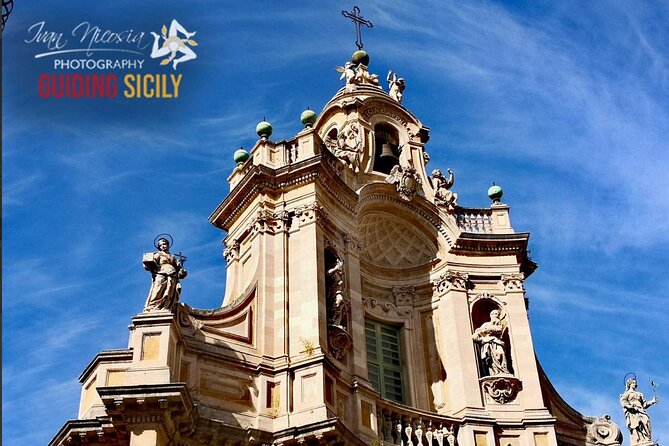
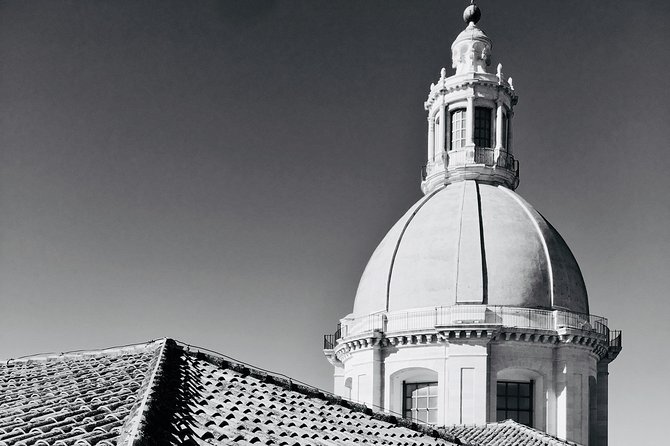
Piazza del Duomo is the correct starting point because it sets the tone for the whole city. The Duomo itself is Norman in origin, but Baroque in appearance, and it carries a sense of long continuity, with the church celebrating its first thousand years of history. When you understand that mix, you start seeing why Catania feels layered instead of frozen in one era.
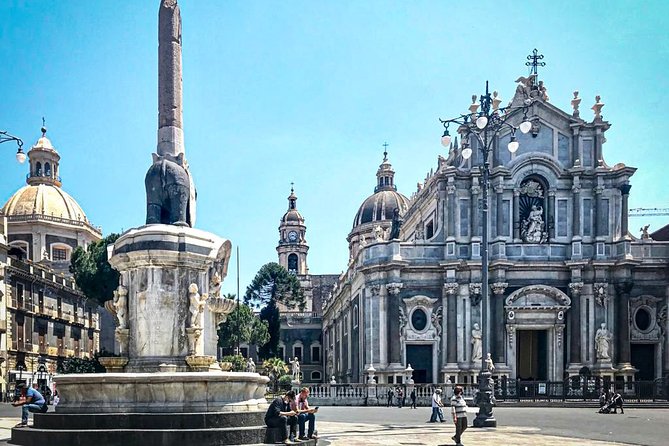
Right on the same square is Palazzo degli Elefanti, the Town Hall. Even better, the fountain symbol of the city, the Liotru, anchors the story in something you can literally see while you stand there. The Liotru is described as an elephant in lava stone, topped with an obelisk, and that volcanic material is not just background, it is part of the identity.
If you choose the morning walking option, the tour also sets up time near the adjacent historic fish market. That is a smart flow: you shift from monument scale to street scale quickly, so you are not stuck only in formal architecture.
Palazzo degli Elefanti, Catania’s lava-elephant town hall
Next comes Palazzo degli Elefanti, Catania’s Town Hall, and it is called out as a World Heritage Site in the tour description. The name is tied to the carved figures of the majestic mammal shown in the gables on balconies on the noble floor. That detail is the kind of thing you would miss without a guide, because from street level you tend to focus on the main façade.
This stop is short, but it is efficient. You are getting the meaning behind the building, not just a quick photo moment. In a city shaped by repeated rebuilding and shifting powers, learning who ruled and how they showed authority is a key part of understanding the present streets.
I like that this tour does not treat civic buildings as boring. The guide’s job here is to connect the symbolic elephant imagery, the World Heritage label, and the wider city story to what you see outside the gates. That is what makes a short urban walk feel worth your time.
A’ Piscaria fish market: where Catania smells like Catania
Near Piazza del Duomo, you get a stop at A’ Piscaria, the daily fish market. This is one of the most praised parts of the experience, and for a good reason: it is not staged, it is real commerce in the middle of the historic center. The market setup is described as a place where you can find local food products beyond fish, including cured meats, cheeses, fruit, and vegetables.
Even if you are not buying anything, you will learn how locals think about food and ingredients. The guide context helps you read the scene, so you understand what you are looking at: what is local, what is common, and why the market is central to the rhythms of the city.
One practical tip from the overall feedback is that the fish market stop is fun and interesting when the guide explains what you are seeing. It also breaks up the walk nicely, giving your brain a shift from monumental landmarks to daily life.
If you want to bring your trip home with you, this stop is where you can form your own plan for where to eat later. Use what you see as a shortlist, then follow up on your own after the tour.
Nearby, and just as well reviewed:
- From Trapani: Cruise to Favignana and Levanzo with lunch
★ 4.2 · 2,286 reviews - Catania: Sunset Jeep Tour of Mount Etna and Lava Flow Caves
★ 4.8 · 2,113 reviews - Palermo Original Street Food Walking Tour by Streaty
★ 5.0 · 2,105 reviews - Mount Etna: Trek to 3000m with cable car and jeep
★ 4.7 · 1,978 reviews
Ursino Castle and the lava-filled moat story
Ursino Castle is a major visual contrast to the church squares and market streets. It is described as a Swabian castle once overlooking the sea, and today it sits within the historic center. The standout idea here is how the landscape changed: in the 17th century, a mighty lava flow filled the moat, leaving black basalt still visible.
That single story does a lot of work. It ties Catania’s geology to military planning, then shows how the city adapted when nature changed the ground rules. You start to understand that lava in Catania is not just scenery, it is a shaping force that affects buildings, defense, and city structure over centuries.
Ursino Castle is listed as admission not included. That means you might spend more time looking from the outside and using the guide’s explanation to understand the setting. If you want museum-style interior time, you can plan it separately, but this guided stop still does a strong job of giving you the historical context.
This is also a great place to reset your legs. Even with short timing, you usually get a clear sense of the castle’s position and why it is still such a landmark.
Via dei Crociferi: Baroque rebuilt after 1693
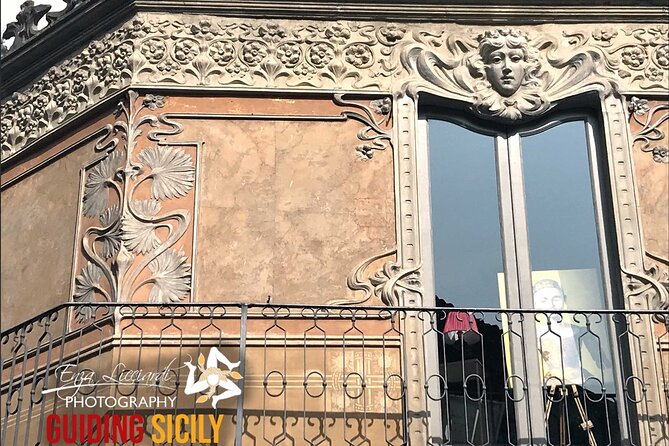
Then you walk to Via dei Crociferi, a street defined by church after church, monastery after monastery, and an almost continuous run of Baroque façades. The tour description points to a critical historical event: these façades were built after the devastating earthquake of 1693. So you are not just seeing beautiful buildings, you are seeing the city’s response to catastrophe.
This stop is short on paper, but it is a big deal in the experience. Long streets like this can feel repetitive if you are left to your own devices, yet with a licensed guide you get the connective tissue. You learn why the style looks the way it does, and why so many façades cluster here.
I also like this section because it teaches you how to read a street as an archive. Once you understand the 1693 rebuilding logic, the details stop being random, and you start spotting patterns in doorways, balconies, and church fronts. That makes your remaining time in Catania more rewarding, because you are carrying a new way to look.
Piazza Università and the courtyard of lava pebbles
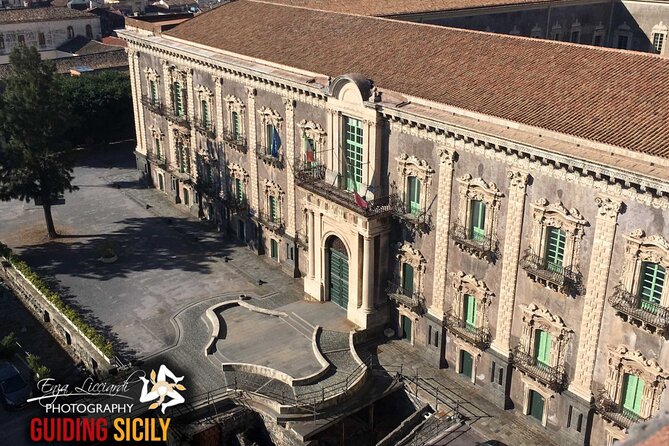
The tour closes with Piazza Università, where the Palazzo del Rettorato encloses a courtyard. This is tied to the oldest university in Sicily, founded in 1434, according to the tour description. When your guide points out details like the courtyard’s lava pebbles, it becomes easy to feel how the city’s geology has been underfoot for generations of students.
In front stands the imposing Palazzo di San Giuliano, also a university seat. The tour notes it was formerly home to one of the most powerful and richest families in Sicily. That gives you another layer to what you see: educational space, elite power, and the use of the same lava-based materials that appear throughout Catania.
This end point works well because it loops back to your earlier “lava symbol” moments. You started with a lava-stone elephant and obelisk, then you end with lava pebbles in a place tied to learning and long-term life in the city. It is a strong way to finish a short walking tour, because you remember the theme.
If you are planning what to do after the tour, this is also a helpful location for navigating. You are still in the core area, so you can build your next hours around nearby streets.
Price and value for a 2 to 3 hour Catania intro
At $24.19 per person for about 2 to 3 hours, this is priced like an entry-level city orientation tour. The real value comes from what you get packaged: a licensed guide, a tight circuit of major sights, and context that helps you understand more than just the names.
A key point is that many stops have admission tickets marked as free. That means your money goes to interpretation and time with a guide, not multiple attraction fees. The one notable exception is Ursino Castle, where admission is not included, so you can decide whether to add interior time later.
The small group cap of 15 also affects value. In a city with tight streets and quick turns, smaller groups usually lead to faster communication and fewer bottlenecks. If you care about asking questions, this format makes it easier.
From the feedback, the guides stand out for making the walk feel educational and entertaining, with storytelling that connects history to real Sicilian lifestyle. If it is your first time in Catania, that is exactly what you want: you do not just want to see the highlights, you want to understand what you are seeing.
How the walk feels: pacing, sidewalks, and audio
This is mostly an easy walking tour in the historic center, but you should still plan for real streets. One review specifically mentioned that the walk is easy overall, with a few sidewalks that can be old and rough. That means good walking shoes are a smart idea, even if the route does not sound like it includes steep climbs.
Also plan for sun and heat. The experience requires good weather to run, and one review mentioned a hot day where the guide was mindful about breaks and shade. Since your tour time is about 10:30 am, it can still be warm, so bring whatever helps you stay comfortable.
Sound level can vary in busy squares and narrow lanes. One review suggested using earphones because the guide was not always easy to hear. If you know you struggle with spoken audio in crowds, consider bringing your own small earphones and using them for the guide’s voice if the tour supports it on-site.
Finally, remember that the tour timing is tight. Stops like the Duomo square and the Town Hall are short, so treat them like high-impact orientation moments, not long museum visits.
Should you book this Catania lava walking tour?
If you want a short, high-value introduction to Catania that connects lava to everyday life, I would book it. This is especially a good choice for first-timers, because it covers the core sights in a logical loop and keeps the focus on understanding the city instead of just collecting photos.
I would also lean toward booking if you care about food culture, because the market stop at A’ Piscaria is built into the route. And if you like guided storytelling, the overall guide performance is a standout theme, with multiple guides praised for being personable, clear in English, and genuinely engaging.
The main reason not to book is straightforward: if the weather is bad, this experience depends on good conditions. If you struggle with walking on older sidewalks, you might also consider your comfort level, but the route is described as manageable overall with a mostly easy pace.
If you want a plan that pairs well with other Catania activities, this tour is a strong anchor. Do it early, learn the city’s patterns, then spend the rest of your day wandering with a better sense of where lava, history, and Sicilian daily life show up around every corner.
FAQ
How long is the walking tour?
The tour is listed as about 2 to 3 hours.
Where does the tour start?
You meet at Piazza del Duomo, 95100 Catania CT, Italy, at the GS (GuidingSicily) infopoint.
What time does the tour begin?
The listed start time is 10:30 am.
Is the tour offered in English?
Yes, it is offered in English.
What is the maximum group size?
The tour has a maximum of 15 travelers.
Is Ursino Castle included in the ticket price?
No. Ursino Castle admission is not included.
Is the tour dependent on weather?
Yes. The experience requires good weather.
What is the cancellation policy?
Free cancellation is available. You can cancel up to 24 hours in advance for a full refund.
Are mobile tickets and service animals supported?
Mobile tickets are provided, and service animals are allowed.
Latest reviews around Sicily
- The Pearl of Sicily: Private Taormina Walking Tour★ 5.0 · 179 reviews
- The Godfather tour Sicily★ 4.5 · 215 reviews
- Half-Day Pizza Making Class in Taormina★ 5.0 · 192 reviews
- Private tour of Etna and Winery Visit with Food and Wine Tasting from Taormina★ 5.0 · 188 reviews
- Taormina Food and Wine Walking Tour (Small Group or Private)★ 4.5 · 180 reviews
- Taormina and Isola Bella Day Tour with Boat Trip from Messina★ 4.5 · 146 reviews
- Pizza Cooking Class★ 5.0 · 225 reviews
- Pizza & Cannolo Making in Taormina by the Sea★ 5.0 · 144 reviews
City Tours, compared.
City Sightseeing Hop-on Hop-off Bus with Audioguide
Read our review →
City Sightseeing Hop-On Hop-Off Bus with Audio Guide
Read our review →
City Sightseeing Rome Hop-On Hop-Off Bus Tour
Read our review →

Fettuccine Pasta Cooking Class in Rome’s City Center
Read our review →
Vatican City: Vatican Museums & Sistine Chapel Entry Ticket
Read our review →
City Sightseeing Florence Hop-On Hop-Off Bus Tour
Read our review →Browse the lists this tour appears in