Reviewed · GUIDED
Guided Tour of Mosaic Tiles in Ravenna
Ravenna’s mosaics feel like frozen light. This guided tour threads together religious history and decorative art so you understand what you are looking at, not just how it looks. Along the way you hear why the stars in Galla Placidia mattered to Dante Alighieri, plus the big political, Byzantine connections behind the monuments.
What I like most is that the tour handles the hardest part for you: getting into the right places. With entrance tickets included, you spend your time inside the churches and baptistery, not chasing ticket counters.
One possible drawback is timing and comfort. In cold weather, and on at least one day where the tour stretched beyond the promised window, it can be harder to stay focused, especially if the guide is hard to hear. Dress warm and plan to stand where you can clearly catch the narration.
In This Review
- Key highlights to know before you go
- Why Ravenna mosaics land differently on a guided walk
- Price and what you actually get for the money
- Stop 1: Mausoleo di Galla Placidia and the star dome moment
- Stop 2: Basilica di San Vitale, Byzantium in an octagonal plan
- Stop 3: Battistero Neoniano, baptism scenes and an old font
- How the listening system and group size affect your experience
- Getting the most out of your 2 to 3 hours in Ravenna
- The guide experience: what great narrators add
- Who this tour is best for
- Should you book this guided mosaic tour?
- FAQ
- How long is the Guided Tour of Mosaic Tiles in Ravenna?
- What sites does the tour include?
- Is the tour in English?
- Does the price include admission?
- Where do we meet the guide?
- What group size should I expect?
- What is the cancellation policy?
Key highlights to know before you go
- Three must-see monuments in one smooth, timed route, all tied together by the story of Ravenna’s mosaics
- Admission tickets included at every stop, so you avoid ticket hunting during the visit
- Small group size (max 28) and radio headsets for clearer listening when the group is larger
- Stop-by-stop storytelling that connects mosaics to power, faith, and everyday symbolism
- Dante Alighieri connections you can actually picture while you look at the dome
Why Ravenna mosaics land differently on a guided walk
Ravenna does something unusual. You get the feeling that the images are not just decoration, but a way of teaching people what to believe, who mattered, and how the world was organized. A guided tour helps because the monuments speak in layers: architecture first, then materials, then the message hidden inside the pattern.
On this tour, you are guided through the religious setting and the decorative art together. That pairing matters because Ravenna’s mosaics are not only pretty. They are tied to emperors, bishops, and the Eastern Roman world that shaped early Christianity in Italy. When the guide explains those links, the mosaics shift from wallpaper to evidence. You start noticing who is represented, how motion is shown, and why colors are used the way they are.
Also, this is a practical tour format. It is offered in English, runs about 2 to 3 hours, and includes admission tickets at each stop. That is a solid way to see the “big names” without burning your day trying to coordinate entry times and lines.
A few more Italy options to weigh
- Colosseum, Roman Forum & Palatine Guided Tour
★ 4.7 · 63,148 reviews - Vatican Museums, Sistine Chapel & St Peter’s Basilica Guided Tour
★ 4.5 · 39,149 reviews - Rome: Colosseum, Palatine Hill and Roman Forum Guided Tour
★ 4.8 · 32,814 reviews
Price and what you actually get for the money
At $33.86 per person for a 2 to 3 hour guided experience, the value comes from three places.
First, the tour includes admission tickets for the Mausoleo di Galla Placidia, Basilica di San Vitale, and the Battistero Neoniano. Entrance costs add up fast in Italy, especially when you want the exact places Ravenna is famous for.
Second, you get guided time in the right order. Ravenna’s monuments can feel overwhelming if you are trying to interpret them on your own. Here, the route keeps you moving between sites that connect thematically, so your brain builds a map.
Third, the tour helps reduce friction. With a mobile ticket and timed entry approach at the major stops, you are less likely to lose your momentum to ticket counters and long searches.
If you are the type who enjoys structure, this is a good deal. If you want total freedom and no group pace at all, you might prefer buying tickets yourself and wandering at your own speed. But for most first-timers, guided value like this is exactly what keeps Ravenna enjoyable.
Stop 1: Mausoleo di Galla Placidia and the star dome moment
Your first stop is the Mausoleo di Galla Placidia, built around the middle of the 5th century at the order of Galla Placidia, who ruled the Western Roman Empire. Even before you see the mosaics, this place sets expectations. Externally it looks modest, almost plain. The contrast is the point.
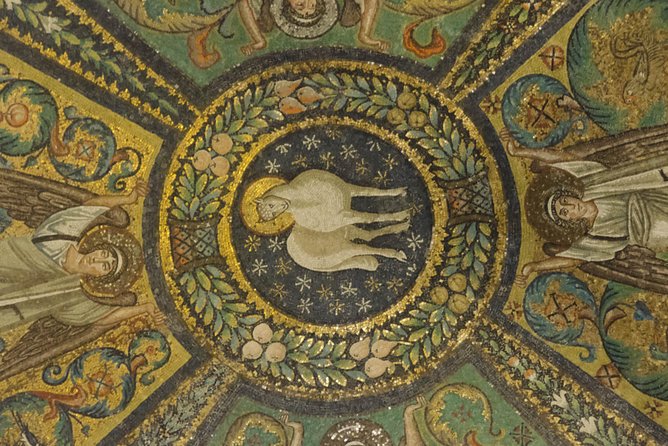
Inside, the decoration is where the monument earns its reputation. The big visual impact is the dome filled with countless stars. It is the kind of image that makes you pause, because your eyes keep trying to count and categorize what you are seeing.
What I especially like about having a guide here is that the stars are not treated as generic beauty. The dome has been a source of imagination for centuries, and the guide ties it to major cultural ripples, including Dante Alighieri. If you know that the Divine Comedy includes ideas inspired by celestial imagery, you start seeing the dome as more than a pretty ceiling. It becomes part of a bigger European story.
Practical note: the time at this stop is brief, around 10 minutes. That is enough for the main dome and key mosaic views, but it means you should not expect leisurely wandering. If you want photos, decide early where you will stand so you do not lose your spot during the group shuffle.
Stop 2: Basilica di San Vitale, Byzantium in an octagonal plan
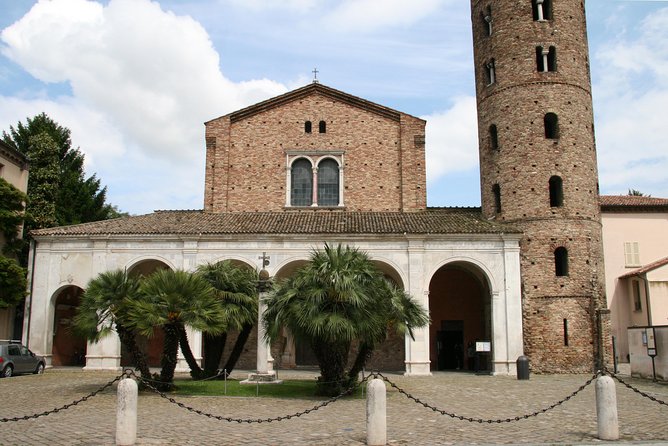
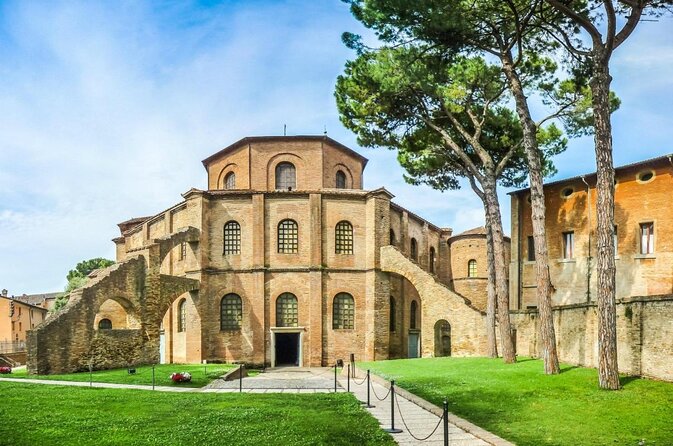
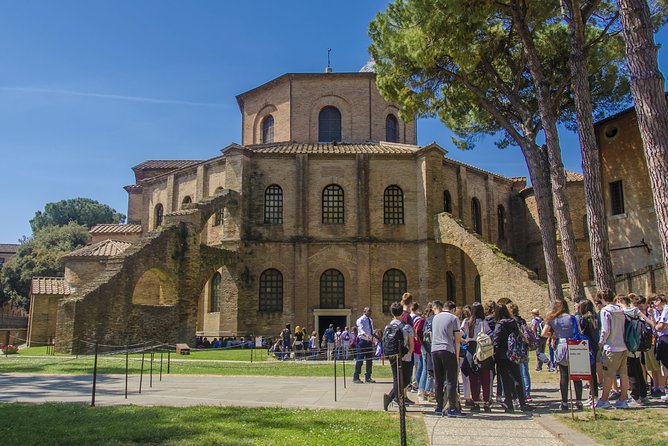
Next up is Basilica di San Vitale, one of the most important monuments of early Christian art in Italy. This is a sixth-century basilica with Eastern influence, and you feel that right away in the layout.
It has an octagonal plan and a large frescoed dome. When you enter, the first thing you notice is scale: the high spaces pull your attention upward. Then the mosaics take over. The apse is the big visual prize, and the mosaic decoration there is designed to command your gaze.
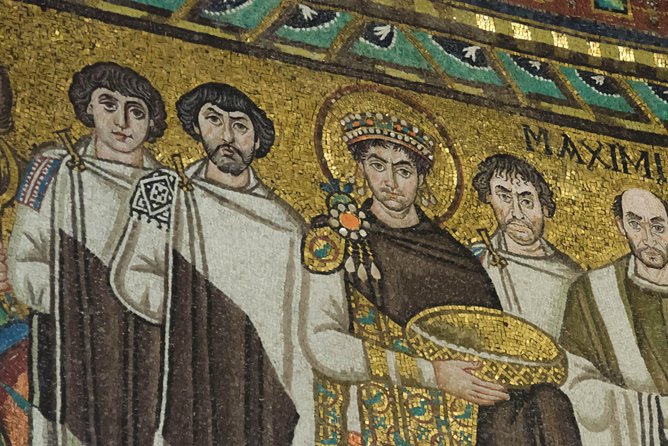
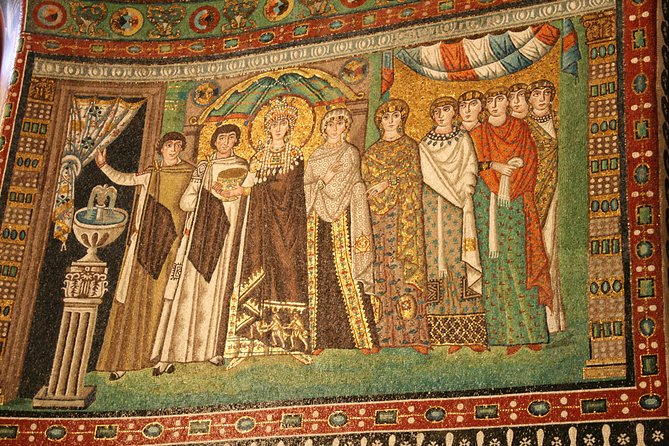
The guide’s commentary matters a lot at this stop because the mosaics are not just symbols floating in gold. You are shown the extraordinary depiction of the imperial couple from Byzantium: Giustiniano and Teodora, shown with their parades. When someone explains what you are looking at, the scene stops being just “two people in fancy outfits” and becomes a statement about who had authority, and how that authority was presented to the religious world.
This stop is allocated about 30 minutes. That is a comfortable chunk of time for San Vitale. You get enough minutes to take in the overall structure, look closely at the apse mosaics, and still hear the key explanations without feeling rushed through the door and out again.
Tip for your visit: once you are inside, try to settle into one or two viewing positions instead of constantly repositioning. Mosaics are easier to understand when you let your eyes adjust and you see how details connect across the whole scene.
Nearby, and just as well reviewed:
- Vatican: Museums & Sistine Chapel Entrance Ticket
★ 4.5 · 144,003 reviews - Vatican Museums & Sistine Chapel Tour with Optional Basilica
★ 4.3 · 67,413 reviews - Milan: Cathedral and Duomo’s Terraces Entrance Ticket
★ 4.6 · 61,054 reviews - Venice: Doge’s Palace Reserved Entry Ticket
★ 4.6 · 42,716 reviews
Stop 3: Battistero Neoniano, baptism scenes and an old font
Your final stop is the Battistero Neoniano, also known as the Battistero degli Ortodossi. It is one of the oldest monuments in Ravenna. Outside it is simple brick, which again sets up a satisfying contrast.
Inside is where the richness hits. You get marble, stucco, and mosaics with a clear Hellenistic-Roman influence. The focus is the dome, commissioned by Bishop Neone in the mid-fifth century. The main scene is the Baptism of Christ, surrounded by a refined procession of the twelve Apostles.
The colors matter here. The apostles stand out against a bright blue background made of tesserae, small mosaic pieces. Up close, it is not the same feeling as a flat painting. The blue looks like it has depth because it is built out of thousands of tiny tiles.
Another reason I like this stop on a guided route is that the explanation goes beyond what is painted. Inside you can still see the baptismal font from the Renaissance period, and it keeps the octagonal shape of the baptistery plan. It also preserves the ambo from the 5th century. That means you are not only looking at mosaics, you are also seeing how different eras layered their own pieces onto a long-lived sacred space.
This stop is about 10 minutes, so again, it is not a slow museum experience. But because the dome scene and the procession are visually dominant, you still walk away with a strong impression.
How the listening system and group size affect your experience
This tour caps at 28 travelers. That number matters because it shapes how the guide can manage quiet listening inside churches. When groups get large, the tour uses a radio device to help you hear the commentary.
From the feedback I’ve seen, radio headsets are often a big reason the tour feels smooth and informative. In ideal conditions, you can walk a little away from the center of the group and still catch the main points. When audio works well, you can do something rare on cathedral-style tours, which is to actually listen while you look.
Still, there is one practical consideration. In at least one case, audio was difficult to hear even with the device, and on another day the timing ran longer than expected. You cannot control cold weather, and you cannot always predict how clear the audio will be in a specific space. So do what you can:
- Wear layers and keep your ears warm.
- Stand where you can hear directly, not where you can only see the guide.
- If the narration sounds faint, move a step closer during the explanation.
These small moves can turn a good visit into a memorable one.
Getting the most out of your 2 to 3 hours in Ravenna
Ravenna can feel dense. Even though this tour is only about a half-day window, you cover three major monuments that each demand attention. To get the most out of it, your goal should be focus, not sprinting.
Think about your viewing strategy:
- Pick one key thing to look at per stop (the star dome, the apse mosaics, the Baptism of Christ scene).
- Let the guide’s story reframe your eyes. You will remember the mosaic much better when you connect it to a person, an emperor, or a moment in doctrine.
- Keep your energy steady. If it is cold, your attention drops when you are uncomfortable, especially in churches where you cannot relax your posture for long.
Also, because the tour includes admission tickets, you should arrive ready to start and not waste time gathering supplies inside. The meeting point is Piazza S. Francesco, 7, at the tourist information area. One tip that saves stress: plan to enter the information center and check in there before the visit begins, since the address alone can be easy to misread.
The guide experience: what great narrators add
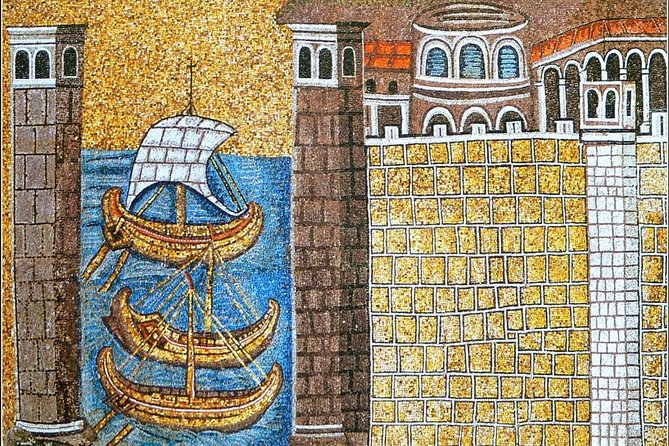
The tour is led by local English-speaking guides, and some of the names that come up include Elisabetta, Francesca, Marco, Serena, Chiara, Silvia, Asunta, and Bardo. The common thread is that the guide is not only describing mosaic details, but connecting them to why Ravenna mattered.
When the guiding is strong, you stop seeing separate monuments and start seeing one connected story:
- Galla Placidia ties political power to spiritual imagery.
- San Vitale turns Byzantine imperial presence into visual theology.
- The Neoniano Baptistery shows how baptism was staged as a holy procession.
This kind of narrative adds real value. Without it, Ravenna mosaics can still impress you, but you might miss the logic behind composition and the reasons certain scenes were chosen.
Who this tour is best for
This guided mosaic walk is a great fit if:
- You want Ravenna’s top mosaic sites in a tight, well-paced route.
- You like learning the meaning behind art, not only taking photos.
- You want English commentary and included admission so you can spend more time looking and less time planning.
It is also a solid choice for a first visit, especially if you are in town only for a day or two. The “big three” monuments set you up well for any follow-up exploration you want to do on your own.
If you hate group pacing, or if you want to linger for long photo sessions at each dome, you might find the stop times feel short. But for most people, those time limits are actually what keep the day from dragging.
Should you book this guided mosaic tour?
I think you should book it if you want an efficient, high-impact Ravenna intro with admission tickets included and English storytelling that connects mosaics to faith and power. The tour’s best strength is that it turns three visually stunning monuments into a coherent experience, so you leave with more than scenes you vaguely remember.
You might skip it or consider a different format if you know you struggle with cold weather standing in churches, or if you strongly prefer totally independent pacing. Also, if clear audio is a deal-breaker for you, you should be ready to stand near the front and actively position yourself to hear.
For most travelers, this is a practical, worthwhile way to see Ravenna’s mosaic heritage without the usual ticket and timing headaches, and with enough context to make the mosaics click.
FAQ
How long is the Guided Tour of Mosaic Tiles in Ravenna?
The tour runs about 2 to 3 hours.
What sites does the tour include?
It includes the Mausoleo di Galla Placidia, Basilica di San Vitale, and the Battistero Neoniano (Battistero degli Ortodossi).
Is the tour in English?
Yes, the tour is offered in English.
Does the price include admission?
Yes, admission tickets are included at each stop.
Where do we meet the guide?
The meeting point is Piazza S. Francesco, 7, 48121 Ravenna RA, Italy. The activity starts at the tourist information office there, where you check in before the visit begins.
What group size should I expect?
The tour has a maximum of 28 travelers. If the group is larger, a radio listening device is used.
What is the cancellation policy?
Free cancellation is available up to 24 hours in advance for a full refund, based on the experience’s local time. If the minimum number of travelers is not met, you will be offered a different date or a full refund.
Latest reviews around Italy
- Total Immersion Wine Tour in Chianti★ 4.9 · 430 reviews
- From Rome: Villa D’Este & Villa Adriana Day Trip with Lunch★ 4.4 · 289 reviews
- Tivoli: Villa Gregoriana Entrance Ticket★ 4.7 · 150 reviews
- Tivoli: Villa D’Este Entry Ticket and App Audio Guide★ 4.3 · 191 reviews
- From Rome: Hadrian’s Villa & Villa d’Este Day Trip & Lunch★ 4.5 · 157 reviews
- Rome: Painting Class with Unlimited Wine★ 4.8 · 109 reviews
- Ravenna: UNESCO Mosaics Entry Tickets★ 4.7 · 255 reviews
- Timed Entrance to Leaning Tower Pisa & Cathedral with Audio★ 4.1 · 385 reviews
Guided, compared.
Colosseum, Roman Forum & Palatine Guided Tour
Read our review →
Vatican Museums, Sistine Chapel & St Peter’s Basilica Guided Tour
Read our review →
Colosseum, Palatine Hill and Roman Forum Guided Tour
Read our review →
Guided Tour of Colosseum, Roman Forum & Palatine Hill
Read our review →
Colosseum & Forum with Audio Guide App -Optional Arena
Read our review →
Colosseum, Roman Forum and Palatine Hill Guided Tour
Read our review →
Naples Underground Entry Ticket and Guided Tour
Read our review →